Loading cart…
No products in the cart.

1876 · Oil on canvas · National Gallery of Art, Washington D.C., United States
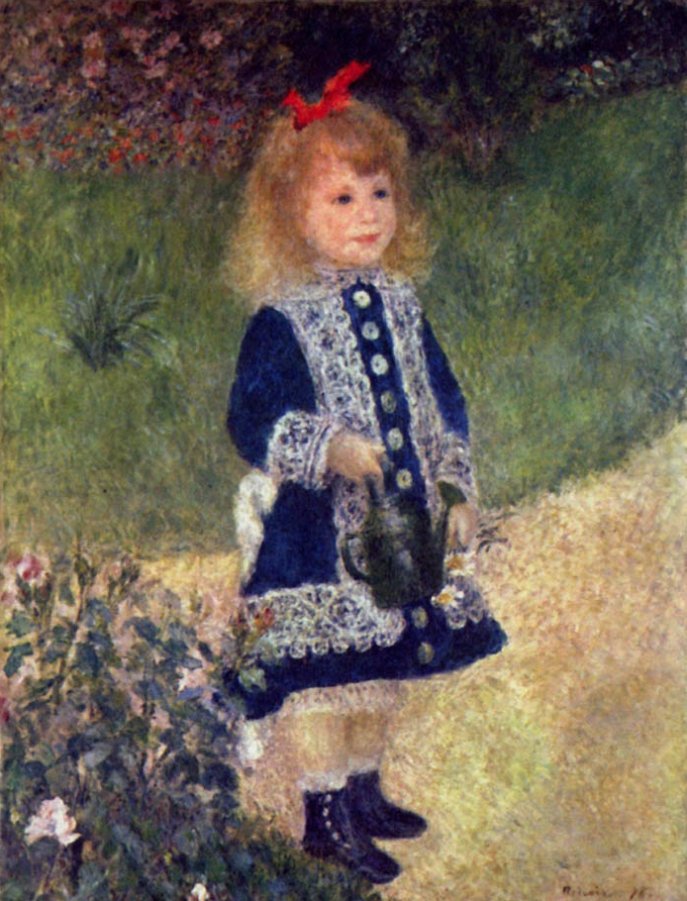
Girl with a Watering Can was painted in 1876 and is thought to depict a child from the household of one of Renoir's Parisian acquaintances, though the identity of the sitter has never been definitively established. The work belongs to a group of child portraits Renoir produced during the mid-1870s as he sought to broaden his patronage among the bourgeois families of Paris who were receptive to his warm and accessible style. Unlike the large-scale social scenes he was painting simultaneously, this work is an intimate portrait in which the subject is placed in a domestic garden setting that reinforces her youth and innocence. The garden, with its flower beds and gravel path, suggests a comfortable private home of the Parisian middle class rather than a public park.
The painting was included in the Third Impressionist Exhibition of 1877, where it was seen alongside a number of other works by Renoir. Chester Dale donated the painting to the National Gallery of Art in Washington D.C. in 1963 as part of a significant collection of French Impressionist works, making it accessible to American audiences who had come to admire Renoir's figure paintings in the decades following the Second World War. The work has since become one of the most reproduced images of childhood from the Impressionist period and is frequently used in educational contexts to introduce audiences to Renoir's technique and subject matter.
The composition places the girl squarely in the center of the canvas, a relatively conventional choice that emphasizes her solidity and presence within the garden space. Renoir uses the diagonal of the gravel path and the masses of flowering plants on either side to create depth without employing strict linear perspective. The girl stands with a slight forward lean, her small watering can held in both hands, her gaze directed outward toward the viewer with an expression that conveys a mixture of seriousness and childlike openness. The blue of her dress, detailed with white lace at the collar and cuffs, is among the most carefully painted elements of the composition, with subtle modulations of tone suggesting the fall of light across the fabric.
Renoir's brushwork in this painting is looser in the garden surroundings than in the treatment of the figure itself, a contrast that directs attention to the girl while maintaining the atmospheric quality of the outdoor setting. The flowers in the background are suggested rather than defined, rendered with rapid dabs of pink, red, and yellow that evoke the abundance of a well-tended garden without cataloguing individual species. The handling of the child's face is notably tender, with soft transitions between tones that capture the smooth quality of young skin. The watering can, a small domestic object with a clear practical function, serves as a prop that situates the child within a world of gentle responsibility and ordered outdoor play, both of which were highly valued qualities in bourgeois depictions of childhood during this period.
The image of a child in a garden carries deep cultural resonances in European painting, evoking themes of growth, innocence, and the passage of time. Renoir approaches these themes without overt sentiment or moralism, presenting the girl as an individual within a specific and pleasant setting rather than as a symbol of abstract virtues. The watering can introduces a note of purposeful activity that distinguishes the composition from purely decorative child portraits, suggesting that even in play, children participate in the cycles of cultivation and care that sustain the domestic world. The garden itself, carefully tended and blooming, mirrors the attention given to the upbringing of children in the bourgeois household that this painting implicitly reflects.
The work also speaks to Renoir's broader interest in the relationship between human figures and their environments, a relationship he consistently explored through the interaction of color, light, and physical presence. The girl is not overwhelmed by the garden around her but stands confidently within it, her blue dress providing a chromatic anchor that ties her to the cooler tones of the sky and path while the warm flowers surround her with color and vitality. This balance between the human subject and the natural world is characteristic of Renoir's approach throughout his career and gives even his smaller and more intimate works a coherence that extends beyond the immediate pleasures of the surface. The painting reminds its audience that attention to ordinary beauty, including the sight of a child in a garden on a summer afternoon, is itself a form of meaningful engagement with the world.