Loading cart…
No products in the cart.

1881-1886 · Oil on canvas · National Gallery, London, United Kingdom
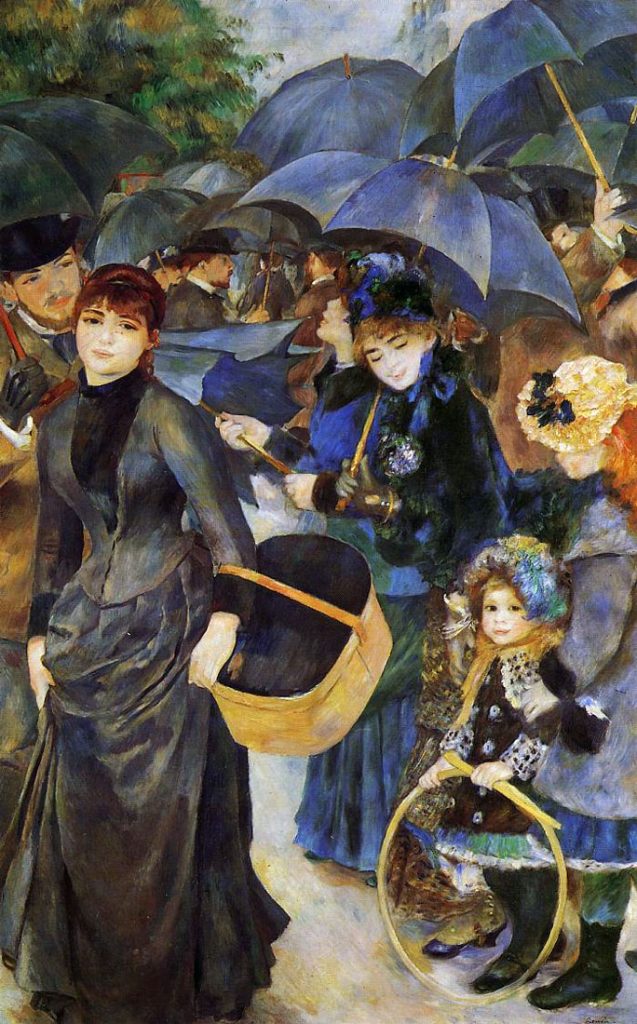
Umbrellas is unusual in the Renoir catalogue because it was painted in two separate campaigns separated by several years, and the division between these two phases is visible to the careful eye in the finished canvas. The right side of the painting, which depicts a woman with a young girl and a smaller child carrying a hoop, was completed around 1881 and displays the soft, feathery brushwork and warm coloring characteristic of Renoir Impressionist manner. The left side, featuring a young woman with a hatbox and the array of opened umbrellas that give the painting its name, was reworked around 1885 to 1886, after Renoir had traveled to Italy and encountered the influence of Renaissance fresco and classical drawing. This left side shows a noticeably harder, more linear handling that reflects his evolving interest in contour and structure. The painting entered the collection of the National Gallery in London as part of the Lane Bequest, a significant gift of Impressionist works assembled by the Irish art dealer and collector Hugh Lane. Lane had a particular enthusiasm for French Impressionism and the inclusion of this painting in his bequest placed it at the center of public debate about the nature and value of modern French art in the early twentieth century. The work has been at the National Gallery since the early twentieth century and is considered one of the key Renoir paintings in British public collections. Its dual nature makes it a uniquely instructive document in the study of Renoir artistic development.
The formal division within the canvas is among the most discussed aspects of the painting and makes it a rare opportunity to observe two phases of a single artist development within one picture frame. On the right, the brushwork is broken and varied, with soft transitions between colors and a general atmosphere of warmth and informality. The children are rendered with the gentle imprecision that characterizes Renoir approach to young figures, their features suggested rather than defined. On the left, the young woman with the hatbox is drawn with greater linear precision, her coat rendered in smooth, flat areas of blue-gray that show the influence of Renoir study of Ingres and Italian Renaissance painting during the period he called his harsh manner. The umbrellas themselves create a striking formal structure across the upper portion of the canvas, their curved forms and overlapping canopies providing a geometric order that contrasts with the softness of the human figures below. The color palette of the umbrellas, dominated by cool blues and grays, unifies the left and right halves of the composition despite their stylistic differences and gives the painting a coherent visual identity. Renoir handling of the wet-weather atmosphere is accomplished through the general coolness of the light and the subdued reflections on surfaces, suggesting overcast Paris skies without resorting to obvious meteorological detail. The result is a painting that reads as unified to a casual observer but rewards closer inspection with its layered history.
The painting engages with the experience of the modern city as lived by its ordinary inhabitants, depicting a scene of everyday urban movement in which anonymous Parisians navigate a rainy day. The figures are not individualized as social celebrities or posed as allegorical types but presented as recognizable people caught in a familiar situation. This democratic attention to the fabric of daily life was central to the Impressionist project and connects Umbrellas to the broader effort of Renoir generation to establish the modern city and its inhabitants as subjects worthy of serious artistic attention. The woman with the hatbox on the left catches the viewer gaze with a direct and somewhat guarded look that lends the painting a subtle narrative tension unusual in Renoir work. At the same time, the painting documents Renoir own uncertainty and evolution as an artist. The visible seam between its two phases, far from being a flaw, makes it an honest record of artistic searching. By the mid-1880s Renoir had grown dissatisfied with what he perceived as the formlessness of pure Impressionism and was actively seeking a new synthesis of color and drawing that would give his work greater permanence and structure. Umbrellas captures that transition in a uniquely direct way, making it both a social document of Parisian life and an autobiographical record of an artist in the process of remaking his own practice.