Loading cart…
No products in the cart.

1872 · Oil on canvas · Walker Art Gallery, Liverpool, United Kingdom
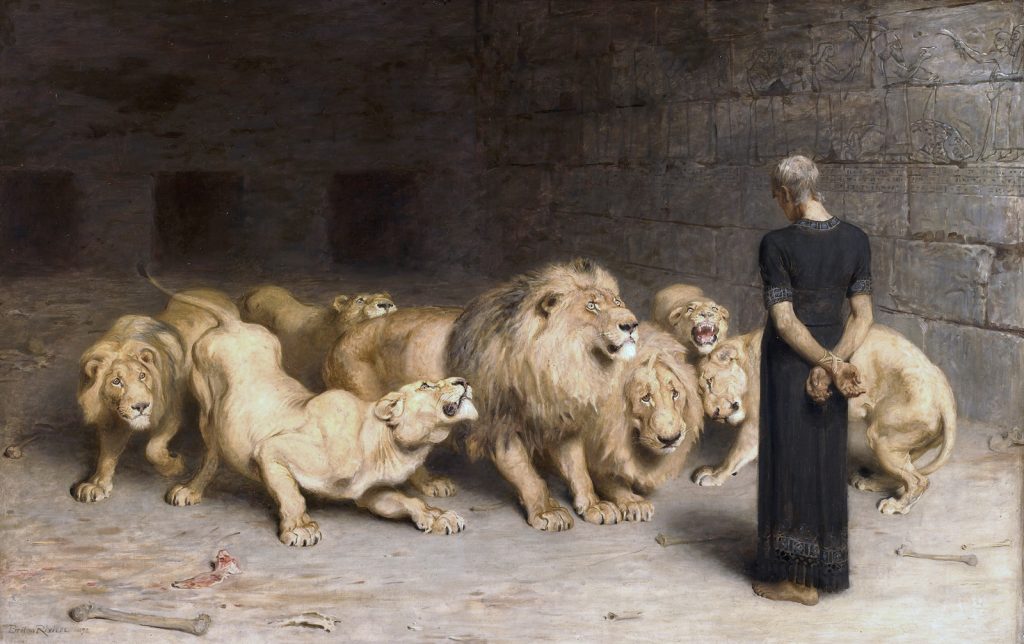
Briton Riviere exhibited this painting at the Royal Academy in 1872, establishing himself as a painter capable of combining serious biblical narrative with the naturalistic animal studies for which he was becoming known. Unlike his later 1890 revisitation of the same subject, this version focuses on the night of Daniel's imprisonment rather than the morning of his vindication, giving the composition a more introspective and psychologically tense quality. The work was produced during a period when Riviere was deepening his knowledge of large cats through regular visits to the Zoological Gardens in London, and the lions in this painting already demonstrate the close observational study that would define his mature animal work. The painting was well received at the Academy and helped secure Riviere's reputation as a painter of moral and historical subjects. It later entered the Walker Art Gallery in Liverpool, where it became part of a strong Victorian collection that also holds other significant works of the period. The choice to depict Daniel at night, in a moment of quiet prayer rather than public vindication, distinguishes this version from more triumphant treatments of the same story.
The composition of the 1872 version is markedly more intimate than the 1890 pendant, organizing itself around a lone human figure surrounded by a loosely arranged group of lions in a darkened interior space. Riviere lights the scene with a cool, filtered glow that suggests moonlight or a distant torch, casting long shadows across the stone floor of the den and sculpting the forms of the lions with subtle gradations of tone. Daniel is depicted seated or kneeling, his head bowed and his hands clasped, which removes any suggestion of confrontational drama and instead emphasizes vulnerability and faith. The lions are rendered with the same careful anatomical accuracy that would become a hallmark of Riviere's work, though here they appear less theatrically posed than in the 1890 painting. The palette is darker and cooler throughout, reinforcing the nocturnal setting and the psychological weight of the subject. The negative space of the den itself is used effectively to create a sense of enclosure and isolation.
Where the 1890 painting celebrates vindication, this earlier version meditates on endurance. Daniel in the lions den at night, before the king returns to check on him, is a figure of uncertainty and trust, a man who has committed himself to a belief he cannot verify in the darkness. Riviere captures this liminal quality with great sensitivity, presenting the prophet not as a heroic figure but as a human being in a moment of profound spiritual testing. For Victorian viewers, the image would have spoken to questions about faith under pressure and the courage required to maintain personal conviction in the face of overwhelming opposition. The lions function not as passive symbols of tamed danger but as real presences in the composition, their physical power made evident even in their stillness. This tension between the potential for violence and the reality of peace serves as the visual embodiment of the miraculous quality the biblical narrative describes.