Loading cart…
No products in the cart.

1898 · Oil on canvas · Guildhall Art Gallery, London, United Kingdom
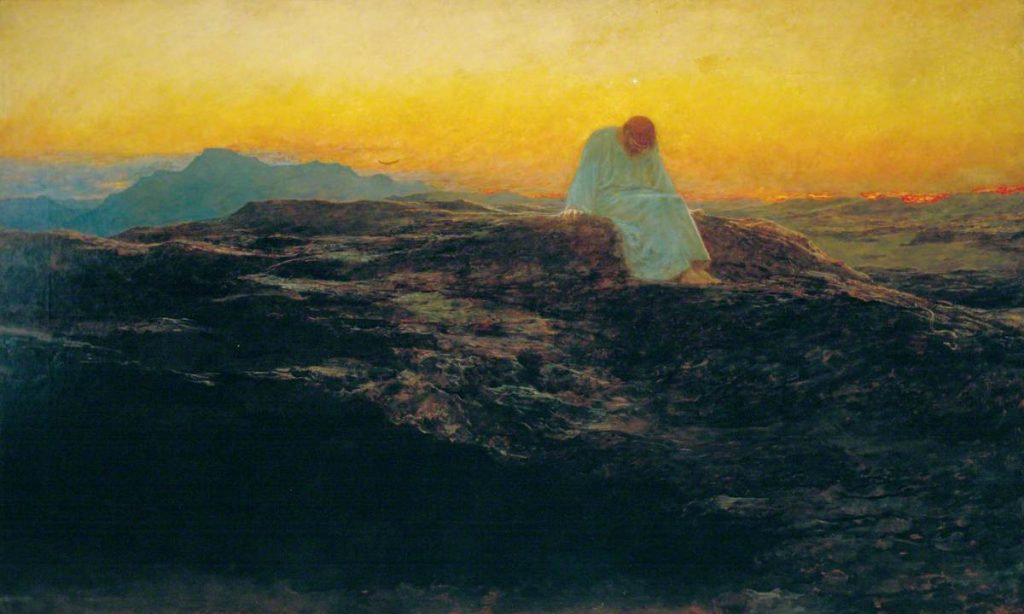
Exhibited at the Royal Academy in 1898, The Temptation in the Wilderness draws on the Gospel accounts of Christ spending forty days in the desert before beginning his public ministry, a period during which he was tempted by Satan. Riviere's interpretation is notable for its emphasis on solitude and its departure from more conventional representations that depicted Satan as a visible figure. Instead, Riviere focuses on the physical environment and the presence of wild animals, drawing on a passage from the Gospel of Mark that mentions Christ being with the wild beasts during the temptation. This choice aligns with Riviere's broader practice of using animals to deepen the emotional and spiritual content of his narrative paintings without relying on overtly dramatic human interaction. The work was produced during a period of sustained engagement with religious subject matter in Riviere's practice, and it reflects the Edwardian public's continued appetite for large-scale biblical painting that combined moral seriousness with pictorial skill. The painting entered the Guildhall Art Gallery collection, where it sits within a broader survey of Victorian and Edwardian figurative art.
The composition places the figure of Christ in the middle distance of a vast, arid landscape, making the human figure relatively small against the expanse of the desert and sky. This spatial arrangement is deliberate, communicating the isolation and vulnerability of the forty days in a way that a more conventionally heroic figure placement would not achieve. The wild beasts that attend the figure are rendered with Riviere's characteristic observational care, their physical presence adding specificity and credibility to the biblical scene. The landscape itself is painted with close attention to the quality of desert light, pale, harsh, and unforgiving, with minimal vegetation to emphasize the barrenness of the environment. Riviere uses a predominantly warm but desaturated palette, with the figure of Christ providing a point of cooler, more luminous tone that draws the eye without overwhelming the landscape. The absence of Satan as a visible figure is a compositional decision that shifts the dramatic weight inward, toward the psychological experience of temptation rather than its external representation.
By choosing to depict the temptation without a visible adversary, Riviere makes a significant theological and artistic statement. The struggle that Christ undergoes in the wilderness is internalized, located within the figure itself rather than externalized as a combat between two visible opponents. This interpretation aligns with a more psychologically sophisticated understanding of temptation as an internal experience, a reading that would have resonated with the more theologically reflective members of Riviere's Victorian and Edwardian audience. The presence of wild beasts, drawn directly from the Marcan text, adds a layer of meaning that connects the temptation narrative to the broader biblical themes of humanity's relationship with the natural world. Christ among the wild animals, unharmed and in a posture of prayer rather than fear, echoes the Daniel imagery and suggests a reading of the wilderness as a space of spiritual testing that does not overwhelm the faithful.