Loading cart…
No products in the cart.

1814 · Oil on canvas · Museo del Prado, Madrid
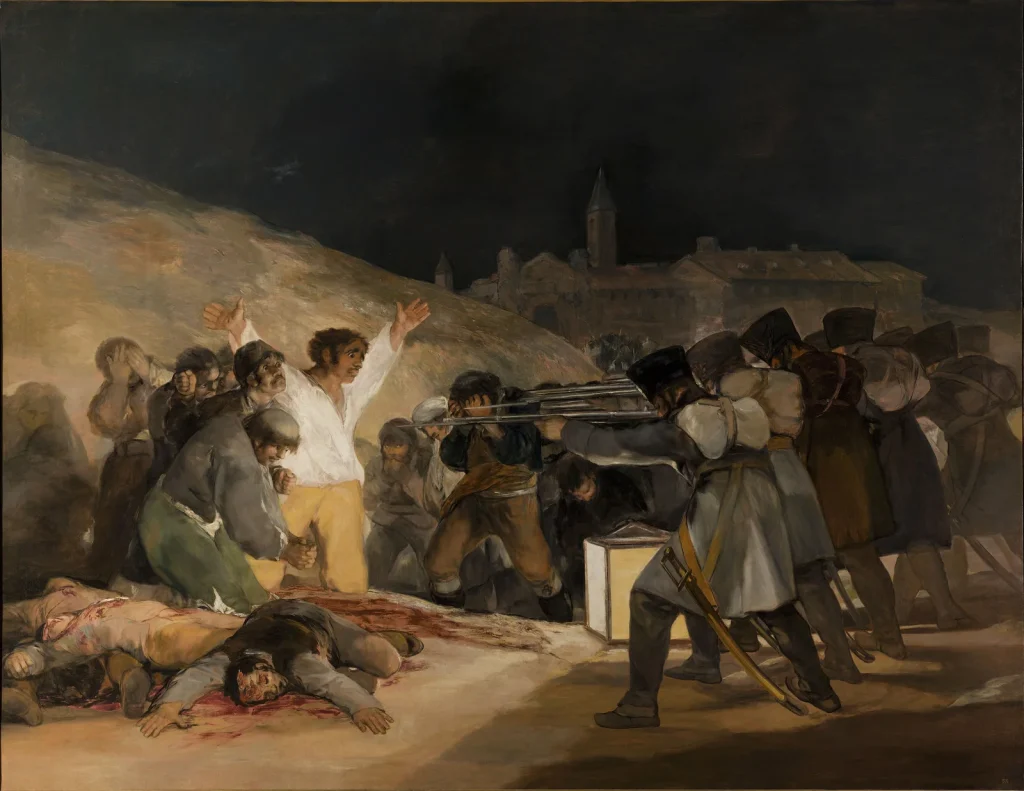
In February 1814 the French had finally left Spain, and Francisco de Goya, sixty-seven years old and completely deaf, wrote to the provisional government. He had spent the six years of the war painting for whoever held Madrid, including the French. Now he offered something else:
To perpetuate by means of his brush the most notable and heroic actions of our glorious insurrection against the tyrant of Europe.
Goya's petition to the Regency, 24 February 1814
The Regency agreed and paid his expenses. Within a few months he had painted two enormous canvases about two days in May 1808: the street fighting of the second, and the executions of the third. This is the second of them, and it is the one that changed what a painting about war could be.
On 2 May 1808 the people of Madrid rose against the French troops occupying the city. Napoleon had lured the Spanish royal family across the border, and when a crowd saw the last of the royal children being taken from the palace, it attacked. The fighting lasted a day. Marshal Murat's cavalry, including his Mameluke horsemen, cleared the streets, and by evening the rising was over.
That night and into the morning of 3 May, the French shot everyone they had caught with a weapon, and many who had none, at several places around the city. One of them was the hill of Príncipe Pío on the western edge of Madrid. The prisoners were brought there in groups and shot by lantern light.
Goya lived in Madrid and was fifty-two. Whether he saw any of it is not known. What is known is that he did not paint it for six years, and that when he did, he painted it like nobody had painted an execution before.
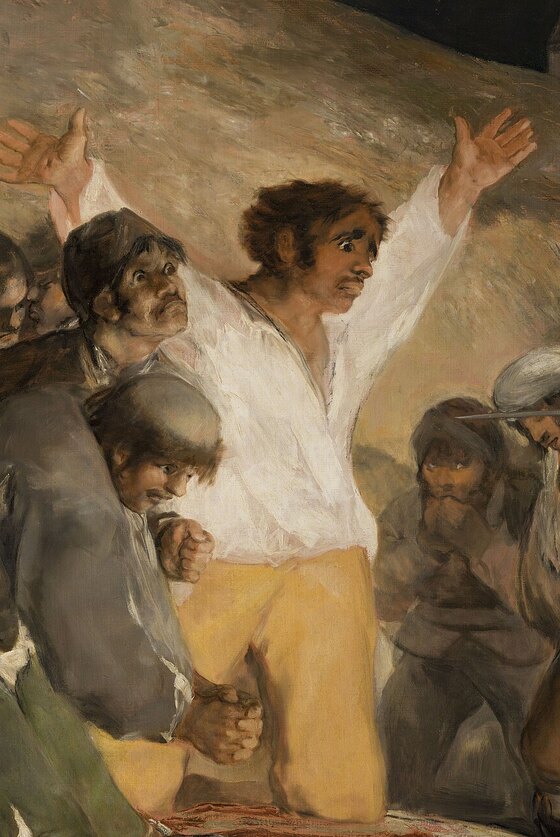
The whole painting is built around one man. He kneels in a white shirt and yellow trousers, arms flung wide, facing the guns, and the lantern lights him up like a stage. Everyone else in the picture is turning away, crouching, covering their face or looking at the ground. He looks straight at the men who are about to kill him.
His pose is a crucifixion. Arms out, palms open. Look closely at his right hand and you will find a mark in the palm, the wound of a nail. Goya does not say he is Christ. He says that this is what is happening: an innocent man is being put to death in front of witnesses, and the people doing it do not see his face.
He is also out of scale. Kneeling, he is as tall as the soldiers standing. Goya bent the proportions so that the eye goes to him first and stays, and so that when you finally look at the rifles you feel how close they are.
Nobody knows who he was. Names have been proposed and none has stuck. He is every man in the line.
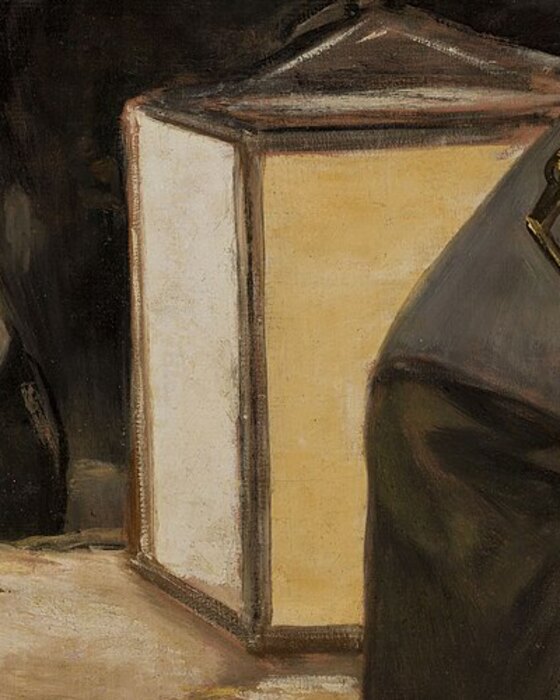
There is no moon and no dawn. The only light in the painting comes from a big square lantern set on the ground between the two groups, and it faces the prisoners. The soldiers stand behind it in their own shadow.
This is the opposite of how light works in older religious painting, where it comes from heaven or from the holy figure himself. Here the light is a piece of army equipment. It is there so the firing squad can see what it is shooting at. Goya turns it on the victims and lets us look with the soldiers' eyes, which is the most uncomfortable place he could have put us.
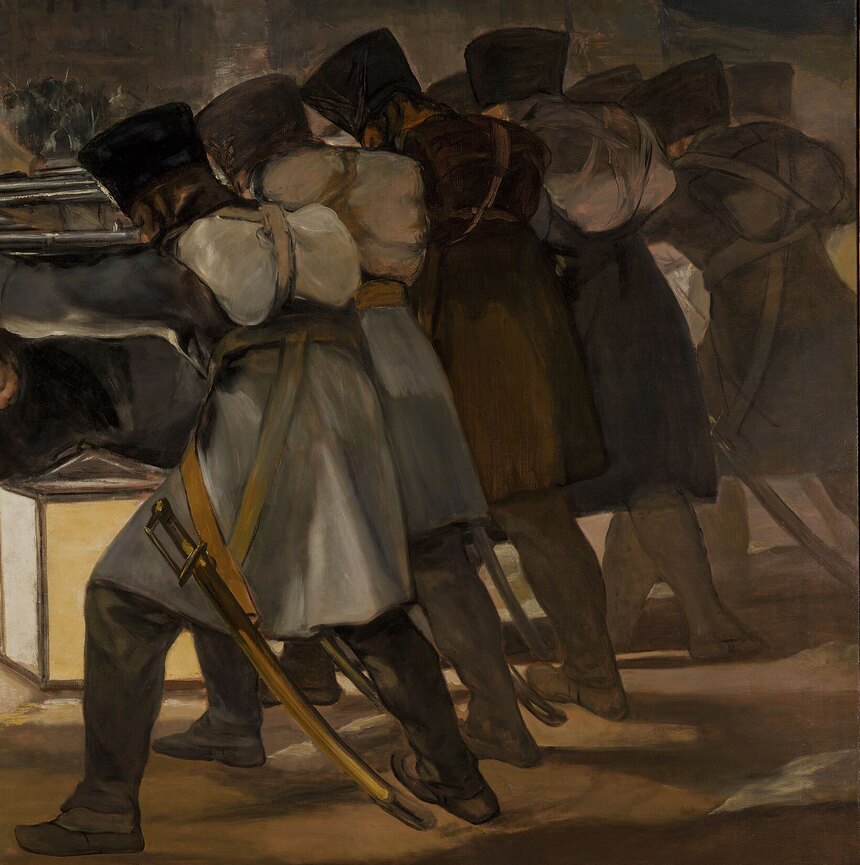
We never see a soldier's face. The squad is a row of backs, packs, sabres and shakos, legs braced at the same angle, rifles level, bayonets fixed. They are painted as one machine with six barrels, and the barrels almost touch the man in white. Goya has removed the distance that makes an execution bearable to watch.
This is the great invention of the picture. War painting before it, Goya's own Second of May included, showed heroes, uniforms, individual acts. This shows a process. Nobody in it is a hero, and the killers are not even villains. They are a job being done.
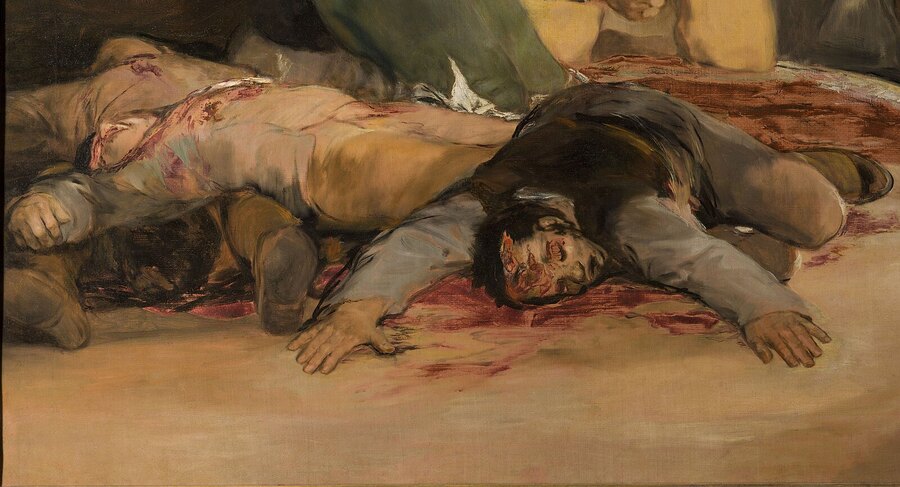
The painting shows three moments at once. At the front, the men already shot: face down in their blood, one with his arms spread in the same pose as the man in white, as if we are seeing what he will look like in a few seconds. In the middle, the group being shot now. And behind them, coming up the hill with their hands over their faces, the next group.
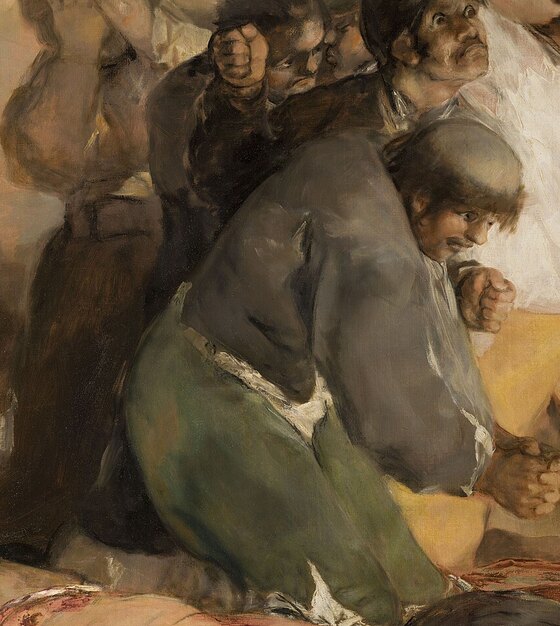
Beside the man in white, a friar with a shaved crown bows over his clasped hands. A man in a hat stares at the guns with his fist to his mouth. Another buries his face in his hands. Each one is dying in his own way, and the range of them is the painting's mercy: it lets each man be a person for one more second before the volley makes them all the same.
Above them the hill is bare, and beyond it the dark shapes of a church and the city's rooftops under a black sky. Madrid is asleep.
On the surface it is a patriotic painting, commissioned by a government to honour a national uprising. That is what Goya offered to paint, and that is how it was received.
But look at what is missing. There is no flag, no officer, no named hero, no glory. The Spanish are ragged and terrified and the French are faceless. The painting does not say "Spain was brave". It says "this is what happened to people", and it says it about any people and any army. That is why it has been borrowed for every war since.
Goya had been drawing the war for years in private, in the etchings he called The Disasters of War, where Spaniards and French commit the same atrocities and the captions say things like "I saw this" and "And nothing can be done". The Third of May is the Disasters painted at the scale of an altarpiece, with the lighting of a martyrdom and the moral clarity of neither side.
Half a century later Édouard Manet stood in front of it in Madrid and went home to paint The Execution of Emperor Maximilian: the same firing squad seen from the side, rifles almost touching the victims, soldiers as a uniformed block. Manet took Goya's structure and drained the drama out of it, which was his way of making the same point.
In 1951 Pablo Picasso, another Spaniard painting another war, made Massacre in Korea: naked women and children on the left, a squad of armoured robots with guns on the right, the guns almost touching. He did not need to explain where the composition came from. By then every educated viewer knew.
Goya himself went the other way. Within five years of this painting he had retreated to a farmhouse outside Madrid and was painting Saturn Devouring His Son on his dining-room wall. The Third of May is the last time he believed a painting could be addressed to the public.
The two May paintings were not exhibited when they were new. Ferdinand VII, restored to the throne in 1814, had no interest in pictures of the people fighting for themselves, and Goya's own record during the occupation made him suspect. The canvases went into storage and entered the Prado in 1834, six years after Goya died in exile in Bordeaux. For decades they were barely mentioned.
In 1937, during the Civil War, the Republic evacuated the Prado's masterpieces from Madrid ahead of Franco's advance. On the road to Valencia the truck carrying the two May paintings had an accident and The Third of May was torn down its left side. The damage was patched and it hung for seventy years with the tear filled in and the missing paint painted over. The Prado's restoration of 2008 removed the old repairs and left the losses visible but toned, so that what you see now is Goya's paint and honest gaps, not a restorer's guess.
The original is in the Museo del Prado, Madrid, hanging beside The Second of May 1808. It is oil on canvas, 268 by 347 centimetres, so the man in white is larger than you are.
It is a hard painting to live with and people choose it on purpose: for a study, a library, a place where an argument about history is welcome. Our hand-painted reproduction of The Third of May 1808 is painted in oil on canvas from the Prado composition, and it needs width. The lantern's glare, the white shirt and the black sky are what carry across a room; the faces of the waiting men are what you find when you walk up to it.
See more of Goya, from the Majas to the Black Paintings, in our Francisco de Goya collection.
Visible details, documented facts and interpretation are kept separate throughout this article. The identity of the man in white is unknown and is left so.


