Loading cart…
No products in the cart.

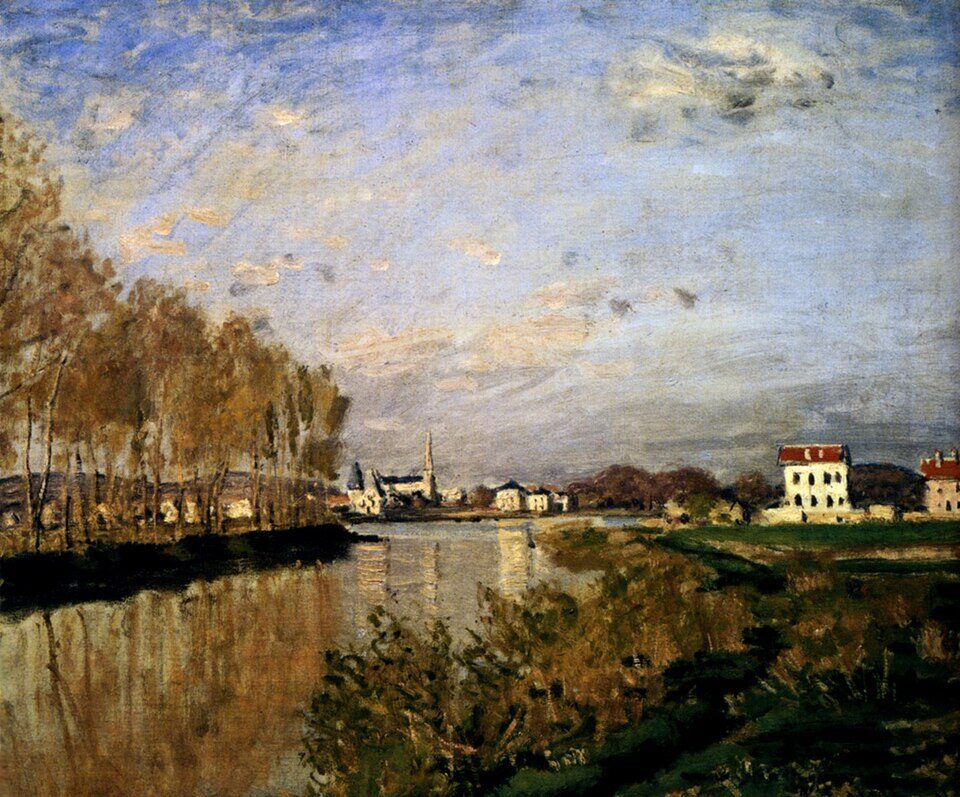
1873 · Oil on canvas · Musee d'Orsay, Paris, France
Save articles to your collection
Log in or create a free account, and this article will be waiting in your Private Collection.
Log in or sign upMonet lived at Argenteuil, a town on the Seine northwest of Paris, from 1871 to 1878, a period of sustained productivity in which he produced some of his most celebrated river paintings. The town was a center of recreational sailing and offered Monet constant access to the water he needed to develop his study of reflection and surface movement. He frequently painted from a studio boat he had constructed, mooring it in different positions along the river to vary his viewpoint.nnThis canvas entered French national collections and is now at the Musee d'Orsay, where it represents the Argenteuil period alongside several other works from the same years. The period is generally considered one of the most technically confident and visually accessible phases of Monet career, with the innovations of La Grenouillere fully assimilated into a practiced and assured handling.
The composition places the viewer at the water level, looking across the Seine toward the far bank with its trees and houses. The sky occupies the upper third of the canvas and its reflection in the water occupies the lower third, with the dark strip of the far bank and its vegetation providing the central horizontal. The sailboats are distributed across the middle distance, their white sails punctuating the blue of the water and sky.nnMonet handles the water surface with a confidence and fluency that marks this as a mature work. The reflections are not literal transcriptions of the objects above the water but interpretations, translated into the optical language of moving water through varied brushwork and broken color. The handling of the sailboat reflections is particularly accomplished, with the white sails rendered in the water as broken strokes of blue-white that convey movement without losing the identity of the reflected object.
The Argenteuil paintings document a moment in the development of the Paris region when industrialization and leisure were visibly coexisting on the same stretch of river. The sailboats that populate these canvases belonged to the new middle class of the Third Republic, people who had the time and money to pursue recreational sailing on weekends. Monet observed this social landscape with the same attentiveness he brought to the behavior of light on water.nnThe paintings from Argenteuil also represent Monet at his most sociable and collaborative. Renoir, Manet, and Sisley all visited and painted alongside him during these years, and the cross-fertilization of ideas and techniques during this period was central to the development of Impressionism as a coherent movement rather than a loose affiliation of individual styles.
Enjoyed this story?
Save articles to your collection
Log in or create a free account, and this article will be waiting in your Private Collection.
Log in or sign upA note from the studio
Our studio is working through an exceptional number of commissions, so we have paused new orders for a short time. We will start taking orders again on 1 October.
Every painting is made entirely by hand, and we would rather pause than rush one. Thank you for your patience and your trust.
Leave your details and we will reserve your place: we will write to you as soon as orders reopen.
Thank you
Your request is saved. We will write to you on 1 October, and a confirmation is on its way to your inbox.