Loading cart…
No products in the cart.

1890 · Oil on canvas · Van Gogh Museum, Amsterdam
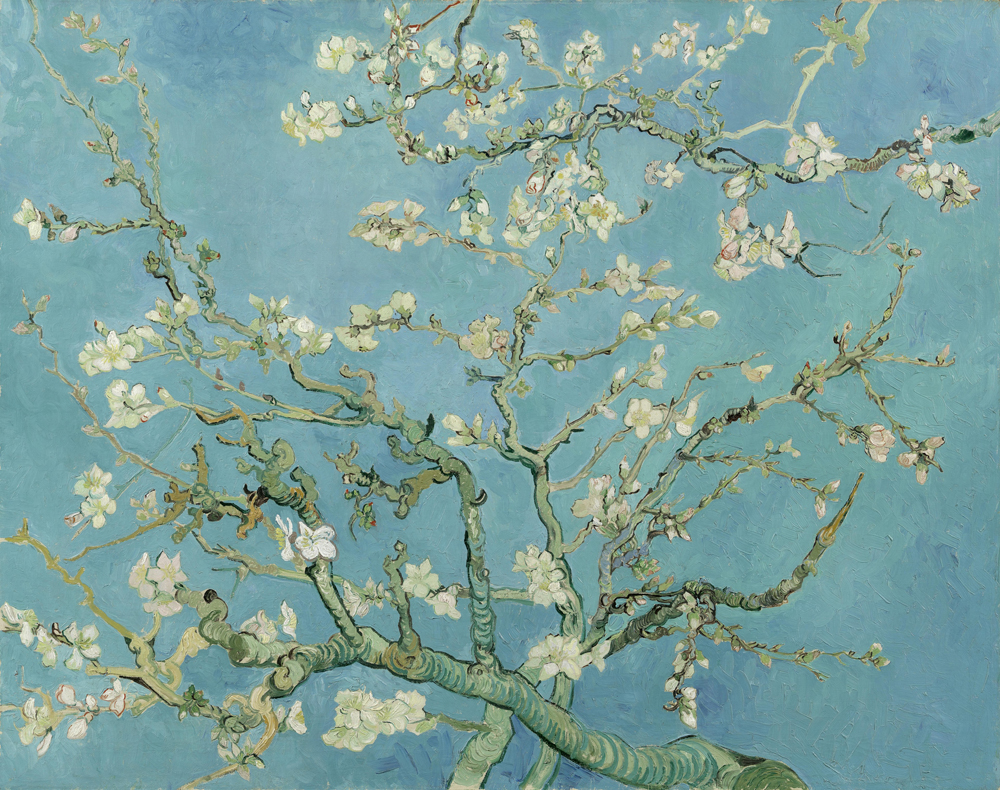
Van Gogh painted Almond Blossom in February 1890 at the asylum in Saint-Remy when he received news that his brother Theo and sister-in-law Jo had a son, named Vincent Willem in his honor. He wrote that he had immediately set about painting a large picture for them and that he wanted to make something cheerful and optimistic to hang in their bedroom. The painting was his gift to celebrate the birth of his nephew, who would later become the guardian of Van Gogh's estate and ensure his posthumous reputation. Vincent Willem van Gogh lived until 1978 and was instrumental in establishing the Van Gogh Museum in Amsterdam, which opened in 1973. The painting now hangs in that museum, fulfilling in a sense the domestic purpose Van Gogh intended for it.
The composition fills the entire canvas with flowering almond branches against a blue sky, with no ground, no horizon, and no landscape context. The format is entirely Japanese in its approach: close observation of a single botanical subject, flat background, strong outlines, clear color areas. Van Gogh was working directly from the ukiyo-e prints he had collected and admired throughout his career. The blossoms are painted with particular care and delicacy, unusual in Van Gogh's often rapid and urgent handling. Each blossom is individually observed, with its specific configuration of petals and its particular stage of opening rendered precisely. The branches are dark against the bright sky, their irregular form providing the compositional structure. The painting has a stillness and clarity that contrasts with much of his work from the Saint-Remy period. It was made during a period of relative calm following his most acute symptoms, and the serenity is visible in the handling.
Almond blossom was an ancient symbol of hope and new beginnings in many cultures, flowering as it does before any other tree, in the coldest part of late winter. Van Gogh was certainly aware of this symbolism when he chose the subject for a painting celebrating a birth. The painting is an expression of hope for the future embodied in a new child. It is also one of the most direct engagements with Japanese aesthetics in Van Gogh's entire output. He had dreamed of going to Japan throughout his career and had settled in Arles partly because he believed the southern light resembled what he imagined Japan to be like. Almond Blossom is his most sustained attempt to paint in a way that honored what he had learned from Japanese printmaking.