Loading cart…
No products in the cart.

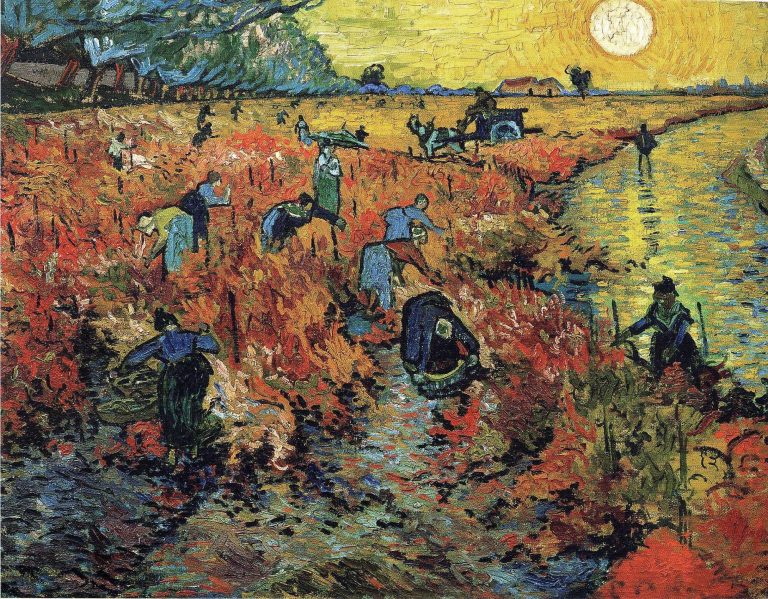
November 1888 · Oil on canvas · Pushkin State Museum of Fine Arts, Moscow
Save articles to your collection
Log in or create a free account, and this article will be waiting in your Private Collection.
Log in or sign up Explore the artistVincent van Gogh →
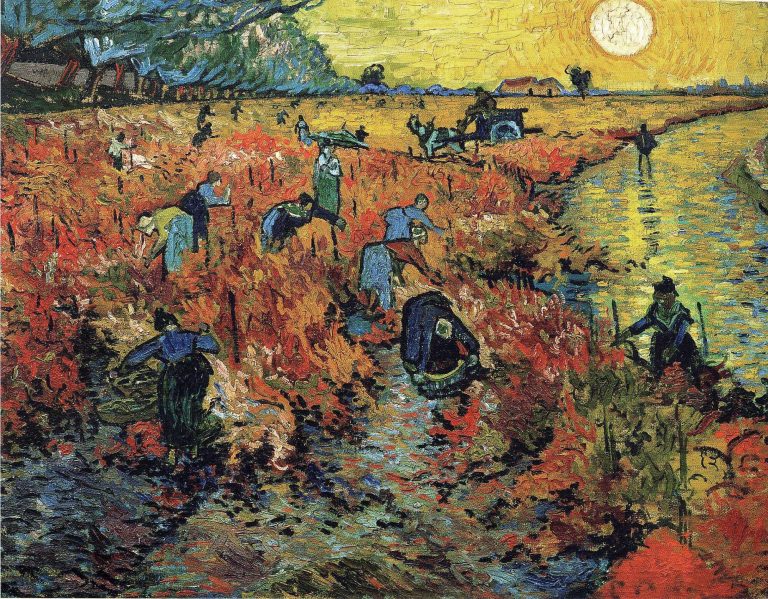
Red vines fill the foreground. Yellow light spreads across the distance and returns through the water at the right. Dark, bent figures work among strokes of orange, green and blue.
Vincent van Gogh painted The Red Vineyard at Arles in November 1888. It belongs to the Pushkin State Museum of Fine Arts in Moscow. Its colour can make the harvest seem almost incandescent, but the people remain occupied with a practical task.
The painting is also attached to a persistent story: that it was the only work Van Gogh sold during his lifetime. The sale to Anna Boch is well documented. The claim that it was his only sale is not an accurate summary of the wider record.
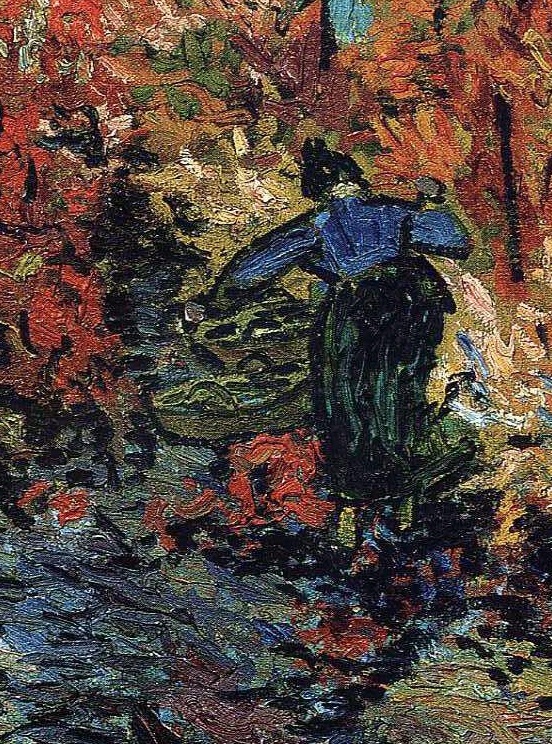
The nearest workers bend low into the vineyard. Their dark clothing interrupts the red, making separate bodies visible within a surface that might otherwise read as an almost continuous blaze.
Van Gogh does not give every person a detailed facial expression. A lowered head, extended arm or bent back can establish an activity. The body becomes legible through its relationship with the rows.
The figures farther away are smaller and more abbreviated. Some stand more upright; others repeat the near workers' downward movements. The field gathers different stages of the same labour rather than presenting a single posed group.
The red does not make the work disappear. It changes the atmosphere in which it is seen. A viewer can feel the intensity of the evening while still recognising the repeated physical effort of a harvest.
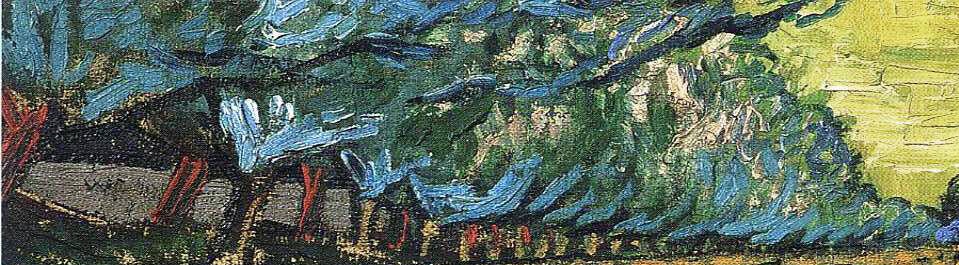
A line of blue-green trees borders the upper left. Their trunks and branches remain dark, while cooler strokes describe the foliage. The vineyard's warm colours do not spread evenly into this part of the landscape.
That contrast gives the painting structure. The tree line contains the red field, and the yellow distance creates another broad area beyond it. Colour is doing work that a carefully ruled perspective grid might do in a different kind of picture.
The palette should not be reduced to the idea that Van Gogh painted exactly what a camera would have recorded. He selects and intensifies relationships between colours. The recognisable subject remains, but its visual energy depends on those decisions.
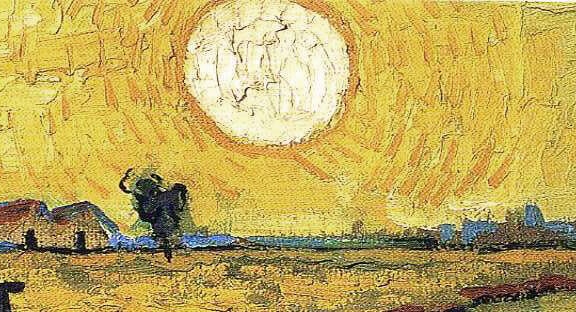
The pale sun sits within an area of curved yellow strokes. Its circular form is easy to find, but the surrounding marks keep the sky from becoming an inert background.
The strokes are visible as marks of paint while also suggesting light and atmosphere. The eye can alternate between seeing a sunset and seeing how a painted surface has been organised.
This does not mean that each stroke records a symptom or reveals a precise mental state. The painting's energy is visible. Turning it into a retrospective medical diagnosis would require evidence the marks cannot supply.
The sun's brightness also helps distribute attention. After looking into the dense, dark bodies of the foreground, the eye can move toward the larger open passage of yellow above them.
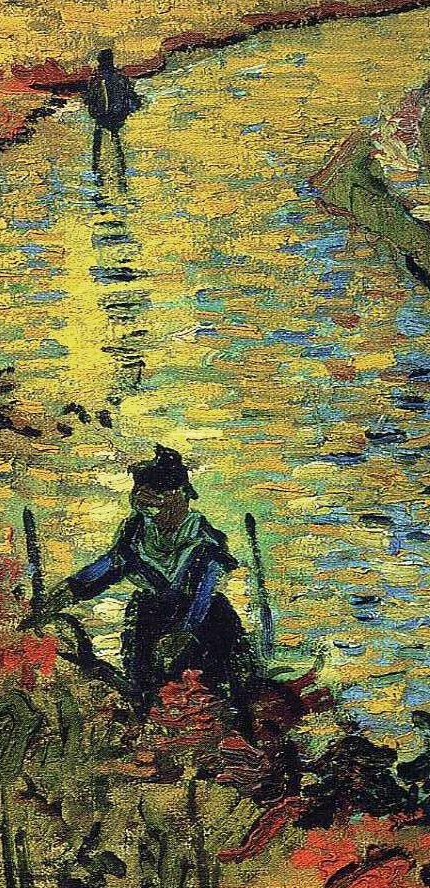
At the right, the water carries yellow reflections toward the foreground. Blue and green marks interrupt them, so the reflected light does not become a single smooth stripe.
The diagonal edge separates water from vineyard while also drawing the eye into the distance. The painting gains a route through its crowded field without losing the intensity of its colour.
People stand or work near that boundary. Their darker shapes become part of the rhythm of reflection and growth. The landscape is not divided into a human scene on one side and an unrelated decorative effect on the other.
The water is especially useful after attention has been absorbed by the red vines. It offers another kind of movement, built from horizontal and broken marks rather than the denser upright strokes of the plants.
In 1890 the Belgian painter Anna Boch bought The Red Vineyard at the exhibition of Les Vingt in Brussels. She was the sister of Eugène Boch, whom Van Gogh knew.
The scholarly edition of Van Gogh's letters identifies the sale in the notes to letter 855. It also records Theo's account-book entry of 6 March 1890: 400 francs received for the painting.
That documentary trail matters. It identifies a buyer, a work and an amount rather than relying on an appealing anecdote repeated without a source.
The transaction is significant without needing to be the only one. A contemporary artist chose this painting while Van Gogh was alive. That fact provides a more particular history than the general image of an artist appreciated by nobody until after death.
No. The Van Gogh Museum explicitly rejects that simple claim. Its account describes other sales, commissions and exchanges, while acknowledging that the exact lifetime total is not known.
Different kinds of transactions also complicate the counting. An outright purchase, a commission and an exchange for another work or materials do not all leave the same kind of record.
The Red Vineyard's sale has become exceptionally famous because its documentation and later reputation make it easy to tell. Familiarity with that one event does not establish that no other work changed hands for payment.
The distinction is worth preserving when sharing the painting. Saying that Anna Boch bought it for 400 francs in 1890 is a supported historical claim. Saying that it was the only painting Van Gogh ever sold makes the evidence narrower than it is.
The Pushkin Museum's conservation project has examined the painting's canvas, paint layer and condition. Its public material makes a useful distinction between the familiar image and the physical object that carries it.
A digital reproduction can make the surface appear fixed and instantly available. Conservation asks different questions: how the materials have changed, what can safely be treated and what should remain untouched.
Those questions do not require inventing brighter colours or reconstructing details. The images here are faithful crops of a historical painting source. They allow closer attention while retaining the limits of the available reproduction.
Look back at the workers after the sale story. The painting's value is not exhausted by an unusual transaction or a famous myth. Its figures continue to work within an evening whose colour can still stop a viewer at a distance.
He painted it in Arles in November 1888.
It belongs to the Pushkin State Museum of Fine Arts in Moscow. It is painted in oil on canvas and measures approximately 75 by 93 centimetres.
Anna Boch bought it at the Les Vingt exhibition in Brussels in 1890. The scholarly letters edition records a payment of 400 francs in Theo's accounts.
No. The Van Gogh Museum says he sold more than one work, although the exact number is uncertain.
People harvesting a vineyard near Arles under a low sun. Red vines, cool trees, yellow sky and reflected light organise the scene.
Vincent van Gogh, The Red Vineyard, 1888, Pushkin State Museum of Fine Arts, Moscow. Faithful public-domain painting reproduction, Wikimedia Commons. Detail images are crops; colour has not been newly altered.
Enjoyed this story?
Save articles to your collection
Log in or create a free account, and this article will be waiting in your Private Collection.
Log in or sign up
Man Writing a Letter
Gabriel Metsu, c. 1664
The gallery list
Every painting is already 50% off. Join the list and we will send you an extra $15 code, plus first access to new collections.
No spam. Unsubscribe anytime. · Privacy Policy
Welcome
Your $15 code is on its way. Explore the gallery while you wait.