Loading cart…
No products in the cart.

1888 · Oil on canvas · National Gallery, London
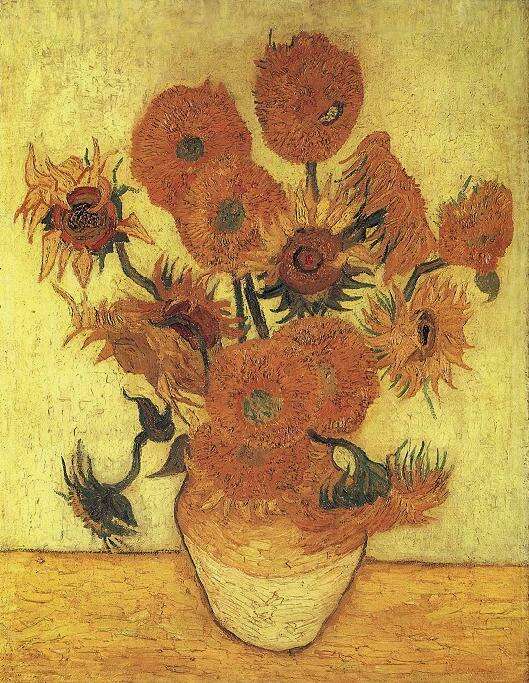
Van Gogh painted several versions of sunflowers in Paris in 1887 and then produced his most celebrated series in Arles in August 1888, when he was preparing his yellow house for the arrival of Paul Gauguin. He intended the sunflower paintings to decorate Gauguin's room and thought of them as particularly his own, as other painters had roses and peonies. He painted four large versions showing sunflowers in various stages of bloom and decay in a yellow terracotta vase. The London version now at the National Gallery is the most famous. It shows fourteen sunflowers in a vase, some in full bloom, some past their peak and drooping, on a yellow-green background. The entire painting is constructed in variations of yellow, which Van Gogh used as a color associated with warmth, friendship, and the south of France. Gauguin admired the Sunflowers enormously and asked for one of the versions after leaving Arles. Van Gogh refused to give him the original but made copies. The Sunflowers became one of the most expensive paintings ever sold at auction in the 1980s and remain a central symbol of Van Gogh's work and of painting itself.
The painting is built entirely within the yellow range, which is both its greatest difficulty and its greatest achievement. The sunflowers, the vase, and the background are all yellow, yet the composition has a strong sense of three-dimensional form because Van Gogh differentiated the yellows with extraordinary precision. The background is cool yellow-green. The vase is warmer ochre. The flowers range from bright chrome yellow in full bloom to yellow-brown in decay. The brushwork is direct and confident. The petals are painted with single strokes that describe their shape and movement simultaneously. The seed heads are built up in thick, swirling impasto that gives them a physical density unlike anything in smooth photographic reproduction. Van Gogh used a palette knife as well as brushes to build up the dense central areas. The composition is formally simple: a vase on a flat surface with a plain background. All the interest is in the variety within unity, the way each flower is different from every other in pose, in stage of bloom, in color temperature, and in the handling of the paint.
Van Gogh associated sunflowers with gratitude and friendship. He painted the Arles series specifically to welcome Gauguin and to create a hospitable environment in the yellow house. They are paintings about warmth, hospitality, and the south of France's particular quality of summer light. Sunflowers also track time. Some are in full bloom, others past their peak. The series implicitly shows the cycle of life through the life of a flower. Van Gogh was deeply interested in cycles of growth and decay throughout his work, and the Sunflowers are one of his clearest meditations on this theme.