Loading cart…
No products in the cart.

1890 · Oil on canvas · Musee d'Orsay, Paris
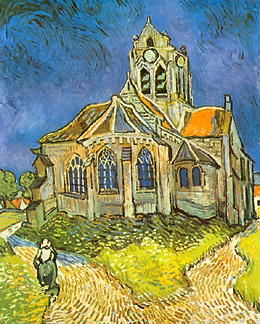
Van Gogh painted The Church at Auvers in June 1890 during his two months in Auvers-sur-Oise. The church of Notre-Dame de l'Assomption is a twelfth-century Romanesque structure that stands at the center of the village. Van Gogh painted it from a slightly elevated viewpoint that makes the building loom against the sky.
He wrote to his sister Wil describing the painting and noting that the colors he used, deep ochre-yellow and pure cobalt blue for the sky, gave the effect of stained glass windows. He was working at a furious pace in Auvers, and this painting belongs to one of the most productive and stylistically assured phases of his entire career.
The painting shows the Gothic church from a three-quarter view, with a path dividing in the foreground and a figure walking along the road in the lower right. The sky behind the church is an intense blue that seems almost to press against the building's outline. The church itself is painted in deep ochres and browns that absorb the afternoon light.
The most distinctive element of the painting is the way the sky pushes against the architectural forms rather than receding behind them. In most landscape painting the sky occupies the background; here it has almost the same visual weight and density as the building in the foreground. This tension between the solid earth-bound structure and the dynamic sky gives the painting its particular energy.
The path that divides in the foreground, with one branch going around each side of the church, gives the composition a directional structure. The lone figure on the road provides human scale and movement.
Van Gogh had a complicated relationship with organized religion, having been deeply devout in his youth and then having moved through periods of intense doubt. The church paintings from Auvers have been read as both a return to religious feeling and as an expression of the disconnect between the human institution of the church and the transcendent sky behind it.
The painting also echoes compositional solutions from Dutch and Flemish art that Van Gogh admired, bringing his career full circle in a sense: the Dutch painter, trained partly in the tradition of Dutch church interiors and town views, painting a French village church with the expressive tools he had developed over a decade of intense work.