Loading cart…
No products in the cart.

1889 · Oil on canvas · J. Paul Getty Museum, Los Angeles
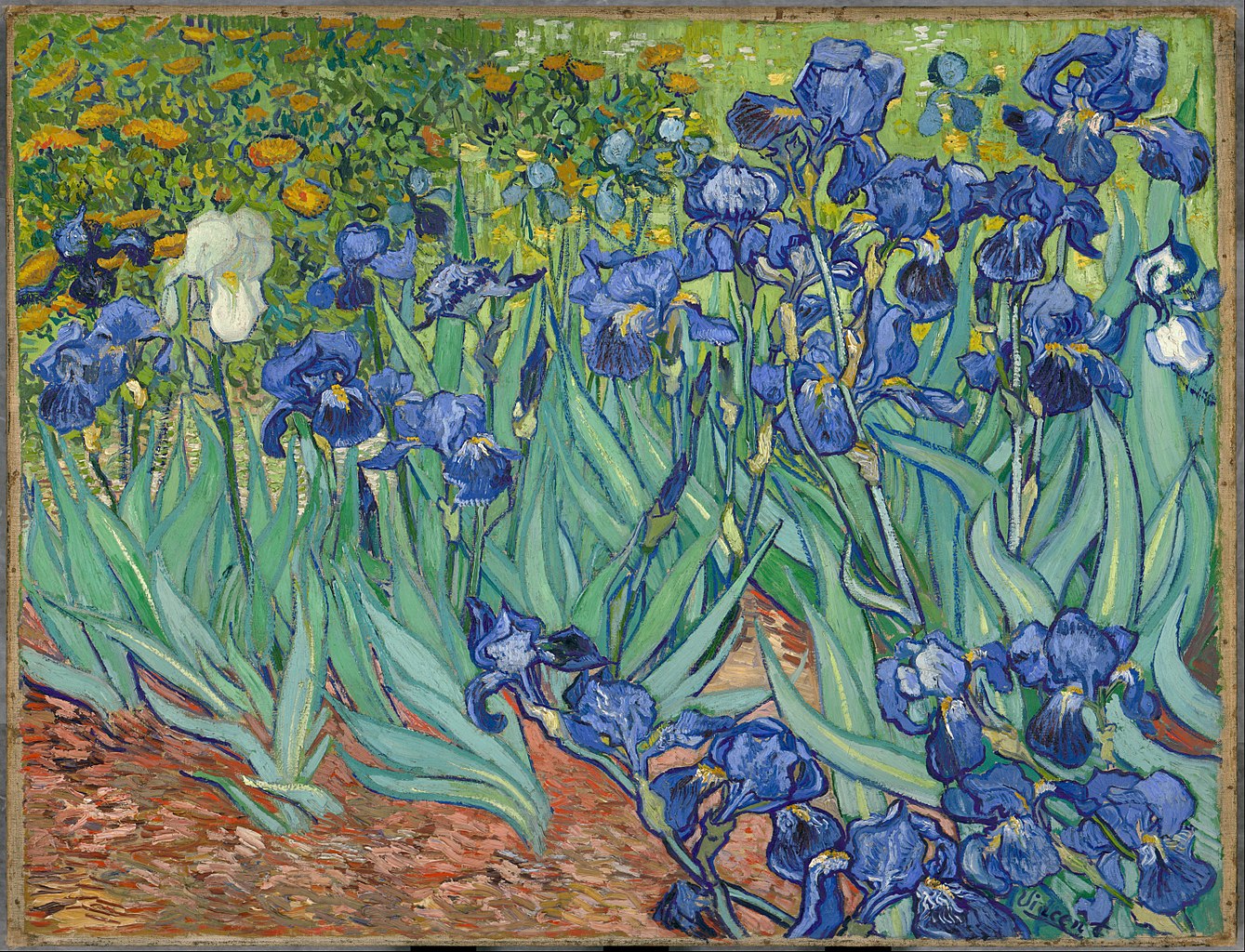
Van Gogh painted Irises in May 1889, one of the first paintings he made after entering the asylum at Saint-Paul-de-Mausole in Saint-Remy. He described it as the lightning conductor for his illness, meaning that the act of painting prevented worse symptoms. The painting was made in the asylum garden, from direct observation, in the weeks after his arrival. The painting was shown at the Salon des Independants in Paris in September 1889, where it attracted significant attention and praise. The critic Octave Mirbeau described it as a work of extraordinary intensity. It was bought by the English engineer and art collector Alexander Reid and passed through several collections before being acquired by the Getty Museum in 1990 for 53.9 million dollars, then among the highest prices ever paid for a painting at auction.
The composition shows a dense cluster of blue irises filling nearly the entire canvas, with one white iris slightly left of center providing the only color contrast. The irises grow out of orange-brown soil that appears at the bottom of the painting. There is no sky, no horizon, no spatial context beyond the immediate tangle of flowers. The blue of the irises is not a single color but built from multiple blues, blue-violets, and blue-greens, applied in short brushstrokes that follow the curves of each petal. The leaves are handled with longer, more decisive marks in yellow-green and dark green. The orange soil provides the complementary contrast that makes the blue of the flowers vibrate. The painting has an almost overwhelming abundance. It refuses to simplify or to select a single focus. Every iris is given equal attention. The composition suggests both the chaos of uncontrolled natural growth and the careful observation of a man paying intense attention to the living world around him.
Van Gogh painted the asylum garden obsessively during his year at Saint-Remy. The garden was the boundary of his world during his confinement, and he studied it with the intensity of someone for whom outdoor observation was a lifeline. The Irises belong to this context: they are a painting made by a man in crisis who found in the close observation of flowers a way to stay connected to ordinary life. The white iris slightly off-center has been read as a self-portrait of a kind: the different one, the one that does not conform to the pattern around it. Whether Van Gogh intended this reading is unknown, but it is consistent with his documented sense of isolation and difference throughout his life.