Loading cart…
No products in the cart.

1888 · Oil on canvas · Yale University Art Gallery, New Haven
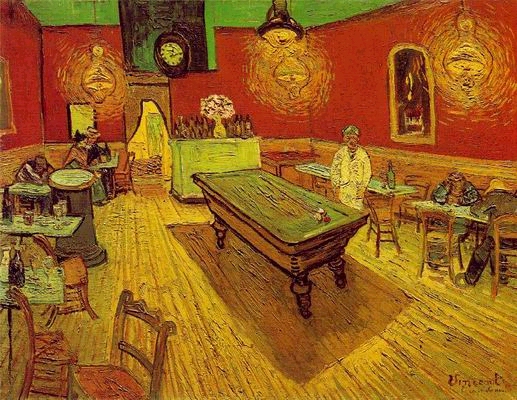
Van Gogh painted The Night Cafe in September 1888 over three nights of continuous work inside the Cafe de l'Alcazar in Arles, owned by Joseph-Michel Ginoux. He described it as one of the ugliest paintings he had made and was clearly disturbed by what he was doing. He wrote to Theo that he had tried to express with red and green the terrible passions of humanity and to express the power of a lowest dive and a gambling den.
The painting was one of a group he traded to Ginoux for a month's accommodation. It subsequently passed through several collections before being purchased by Yale University in 1961. The room depicted no longer exists, though the building on Place Lamartine in Arles still stands.
The color in The Night Cafe is deliberately aggressive. The red walls clash violently with the green billiard table. The yellow of the gas lamps creates halos that seem to radiate disorder rather than comfort. Van Gogh wrote that he had deliberately used colors that contrast and cancel each other out to express the idea that the cafe was a place of corruption and ruin.
The perspective is exaggerated even more dramatically than in The Bedroom. The floor rushes away from the viewer at an impossible angle. The far wall seems too far away. The figures hunched over the tables at the edges of the room are isolated and inert, in contrast with the aggressive central space of the billiard table.
The paint handling is thick and confident throughout. The gas lamp halos are built in dense, radiating impasto. The billiard table's green is flat and assertive. The red walls are painted in layers of different reds that give the surface a restless, shifting quality.
Van Gogh wrote that he wanted to show that the cafe was a place where one could destroy oneself with liquor and gambling, and that the sharp color contrasts expressed the idea of the blood-red and yellow-green of absinthe working on a person's nerves. He was making one of his most deliberate arguments about the expressive power of color independent of naturalistic representation.
The Night Cafe also documents the social reality of working-class Arles. The figures at the edges of the room are drifters and night workers, people with nowhere else to go at three in the morning. Van Gogh was both repelled by and sympathetic toward them, consistent with his lifelong interest in the lives of workers and the poor.