Loading cart…
No products in the cart.

1889 · Oil on canvas · Museum of Modern Art, New York
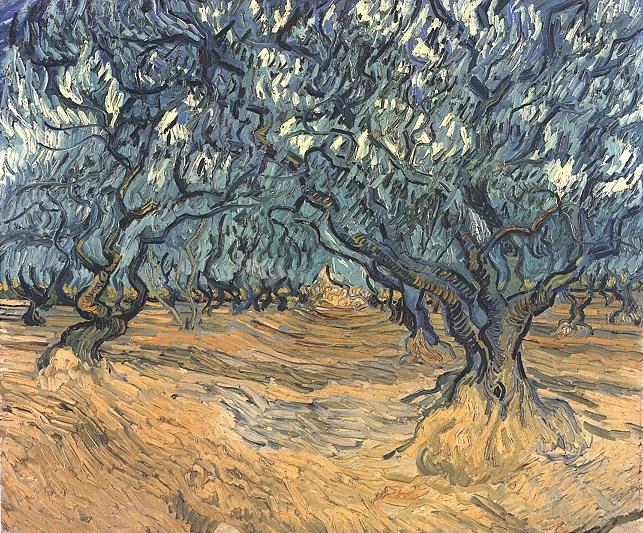
Van Gogh painted multiple versions of olive trees during his year at the Saint-Paul-de-Mausole asylum, finding in the ancient gnarled trees of the Provence landscape a subject that matched his emotional state and technical interests. He produced about fifteen olive tree paintings between June and December 1889, working in the orchards visible from the asylum grounds.
He wrote extensively to Theo and to his painter friend Emile Bernard about the olive trees, arguing that they were the most difficult subject he had attempted because of the constantly changing appearance of the silvery leaves in different lights and the complex movement of the branches.
The MoMA Olive Trees shows a grove of trees in full movement, their trunks twisted and their silvery-green foliage rendered in short, curved brushstrokes that seem to flow and eddy around each branch. The ground is painted in complementary colors of orange and yellow that make the blue-green of the leaves vibrate. The sky is a cool blue with white cloud forms.
The entire painting has a quality of dynamic movement. Nothing is still. The trees writhe, the ground undulates, the sky shifts. This animation of the landscape through directional brushwork is one of Van Gogh's most distinctive contributions to the history of painting.
Van Gogh found in the olive trees both a practical subject and a symbolic one. Olive trees are ancient, associated with Mediterranean culture for thousands of years. They are survivors, living for centuries and continuing to fruit. Painting them in his most psychologically difficult year, Van Gogh may have found in their persistence and endurance a kind of companionship.