Loading cart…
No products in the cart.

1890 · Oil on canvas · Private collection
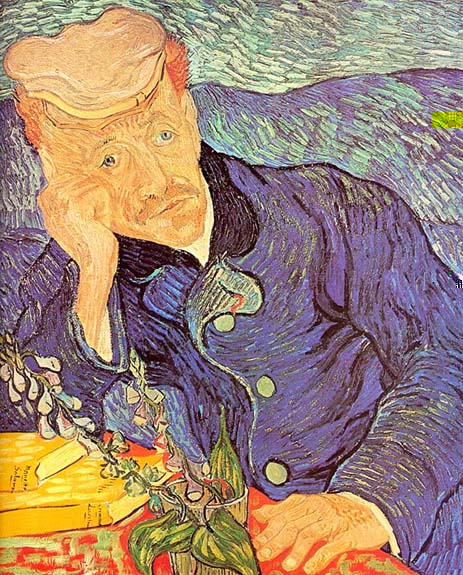
Van Gogh painted Portrait of Dr. Gachet in June 1890, shortly after arriving in Auvers-sur-Oise where Dr. Paul Gachet, a physician and amateur painter with an interest in the mentally ill, had agreed to look after him. Van Gogh made two versions of the portrait. The first, now in a private collection, is considered the finest. The second is in the Musee d'Orsay in Paris.
In 1990 the first version was sold at Christie's New York for 82.5 million dollars, then the highest price ever paid for a painting at auction. The buyer, the Japanese paper magnate Ryoei Saito, created controversy by announcing he wanted to be cremated with the painting. After Saito's death in 1996 the painting disappeared into private hands and has not been publicly exhibited since. Its location today is unknown.
The portrait shows Gachet leaning on a table with a melancholy, distracted expression, his head resting on his right hand. On the table in front of him are two yellow novels and a sprig of foxglove, a plant used medicinally for heart conditions. The foxglove connects the sitter to his medical profession while also suggesting vulnerability and care.
The background is painted in the cool blue-green Van Gogh used extensively at Auvers. Gachet's face is rendered with intense observation: the reddish hair, the blue eyes, the slightly compressed lips. The pose, leaning on the hand with a distant expression, was a conventional melancholy pose in European portraiture but Van Gogh gives it particular psychological weight.
The paint handling is looser and more rapid than his Arles work, consistent with the pace at which he was producing paintings in Auvers. The background and the coat are painted in broad, sweeping strokes while the face receives more detailed attention.
Van Gogh wrote that he wanted to paint modern man, sad but gentle yet clear and intelligent, and that the portrait expressed the heartbreak of our time. He identified with Gachet, seeing in the physician a fellow sufferer who had found a way to function despite his sensitivity and melancholy.
The portrait is also a document of a specific relationship at a specific moment. Gachet was the last person who knew Van Gogh well in the weeks before his death, and the portrait preserves something of what Van Gogh saw in the man who was trying to help him.