Loading cart…
No products in the cart.

1885 · Oil on canvas · Van Gogh Museum, Amsterdam
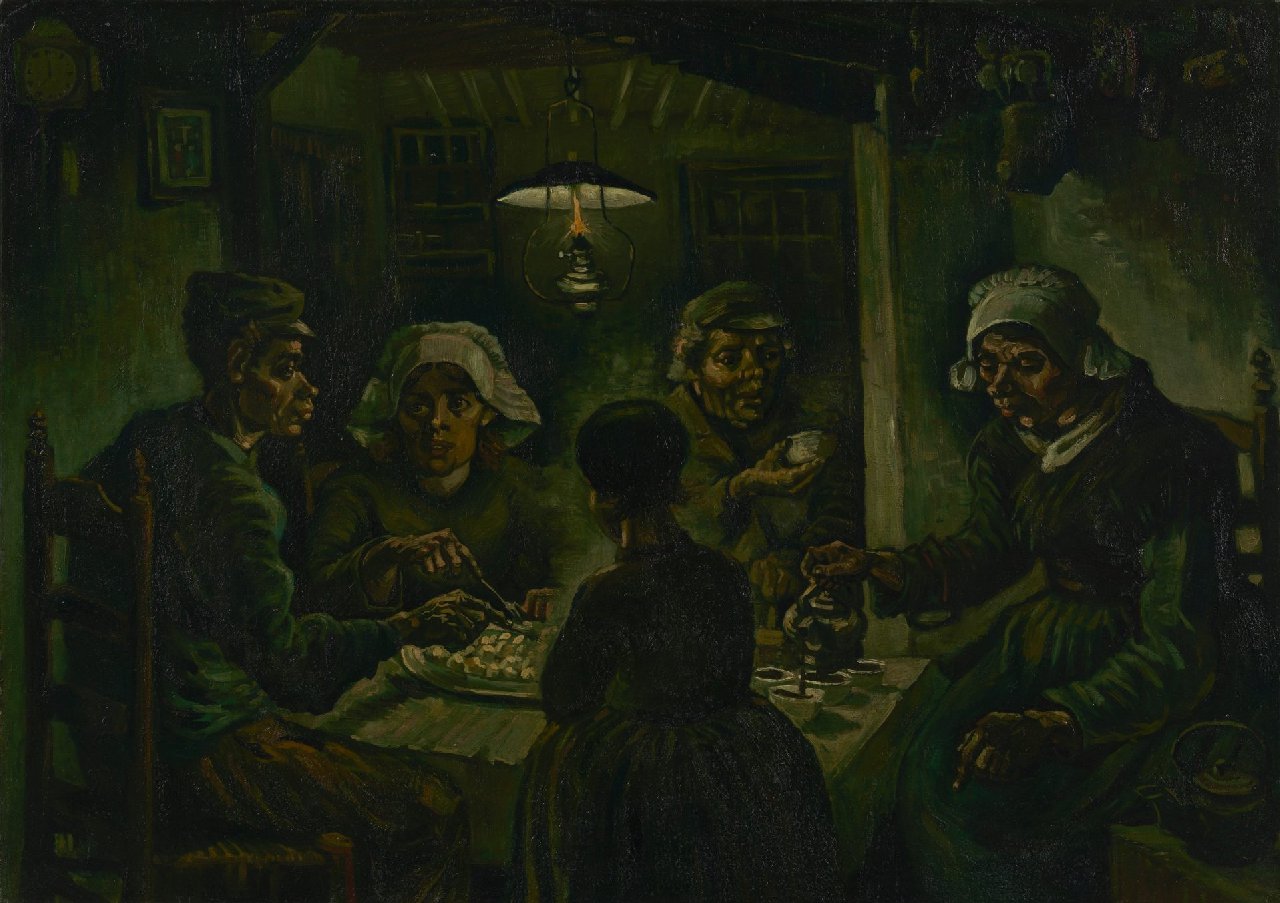
Van Gogh painted The Potato Eaters in April and May 1885 in Nuenen in the Netherlands, where he was living with his parents. It was his first major ambitious painting, the culmination of over a year of figure studies of the peasant families he observed in the region. He made numerous preparatory studies and produced several smaller versions before the final large canvas.
He was deeply proud of the painting and considered it his most important work to date. He sent it to his brother Theo in Paris, hoping it would be shown in the galleries there, but it received a poor reception from the artists and critics who saw it. Later in his life, from Paris and Arles, he came to see its dark palette as a limitation he had overcome, but he never stopped considering it a foundational work.
The painting is deliberately dark and earthy, using a palette dominated by browns, ochres, and blacks that Van Gogh associated with the hard life of agricultural labor. He wrote that he wanted the painting to smell of bacon grease and potato steam, wanting viewers to physically sense the conditions in which these people lived.
The five figures are gathered around a small table, sharing a single dish of potatoes under a hanging oil lamp. The lamp is the only light source and casts deep shadows over everything. The faces are rough and not idealized, the hands large and gnarled from field work. Van Gogh insisted on this unbeautified representation, saying he wanted to paint the peasants as they really were.
The composition is tight and enclosed, with the figures pressing forward toward the viewer in a way that makes the space feel cramped and shared. The potato dish at the center of the table is the focal point around which everything else organizes.
Van Gogh wrote that the painting was about people who had earned their food honestly with their own hands, and that he wanted viewers to understand and respect that labor. He was deeply influenced by the ideas of Jules Michelet about the dignity of working people and by Millet's depictions of peasant labor.
The Potato Eaters is the most socially engaged of his major paintings, making an explicit argument about class, dignity, and the value of labor. It belongs to a tradition of European paintings that took working people as subjects worthy of serious artistic attention, and it remains the most powerful work from Van Gogh's Dutch period.