Loading cart…
No products in the cart.

1889 · Oil on canvas · Musee d'Orsay, Paris
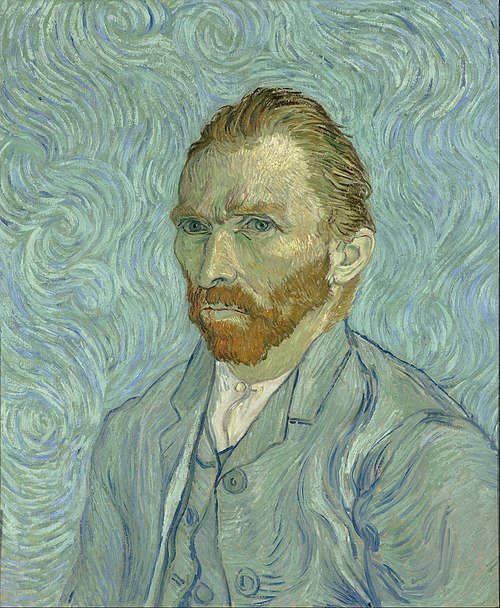
Van Gogh painted this self-portrait in September 1889 at the asylum in Saint-Remy, shortly before his departure for Auvers-sur-Oise. It is generally considered his finest self-portrait and one of the greatest self-portraits in the history of art. He sent it to his mother and sister in September 1889 along with a note saying it would give them an idea of who he had become. The painting shows him in his painter's jacket against the swirling blue-gray background that characterizes his late Saint-Remy work. His expression is direct and searching, his gaze aimed slightly past the viewer. The painting was made at a moment when he was recovering from one of his most serious episodes and preparing for what he hoped would be a more stable period in the north.
The swirling background of blue-gray that moves in the same dynamic patterns as the sky in The Starry Night creates a continuous movement that seems to flow around and through the figure. Unlike his earlier self-portraits, which show the sitter against relatively stable backgrounds, this one places the figure within a world of constant motion. His face is rendered with intense precision. The red beard, the blue eyes, the compressed lips, the slight asymmetry of his expression: all are observed and recorded without idealization. The painter's jacket is handled more loosely, the blue and orange strokes describing its fabric without the same precision as the face. The paint is applied with the urgent, directional brushwork of his late period, every stroke following the form and movement of what it describes. The background swirls around the figure as though the environment itself is in motion while the figure maintains a precarious stillness at its center.
This self-portrait was Van Gogh's gift to his mother and sister, his way of saying: this is who I am now, after everything. The direct gaze and the controlled expression suggest a man who has survived something and emerged changed but intact. The swirling background suggests that the world around him remains turbulent even as he achieves a degree of interior stillness. It is the culmination of a decade of self-scrutiny through paint. He made more than 35 self-portraits in a period of three years, using the practice to understand himself at a time when he could not always afford models. This final one, made when he knew he was leaving the asylum and uncertain about his future, has the quality of a summation.