Loading cart…
No products in the cart.

1889 · Oil on canvas · Courtauld Gallery, London
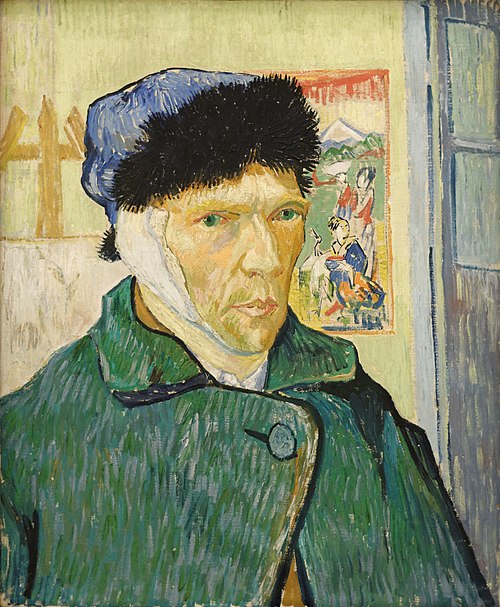
Van Gogh painted this self-portrait in January 1889, just weeks after the incident in which he cut off part of his lower left ear on 23 December 1888. The breakdown followed the departure of Paul Gauguin from Arles after a period of escalating tension between the two painters. Van Gogh was hospitalized briefly and then returned to the yellow house, where he painted two self-portraits showing his bandaged ear. The Courtauld version shows him wearing his winter coat and a fur hat, with a Japanese woodblock print visible on the wall behind him and his artist's easel to his right. It was painted while the bandage was still on, suggesting he worked on it almost immediately after his return from hospital. The painting was sent to his brother Theo in Paris.
The painting is formally composed and technically confident, which makes it striking given the circumstances of its production. Van Gogh is not depicted in distress. His gaze is level, his posture upright, his expression composed. The bandage is a visible fact rather than a dramatic focal point. The Japanese print on the wall behind him is no accident. Van Gogh collected and deeply admired Japanese woodblock prints and considered them a model for a simpler, more direct approach to painting. Including one in a self-portrait is a statement about artistic lineage and aspiration made at a moment of personal crisis. The color is built in the cool blues and blue-greens of his winter Arles palette, with the orange-red of his beard providing the central warm accent. The winter coat is painted in thick, directional strokes that give it weight and presence.
The self-portrait is one of many Van Gogh made throughout his career. He made over 35 self-portraits in a three-year period, partly because he could not afford models and partly because he was working through questions about identity, appearance, and selfhood that preoccupied him throughout his life. This particular portrait confronts the fact of his breakdown directly but without melodrama. The bandage is visible, the Japanese print is on the wall, the easel is present: he is still a painter, still working, still himself. It is one of the most resilient images in the history of art.