Loading cart…
No products in the cart.

1888 · Oil on canvas · Van Gogh Museum, Amsterdam
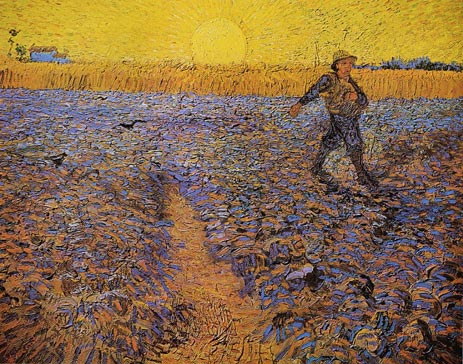
Van Gogh painted several versions of The Sower throughout his career, beginning in 1888 in Arles. The subject was drawn from Jean-Francois Millet, whose work Van Gogh revered as the most complete expression of peasant life and labor in painting. The sower as a figure of labor, fertility, and faith recurred for Van Gogh as one of his most charged symbols.
The Arles version, with its dominant sun, was painted in November 1888. Van Gogh was working on the theme simultaneously with the Sunflowers and the first bedroom paintings, in a period of intense productivity before Gauguin's arrival.
The composition is dominated by the setting sun, which occupies the right third of the canvas at a scale that is intentionally unrealistic. The sky around it is painted in vivid yellows and oranges that seem almost to vibrate. The sower moves across the foreground toward the left, a small dark figure against the radiant light behind him.
The color contrast between the warm right side of the canvas, dominated by the sun, and the cooler left side, where the sower works in shadow, creates a strong diagonal division that organizes the composition. The path leads from the foreground toward the light in a way that gives the composition a sense of directional movement.
For Van Gogh, the sower was a figure of hope and faith, someone who acts without certainty of outcome, casting seed into the earth and trusting the process of growth. He associated the subject with his own work as a painter and with his earlier vocation as a lay preacher. The large sun behind the figure is both a naturalistic element and a symbol of the divine or the transcendent.
The painting represents Van Gogh's most direct fusion of religious feeling with everyday subject matter, his attempt to find the sacred in the ordinary that had driven him since his earliest days as a preacher in the Belgian mining regions.