Loading cart…
No products in the cart.

1890 · Oil on canvas · Van Gogh Museum, Amsterdam
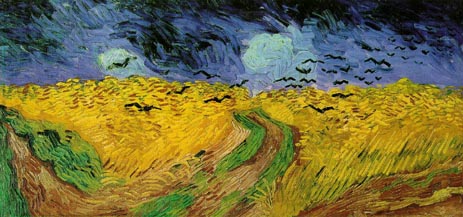
Van Gogh painted Wheat Field with Crows in July 1890 during his final weeks in Auvers-sur-Oise, where he had moved in May 1890 under the care of Dr. Paul Gachet. He produced an extraordinary quantity of work during his two months in Auvers, averaging more than one painting per day. Wheat Field with Crows was long considered his final painting, though recent scholarship has cast doubt on this, suggesting it may have been completed slightly before his last canvas. Van Gogh wrote to his mother and sister about the wheat fields he was painting in Auvers, describing them as vast expanses under troubled skies that he wanted to express as sad and extreme in their loneliness. The painting has an unusually wide, almost panoramic format that gives the sky and field an expansive quality unlike his earlier works.
The composition is divided horizontally between the agitated wheat field in the lower portion and the dramatic sky above. Three paths lead into the field from the foreground but none reaches a destination, all ending abruptly in the wheat. The crows rise from the field into the sky, creating a visual transition between the two zones that also functions as a disturbing interruption of the landscape\'s order. The brushwork throughout is intense and varied. The wheat is painted in short, curved strokes that create a sense of movement in the wind. The sky is built in thick horizontal bands of blue, blue-black, and white that suggest both storm clouds and physical pressure. The paths are painted in warm ochre and orange against the cool blue-green of the surrounding wheat. The crows are almost silhouettes, painted with quick, decisive marks in black and dark blue. Their irregular, scattered formation across the upper portion of the canvas creates a sense of alarm that the landscape alone does not contain.
The three paths that lead nowhere and the crows rising from the field have been read since Van Gogh\'s death as expressions of hopelessness, as a final statement about isolation and the impossibility of finding a way forward. This reading gains force from the biographical context: he died by a gunshot wound on 27 July 1890, days or weeks after completing this painting. However, Van Gogh also wrote about Auvers with enthusiasm and hope in his final weeks, describing the countryside as extraordinarily beautiful and his work as going better than he had hoped. The painting may express turbulence without despair, a storm over a landscape that is also vital and abundant. The interpretation depends on which letters and which paintings one emphasizes.