Loading cart…
No products in the cart.

1887 · Oil on canvas · Van Gogh Museum, Amsterdam, Netherlands
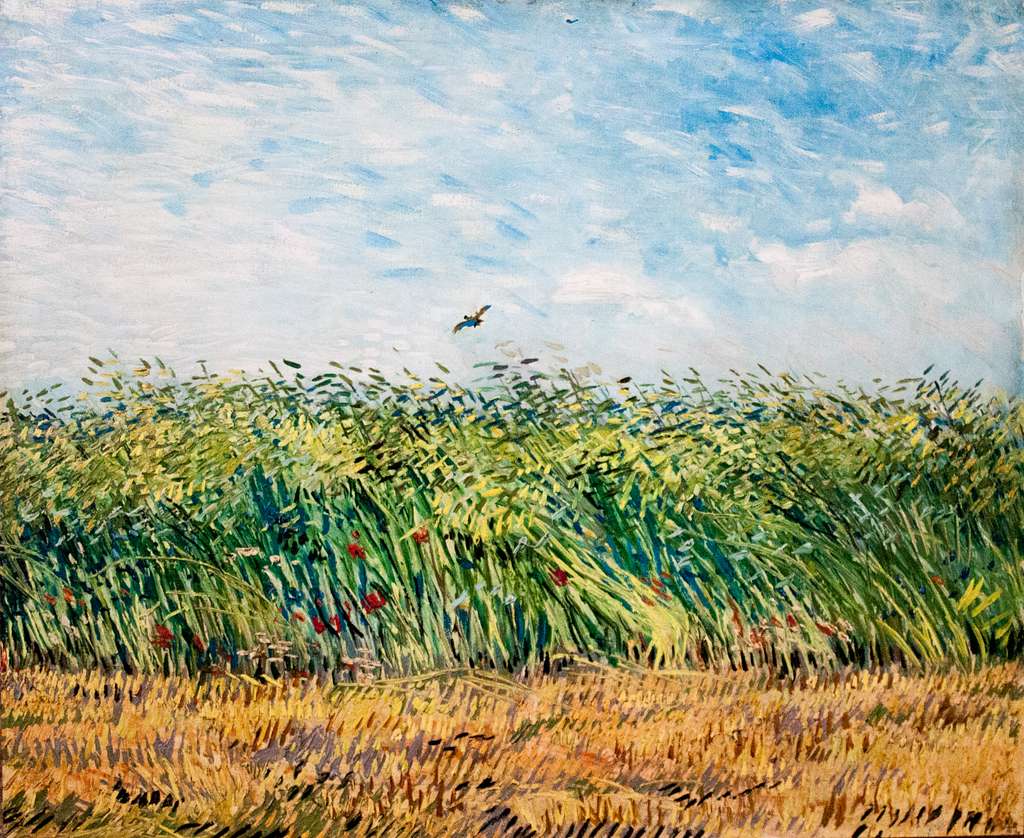
Vincent van Gogh created this painting during his two-year stay in Paris, a period that ran from 1886 to 1888 and proved transformative for his entire artistic development. Living with his brother Theo in Montmartre, van Gogh immersed himself in the Parisian art world and came into direct contact with the work of the Impressionists and Post-Impressionists. This exposure fundamentally altered his approach to color, moving him away from the dark, earthy tones he had favored in the Netherlands toward a far more luminous and expressive palette. Wheatfield with Partridges stands as a clear product of this transition, showing how van Gogh was actively synthesizing lessons learned from artists such as Camille Pissarro and Georges Seurat while still maintaining his own distinct visual language rooted in emotional directness and energetic brushwork. The painting remained within the collection now housed at the Van Gogh Museum in Amsterdam, where it is preserved alongside hundreds of other works from across the artist's career. During the Paris years, van Gogh produced an extraordinary volume of canvases as he worked through new ideas about light, color relationships, and compositional structure. Wheatfield with Partridges fits within a broader group of nature studies he executed during this time, many of which drew on the parks and outskirts of the city as subjects. The inclusion of the partridges as living elements within the wheat field gives the composition an animated, almost pastoral quality that connects to older Dutch and Flemish traditions of landscape painting while simultaneously pushing forward into new territory defined by bold color contrasts and visible, expressive paint application.
The composition of Wheatfield with Partridges is structured around a broad horizontal expanse of golden wheat that fills the majority of the picture plane, anchoring the viewer firmly within the field rather than offering a distant, panoramic perspective. Van Gogh divides the canvas loosely between the warm yellows and greens of the wheat below and the cooler, more varied blues and whites of the sky above. This division creates a sense of visual tension between earth and atmosphere that animates the entire surface. The partridges are positioned with a naturalistic scatter across the lower portion of the composition, their muted brown and gray tones providing counterpoints to the surrounding warmth of the grain. The brushwork throughout is energetic and directional, with the wheat rendered in sweeping strokes that suggest movement in a light breeze, a technique that van Gogh would continue to refine in later works. The color relationships in this painting demonstrate van Gogh's engagement with the theoretical ideas circulating in the Parisian art world during the late 1880s. He applies complementary color contrasts with increasing confidence, allowing warm oranges and yellows to vibrate against cooler blue-green tones in a way that generates visual energy without sacrificing coherence. The sky is not a flat uniform blue but a nuanced field of broken color suggesting diffuse light rather than direct sunshine, which softens the overall mood of the scene. The paint surface itself carries a considerable physical presence, with areas of impasto built up to give texture and weight to the wheat stalks and earth. This material quality distinguishes the work from purely decorative landscape painting and aligns it with van Gogh's broader ambition to render felt experience rather than mere visual appearance.
Wheatfield with Partridges reflects van Gogh's deep and enduring connection to the natural world, a connection that he regarded as both a source of personal solace and a subject of genuine spiritual significance. Throughout his letters to Theo, van Gogh repeatedly described nature as something to be encountered with humility and attentiveness, and his landscape paintings from the Paris period show him working out what that attentiveness might look like in paint. The wheat field as a motif carried particular resonance for him, evoking the agricultural landscapes of his Dutch upbringing and the cycles of sowing, growth, and harvest that he associated with both human labor and the passage of time. The presence of the partridges within the field adds a layer of quiet vitality to the scene, suggesting that the natural world is not merely a backdrop but an active, inhabited space full of independent life. The painting also signals a moment of genuine artistic searching in van Gogh's career, a period when he was consciously working to expand his technical and expressive range by absorbing new influences without losing his own voice. The move toward brighter color that this work embodies was not simply a stylistic adjustment but a philosophical one, reflecting van Gogh's belief that color could carry emotional and even moral weight. By rendering an ordinary wheat field with such chromatic intensity and painterly investment, he elevated an everyday agricultural subject into something that rewards sustained looking. This approach, finding significance in the familiar and overlooked, remained central to his artistic vision throughout his career and gives works like Wheatfield with Partridges their lasting capacity to engage viewers on both a visual and an emotional level.