Loading cart…
No products in the cart.

1888 · Oil on canvas · Van Gogh Museum, Amsterdam
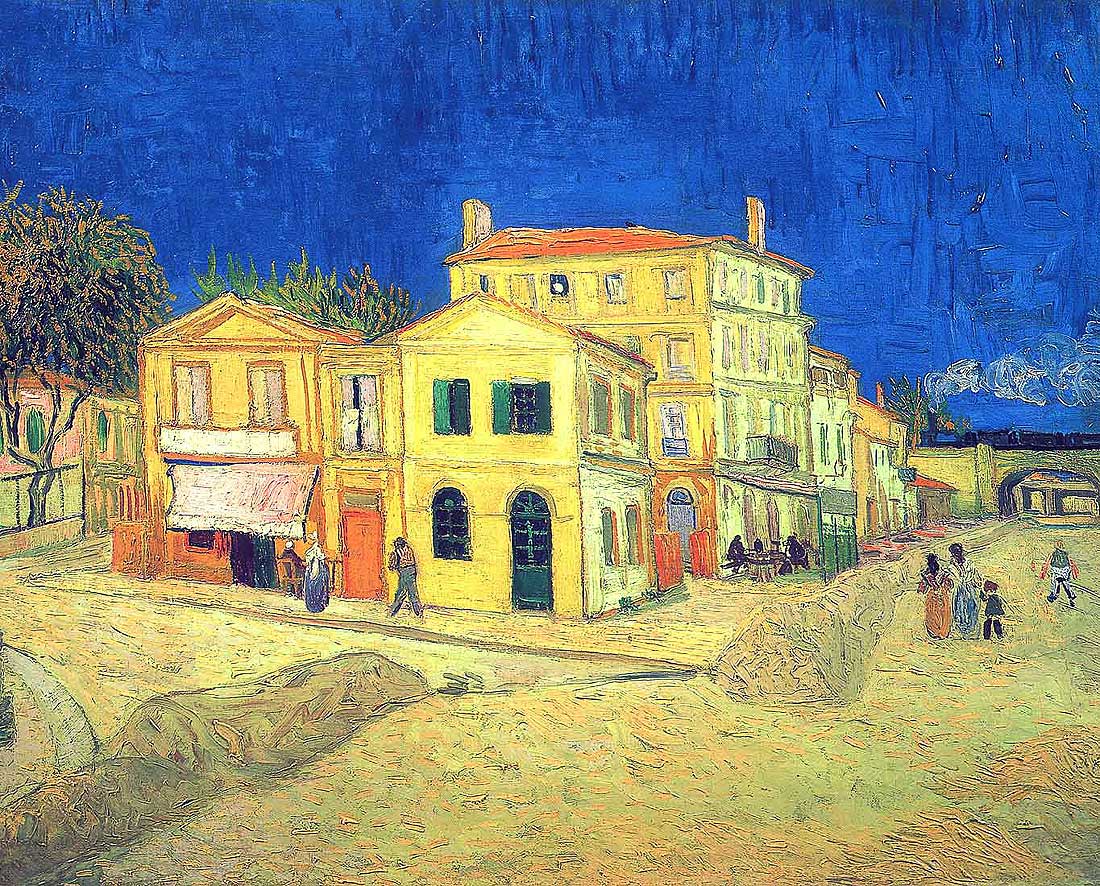
Van Gogh painted The Yellow House in September 1888, showing the building on Place Lamartine in Arles where he rented the right wing as his studio and home. He had moved into the yellow house in May 1888 and was deeply attached to it, decorating it with his own paintings and preparing it for the arrival of Paul Gauguin, whom he hoped would be the first member of an artists colony he called the Studio of the South.
The house was bombed by Allied forces in 1944 and no longer exists. The painting is one of the primary documentary records of a building that had extraordinary significance in Van Gogh's life and in the history of art.
The composition shows a street corner with the yellow house occupying the right portion and a railway bridge visible in the upper left. The painting is done in full daylight with a bright blue sky and strong shadows. The yellow of the house is painted in thick, confident strokes that make the building radiate warmth against the cooler blues of the sky and shadow.
The street scene includes several figures and a restaurant across the road, all rendered loosely and integrated into the sunny scene. The composition has the matter-of-fact quality of a painting made with direct purpose: to document a specific place that mattered to the painter.
The Yellow House represents Van Gogh's brief moment of domestic stability and artistic ambition in Arles. He was deeply proud of the house and of his plan to establish a community of painters there. The painting celebrates the house as a home and a studio, a place where serious art could be made in community with other artists.
The plan failed. Gauguin left after two months, the crisis of the ear incident ended Van Gogh's time in Arles, and he never returned to the yellow house. The painting preserves the moment of hope before the collapse.