Loading cart…
No products in the cart.

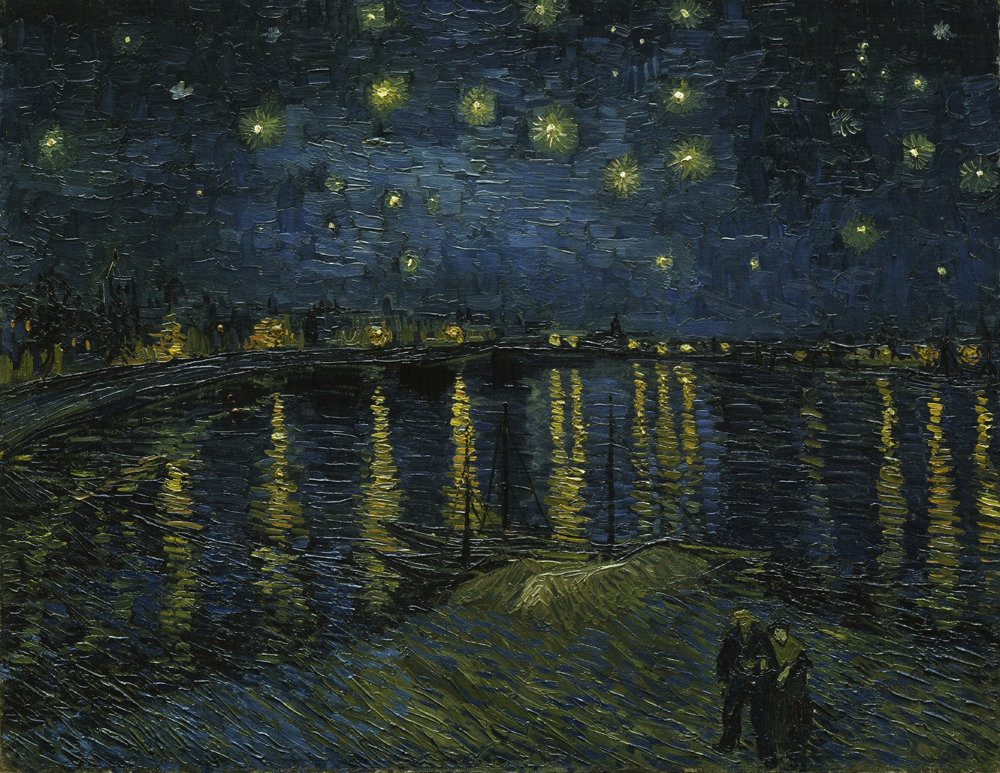
1888 · Oil on canvas · Musee d Orsay, Paris, France
Save articles to your collection
Log in or create a free account, and this article will be waiting in your Private Collection.
Log in or sign upVincent van Gogh arrived in Arles in the south of France in February 1888, seeking stronger light and a new visual environment after years in Paris. The town of Arles had recently installed gas street lighting along the quays of the Rhone River, and van Gogh was captivated by the way this warm artificial light reflected against the moving surface of the water at night. He described the scene in a detailed letter to his brother Theo, explaining that he went out at night with his canvas and worked directly from the motif, painting the sky, the gas lamps, and their reflections by the actual light they provided. This was a technically demanding feat, working in near darkness with only the light of the scene itself as his guide. He wrote that he found night more alive and richly colored than day, a conviction that drove several major nocturnal paintings during his time in Arles. The work was sent to Theo in Paris along with other canvases from this extraordinarily productive period. It entered the collection of the Musee d Orsay through a series of bequests and is now considered one of the finest examples of van Gogh nocturnal work. It predates the more famous Starry Night, painted the following year in Saint-Remy, by approximately ten months.
The composition is divided horizontally into three distinct zones: the upper sky filled with stars whose light radiates outward in concentric halos, the middle band of dark buildings and gas lamps along the quay, and the lower portion of the river whose surface is broken into short, energetic strokes of reflected color. Van Gogh used complementary color contrasts throughout the work, setting the deep cobalt and Prussian blue of the sky and water against the warm cadmium yellows and oranges of the gaslight reflections. The brushwork varies in character across the surface, with smooth, horizontal strokes describing the flat water and short, curved strokes animating the sky around each star. Two small figures walk along the embankment in the right foreground, their scale emphasizing the vastness of the sky and the intimacy of the light on the water. The absence of clouds and the clarity of the stars communicate the dry, warm air of the southern French night. The overall effect is one of harmony between the human-made and the natural, with gaslight and starlight treated as equally valid sources of wonder.
Van Gogh regarded color not merely as a descriptive tool but as a vehicle for emotional and spiritual content. The night sky filled with radiating light sources represented for him a kind of access to the infinite, a feeling he described in letters as analogous to the consolation he had once sought in religion. The two figures on the embankment, often interpreted as a couple, introduce a note of human connection into the vast impersonal scale of the night. The painting reflects the broader Post-Impressionist project of using direct observation as a starting point for an art that went beyond surface appearances to reach something more essential. In the decades since van Gogh death, works like Starry Night Over the Rhone have become emblematic of the idea that artistic vision involves not just accurate perception but the transformation of visual experience into emotional truth. The painting draws visitors to the Musee d Orsay in enormous numbers and continues to inspire reproductions, references, and adaptations across popular culture worldwide.
Enjoyed this story?
Save articles to your collection
Log in or create a free account, and this article will be waiting in your Private Collection.
Log in or sign up