Loading cart…
No products in the cart.

1670 · Oil on canvas · National Gallery of Ireland, Dublin, Ireland
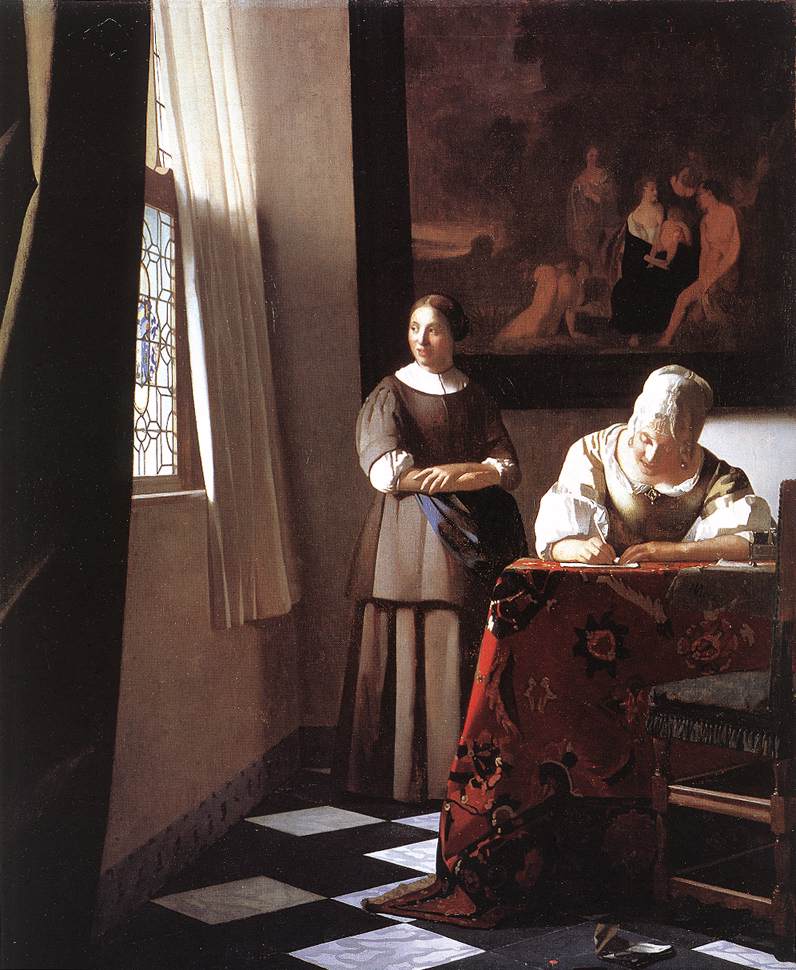
Lady Writing a Letter with Her Maid dates to around 1670 and is one of the largest and most formally ambitious interior paintings Vermeer produced. It entered the collection of the National Gallery of Ireland in Dublin, where it has been since 1974, following a dramatic theft and recovery that drew international attention. The painting was stolen by art thieves in 1974 and again in 1986, the second time along with several other works from Russborough House in County Wicklow, the private collection of Sir Alfred Beit. Both thefts led to significant conservation challenges, and the second recovery, in 1993, found the painting rolled up and damaged. Careful restoration at the National Gallery of Ireland stabilized the work and repaired areas of paint loss, and the painting is now displayed in controlled environmental conditions that protect its long-term stability.
The provenance of the painting before its arrival in the Beit collection can be traced through several European sales and private collections during the nineteenth and early twentieth centuries. Technical analysis conducted during and after restoration has provided detailed information about Vermeer layered painting technique, his underdrawing practices, and the specific pigments he used, including natural ultramarine, lead white, yellow ochre, and vermilion. The large scale of the canvas relative to most Vermeer works has led some scholars to suggest it may have been intended for a specific interior setting where its size would have been appropriate, though documentary evidence for such a commission does not survive. The painting is now considered one of the most significant works in the National Gallery of Ireland collection.
The composition of Lady Writing a Letter with Her Maid is organized around a strong vertical division between the two figures. The seated woman at the left, bent over her writing table, is fully absorbed in her task, her face directed downward and her right hand moving across the paper. The maid standing at the right is entirely contrasted with her mistress in posture and attention: she stands upright, her arms folded, and her gaze directed outward toward the window above and to the left, where the primary light source lies. This pairing of absorbed and distracted attention is a compositional strategy that creates visual and psychological tension without requiring any dramatic action or facial expression. The viewer is drawn to compare the two figures and to speculate about their inner states.
The space of the room is rendered with Vermeer characteristic economy. A large tapestry or curtain occupies the lower left corner, a device Vermeer uses in several paintings to establish depth and to introduce rich textural contrast in the foreground. The writing table is covered with a crumpled letter and scattered papers, suggesting that the correspondence in progress is part of an ongoing exchange rather than a single isolated act. The black and white tiled floor recedes toward the back of the room, establishing spatial depth through geometric perspective. Light enters from the left and illuminates the mistress white collar and the maid apron with equal care, refusing to privilege either figure in terms of painterly attention even as their social positions are clearly differentiated by their poses and their relationship to the activity at the center of the scene.
Lady Writing a Letter with Her Maid addresses the theme of written communication with greater social complexity than any of Vermeer other letter paintings because it simultaneously presents the act of writing and the experience of waiting in the same frame. The mistress is actively engaged in constructing a message that will travel beyond the room and connect her with an absent recipient, while the maid is suspended in the enforced patience of her service role, waiting for her mistress to complete the task so that she can presumably carry the letter to its destination. This juxtaposition of active and passive participation in the same social ritual creates a quietly powerful image of the different ways that people inhabit shared time and shared space.
The scattered letter on the floor near the writing table has been interpreted by scholars as a reference to a previous communication in the exchange, possibly a letter that provoked an emotional response and prompted the reply currently being written. If this reading is correct, the painting presents not a single moment but the middle of a narrative, with earlier events implied by the discarded paper and future events implied by the unfinished letter. This temporal layering is characteristic of Vermeer approach to narrative, which consistently prefers implication over explicit storytelling. The maid gaze toward the window introduces yet another temporal dimension, as her attention seems directed toward something beyond the room, perhaps toward the world through which letters travel and the world to which her mistress words are addressed.