Loading cart…
No products in the cart.

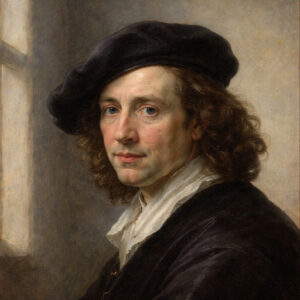
Johannes Vermeer was born on October 31, 1632, in the city of Delft in the Dutch Republic, a prosperous and culturally vibrant trading center that would remain his home for the entirety of his life. His father, Reynier Janszoon, worked…
Johannes Vermeer was born on October 31, 1632, in the city of Delft in the Dutch Republic, a prosperous and culturally vibrant trading center that would remain his home for the entirety of his life. His father, Reynier Janszoon, worked as a weaver of fine caffa fabric and also operated an inn, and he later registered as an art dealer, a profession that would shape the young Johannes in ways both practical and creative. Growing up in a household connected to the trade of paintings, Vermeer had early exposure to the buying and selling of art that was flourishing across the Dutch Republic during one of the most productive periods in European cultural history. The details of his formal artistic training remain unclear to scholars, though it is widely believed that he may have apprenticed under a more established painter in Delft or a nearby city such as Amsterdam or Utrecht. By 1653, Vermeer had married Catharina Bolnes, a woman from a Catholic family, and he converted to Catholicism at or around the time of the marriage. That same year he was registered as a master painter in the Delft Guild of Saint Luke, marking his official entry into the professional world of art. He and Catharina went on to have fifteen children together, a large family that placed considerable financial strain on the household throughout his career.
Vermeer devoted himself to painting with a depth of focus that resulted in a relatively small body of work, with scholars attributing approximately thirty-six paintings to him with confidence. He worked slowly and deliberately, and it is believed he produced no more than two or three paintings per year. For much of his life, he supplemented his income by working as an art dealer, a vocation he inherited from his father. He was twice elected headman of the Delft Guild of Saint Luke, a mark of the respect his peers held for him locally, even though he never achieved the wide fame during his lifetime that later generations would come to associate with his name. His financial situation deteriorated sharply during the Franco-Dutch War of the early 1670s, when the Dutch economy suffered greatly, and the market for luxury goods including paintings collapsed. Vermeer died in December 1675 at the age of forty-three, leaving his wife and children in significant debt. It was not until the nineteenth century, largely through the efforts of French art critic Theophile Thore-Burger, that Vermeer was rediscovered and his paintings began to receive the sustained scholarly and public attention they have commanded ever since. Today his work is held in the collections of museums around the world, and his quiet domestic interiors continue to resonate with viewers who find in them a rare sense of stillness and light.
The style of Vermeer is defined above all by his extraordinary command of light, particularly the cool, diffuse northern light that enters his painted interiors through windows situated on the left side of the composition. This lighting technique gives his figures and objects a luminous, almost tangible quality that has fascinated painters, scientists, and art historians for centuries. Vermeer applied paint in thin, carefully layered glazes that allowed light to interact with the surface of the canvas in a way that mimics how the human eye perceives reflected and absorbed light in a real interior space. He paid meticulous attention to the rendering of textures, from the rough weave of a wool carpet draped over a table to the soft sheen of a silk garment or the cool ceramic surface of a jug. His palette was restrained and deliberate, built around a foundation of lead white, natural ultramarine derived from lapis lazuli, and warm earth tones, with accents of yellow ochre and vermilion used sparingly to draw the eye. The result is a color harmony that feels both precise and deeply atmospheric, never harsh and never muddy.
Beyond his technical handling of paint and light, the visual language of Vermeer is characterized by a profound sense of psychological stillness. His figures, most often women engaged in quiet domestic tasks such as reading a letter, pouring milk, or playing a musical instrument, exist in a state of absorbed concentration that invites the viewer to observe without intruding. The compositions are carefully arranged, with objects distributed across the picture plane in ways that create a sense of balance and spatial depth without feeling rigid or artificial. Scholars have long debated whether Vermeer used a camera obscura, an optical device that projects an image of the outside world onto a flat surface, as an aid in achieving the precise rendering of perspective and the subtle blurring of out-of-focus elements that appear in several of his paintings. Whether or not he relied on such a tool, the spatial intelligence evident in his work speaks to a painter of exceptional observational skill and compositional patience. His influence on subsequent generations of artists has been considerable, and collectors today who wish to experience that influence firsthand can bring it into their own homes through a hand-painted oil reproduction of his most celebrated works.
Each card links to its own article with full analysis and reproduction details.
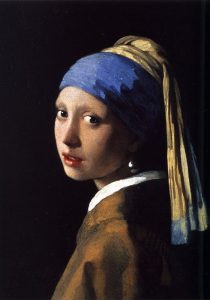 #1
#1
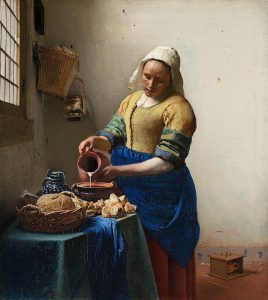 #3
#3
 #4
#4
 #5
#5
 #6
#6
 #7
#7
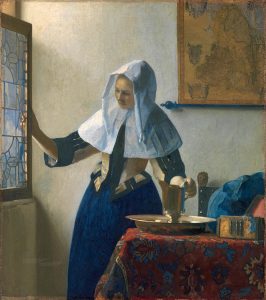 #8
#8
 #9
#9
 #10
#10
A print can reproduce colors. What it cannot reproduce is texture, depth, and the physical presence of oil paint on canvas. Johannes Vermeer technique depends on these.
At ByMuseum, every reproduction is painted by hand using oil on canvas. There is no inkjet, no digital print. The brushwork is real. The result looks like a painting because it is one.