Loading cart…
No products in the cart.

1668 · Oil on canvas · Musee du Louvre, Paris, France
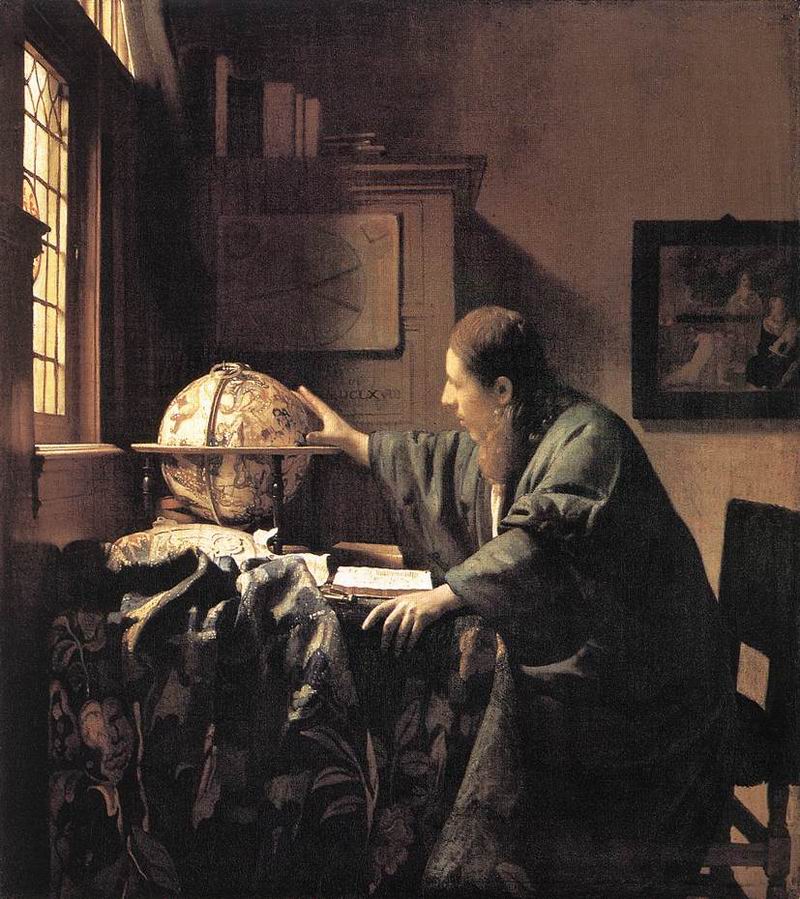
The Astronomer is one of only two paintings by Vermeer that carry a date, making it an unusually secure point of reference within the chronology of his relatively small body of work. The date 1668 appears on the painting itself, and dendrochronological analysis of the oak panel has confirmed a date consistent with this inscription. The companion piece, The Geographer, is dated 1669, and the two works are closely related in format, setting, and subject matter, suggesting that Vermeer conceived them as a pair representing complementary fields of scholarly inquiry, one directed toward the heavens and the other toward the surface of the earth. The identity of the scholar depicted has been the subject of considerable discussion, with some researchers proposing that the figure may be based on Antoni van Leeuwenhoek, the celebrated Delft microscopist and contemporary of Vermeer. While no definitive proof supports this identification, Leeuwenhoek and Vermeer are known to have been born in the same city and year and to have moved in overlapping social circles. The painting passed through several notable collections before entering the Louvre, including a period in the collection of the Rothschild family. It was seized during the Second World War and later recovered and returned to its rightful owners before eventually being acquired by the French national collections.
Vermeer organized the composition around the figure of a man seated at a table covered with a richly patterned cloth, leaning forward to touch or turn a large celestial globe that sits at the right edge of the picture space. The globe is identifiable as the model designed by Jodocus Hondius and published in Amsterdam in 1600, a well-known instrument that would have been familiar to educated Dutch viewers of the seventeenth century. Light enters through a window on the left side of the composition, falling across the scholar and illuminating the globe, the papers on the table, and the folds of the man clothing with the characteristic softness and precision that defines Vermeer approach to interior light. A cupboard or cabinet stands against the back wall, and a painting or chart hangs above it, adding to the sense of an environment dedicated to serious intellectual work. The figure composition places the scholar in a moment of active engagement rather than passive contemplation. His outstretched arm and the slight forward tilt of his body convey concentration and purpose, as though he is in the process of verifying a calculation or tracing a path across the surface of the globe. This sense of active inquiry distinguishes the work from more static scholar portraits and aligns it with the broader Dutch Golden Age interest in depicting practical knowledge and empirical investigation.
The subject of astronomical study carried rich symbolic and philosophical associations in seventeenth century Dutch culture. The celestial globe represented not only the scientific study of the stars but also the aspiration of the human intellect to comprehend and map the divine order of creation. Dutch cartographers and instrument makers of the period were among the most technically accomplished in Europe, and their products circulated internationally as objects of both practical utility and cultural prestige. By depicting a scholar engaged with such an instrument, Vermeer participated in a broader cultural project of representing Dutch intellectual achievement and its connections to maritime commerce, navigational science, and global trade. The painting on the wall behind the scholar has been identified as a depiction of Moses being found in the bulrushes, a biblical subject that introduces a dimension of religious meaning into an otherwise secular scene. Some scholars have interpreted this juxtaposition as a reminder that all human knowledge operates within a framework of divine providence, and that the astronomer study of the heavens is ultimately a form of contemplation of the works of the Creator. Others have read the pairing more simply as a conventional decorative element of the kind that frequently appears in Dutch interior paintings without carrying a specific programmatic meaning. The painting as a whole rewards both scientific and spiritual readings and demonstrates the layered complexity that characterizes Vermeer finest interior scenes.