Loading cart…
No products in the cart.

1663 · Oil on canvas · Rijksmuseum, Amsterdam, Netherlands

Save articles to your collection
Log in or create a free account, and this article will be waiting in your Private Collection.
Log in or sign upWoman Reading a Letter was painted around 1663 and has remained one of the most carefully studied works from Vermeer productive middle period. The painting entered the collection of the Rijksmuseum and has been part of that institution holdings for well over a century, where it continues to attract scholarly attention and public admiration. Its provenance traces through several prominent Dutch collections before reaching its current home, and archival research has helped establish a reasonable chronology for its creation relative to other interior scenes Vermeer produced during the same years. The work demonstrates how Vermeer refined his approach to depicting solitary figures in domestic interiors, narrowing his compositional focus and increasing his mastery of diffused northern light filtering through unseen windows to the left of the frame. Scholars have debated the identity of the letter sender, with many suggesting the correspondence may be from a husband or lover at sea, a common circumstance in the seafaring Dutch Republic of the seventeenth century.
The painting survived intact through centuries of ownership changes and has undergone technical examination using X-ray and infrared reflectography, revealing that Vermeer made compositional adjustments during the painting process. Earlier versions of the composition apparently included a map on the wall and additional objects on the table, elements that Vermeer ultimately simplified to concentrate attention on the solitary figure. This kind of deliberate editing reveals a thoughtful artistic process rather than spontaneous execution. Conservation records at the Rijksmuseum document the stable condition of the panel and the exceptional preservation of the paint layers, which has allowed researchers to study Vermeer technique with unusual clarity. The painting is regularly cited in scholarly literature on seventeenth century Dutch genre painting as a defining example of the period intimate interior tradition.
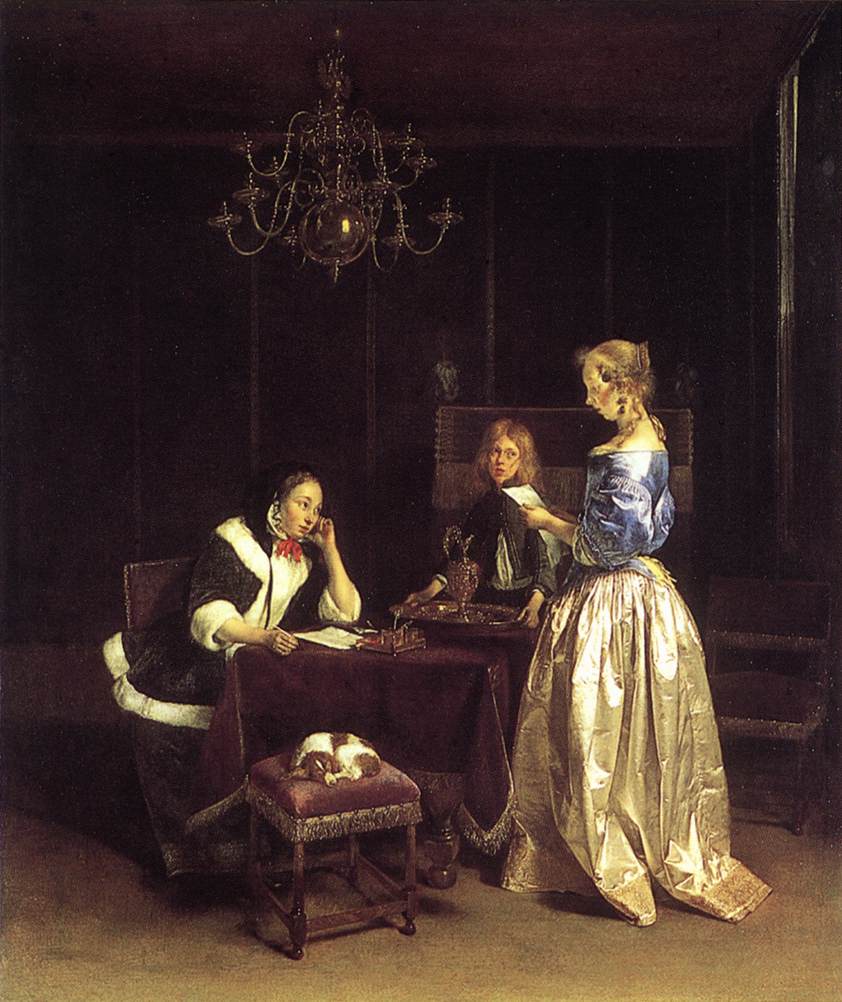
The composition of Woman Reading a Letter is built around a carefully balanced arrangement of verticals and horizontals. The standing woman occupies the center of the picture plane, her blue morning jacket catching the cool diffused light that enters from the left. Vermeer positions the figure so that her face is turned fully toward the letter, denying the viewer direct eye contact and reinforcing the sense of private absorption. The table in the foreground, draped with a richly textured cloth, creates a horizontal anchoring element that grounds the composition and establishes a sense of spatial depth without relying on dramatic perspective lines. Chairs arranged in the foreground add further recession into the pictorial space. The overall geometry is simple but highly intentional, and every object is placed with an awareness of how it will guide the viewer gaze through the scene.
Vermeer handling of light in this work is particularly sophisticated. The illumination falls evenly across the woman figure, modeling her form with soft gradations rather than sharp contrasts. The blue of her jacket is one of the most admired passages in the painting, achieved through the use of natural ultramarine ground from lapis lazuli, a pigment Vermeer favored and used generously throughout his career. Technical analysis has confirmed the layered buildup of this blue, which gives it an unusual depth and luminosity. The white plaster wall behind the figure reflects ambient light and creates a neutral backdrop that intensifies the colors of the clothing and objects in the foreground. Vermeer treatment of the woman rounded form against the flat wall demonstrates his ability to suggest volume through subtle tonal transitions rather than emphatic brushwork.
The central theme of Woman Reading a Letter is the experience of private emotional life in a domestic setting. Letters in seventeenth century Dutch society carried significant emotional weight because they represented the primary means of communication between separated individuals, whether merchants at sea, soldiers on campaign, or family members in distant cities. Vermeer does not reveal the content of the letter, and this deliberate withholding transforms the viewer into a respectful witness rather than an intruder. The woman body language conveys total absorption, and there is a stillness to the image that suggests a moment suspended outside of ordinary time. Her slightly parted lips and intent gaze suggest she is reading carefully, perhaps for the second or third time, extracting every possible meaning from the written words.
The painting also engages with broader themes of absence and connection. The letter is a material trace of someone who is not present in the room, and the woman response to that trace makes the absent person emotionally real within the scene. Art historians have linked this theme to the widespread Dutch experience of maritime trade and travel, which regularly separated families for extended periods. The blue color of the woman jacket has sometimes been interpreted as a visual echo of the sea, though this reading remains speculative. What is clear is that Vermeer has created an image in which everyday domestic life carries profound emotional resonance. The restraint of the composition, with no theatrical gestures or dramatic accessories, places the weight of meaning entirely on the act of reading itself and on the interior life it implies.
Enjoyed this story?
Save articles to your collection
Log in or create a free account, and this article will be waiting in your Private Collection.
Log in or sign up