Loading cart…
No products in the cart.

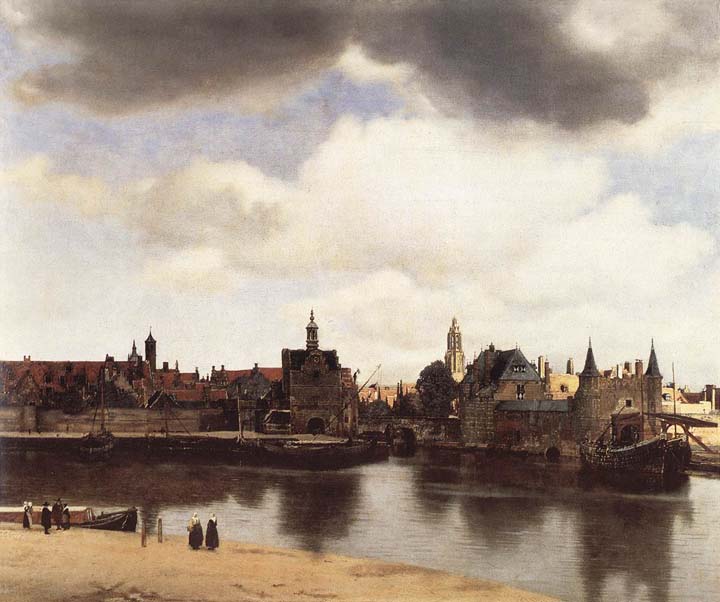
1660 · Oil on canvas · Mauritshuis, The Hague, Netherlands
Save articles to your collection
Log in or create a free account, and this article will be waiting in your Private Collection.
Log in or sign upView of Delft is one of only two known outdoor paintings by Vermeer, and it stands apart from the vast majority of his output as a large-scale topographical view rather than an intimate interior scene. The painting is dated to around 1660 based on stylistic analysis and the appearance of certain buildings that can be cross-referenced with archival records of Delft urban development. The Rotterdam Gate and the Schiedam Gate are both visible in the image, and their inclusion, along with the towers of the Nieuwe Kerk and the Oude Kerk, has allowed historians to identify the precise viewpoint Vermeer used, which was from across the Schie canal to the south of the city. The painting appeared in the Dissius sale of 1696, where it fetched a notably high price, suggesting that even Vermeer contemporaries recognized it as an exceptional work.
The painting was acquired by King William I of the Netherlands in 1822 for the Mauritshuis in The Hague, where it has remained ever since. The novelist Marcel Proust famously described a small patch of yellow wall in this painting as the most beautiful thing in the world, and his description in the novel In Search of Lost Time contributed to the painting international reputation during the twentieth century. Technical research has shown that Vermeer likely used a camera obscura to establish the precise proportions and spatial relationships in the composition, though the final painting demonstrates considerable interpretive freedom in the handling of light, color, and atmospheric conditions. The scale of the work is unusual for Vermeer and suggests it may have been a special commission or a deliberate demonstration of technical range.
The composition of View of Delft divides the picture plane into three horizontal bands: the foreground strip of quayside with figures, the band of water and city architecture in the middle ground, and the vast cloudy sky that occupies more than half the canvas. This arrangement creates a sense of expansive space and atmospheric depth that differs fundamentally from the compressed interiors of Vermeer other works. The reflections of the buildings and sky in the canal water are rendered with careful attention to the distorting and rippling effects of the water surface, and the transition between reflected and real forms is handled with unusual subtlety. The figures on the quay are small and loosely painted compared to the architectural elements, functioning as scale indicators rather than narrative subjects.
The most celebrated passage in the painting is the sunlit patch of the Schiedam Gate tower and the adjacent rooftops, which burst into warm golden light against the darker shadowed portions of the cityscape. This contrast between illuminated and shadowed areas creates a dynamic rhythm across the middle ground and gives the painting its distinctive sense of atmospheric vitality. The sky is painted with broad, confident strokes that suggest the movement of clouds and the shifting quality of northern European light. Vermeer use of lead white in the sky areas, layered with subtle glazes of gray and blue, creates a luminosity that reads as genuinely atmospheric rather than purely decorative. The painting rewards close examination of its surface, where thick impasto passages in the lit areas contrast with thinner, more translucent handling in the shadows.
View of Delft carries multiple layers of meaning rooted in both personal and civic identity. Delft was Vermeer hometown and the place where he spent virtually his entire career, and this large topographical view can be read as an act of civic pride and local affiliation. The Dutch Republic in the mid-seventeenth century had a strong tradition of city views as expressions of urban identity and commercial vitality, and Vermeer contribution to this tradition is distinguished by its atmospheric ambition rather than purely documentary intent. The city is shown under variable cloud cover, with sections emerging into brilliant sunlight while others remain in shadow, creating a dynamic image that feels observed from life rather than constructed from survey data.
The painting also raises questions about the relationship between art and lived experience of place. Vermeer did not simply record what he saw but made selective decisions about lighting, color emphasis, and spatial compression that transform the view into an interpretation of Delft rather than a neutral document. The small figures on the quay, whose backs are turned to the viewer, suggest the experience of looking at one own city from a contemplative distance, and this quality of reflective observation resonates with the mood of many of Vermeer interior scenes. The painting invites viewers to consider how a familiar place can become strange and beautiful when seen with careful attention, and this invitation remains as powerful for contemporary audiences as it would have been for viewers in seventeenth century Delft.
Enjoyed this story?
Save articles to your collection
Log in or create a free account, and this article will be waiting in your Private Collection.
Log in or sign up