Loading cart…
No products in the cart.

c. 1664 · Oil on canvas · Isabella Stewart Gardner Museum, Boston, United States (stolen 1990, location unknown)
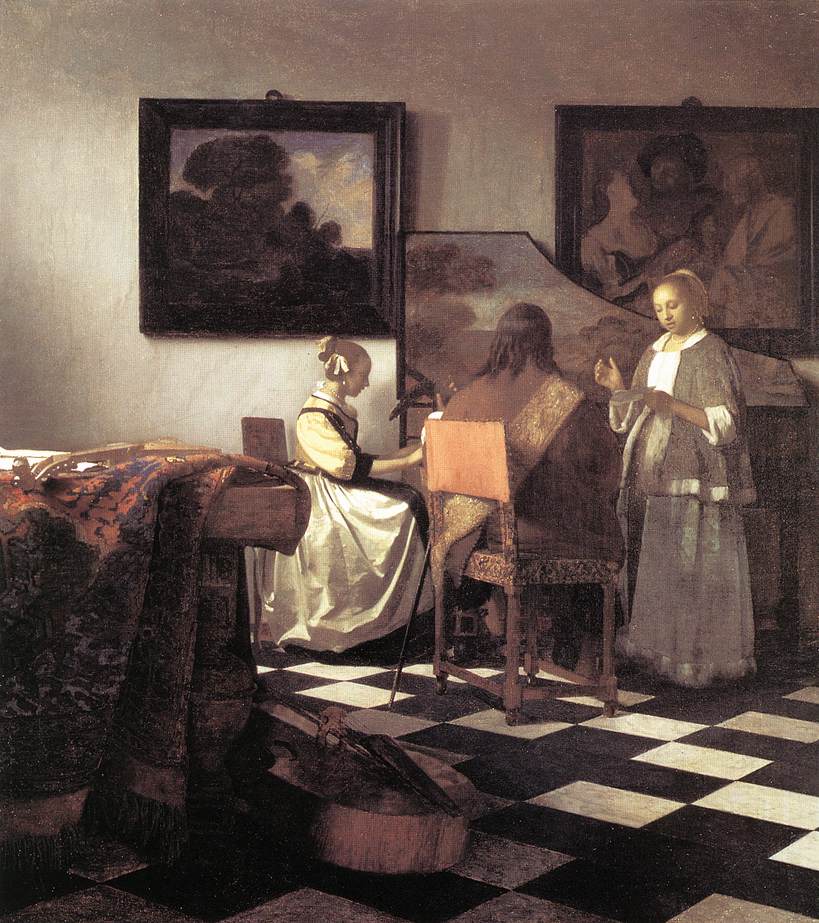
The Concert was stolen from the Isabella Stewart Gardner Museum in Boston on the night of March 18, 1990, in a theft that also removed twelve other works from the collection, making it one of the largest property thefts in the history of recorded crime. The painting has not been recovered as of the time of writing, and the empty frames that once held it and the other stolen works remain on display at the Gardner Museum as a reminder of the loss and an expression of the institution determination to recover the collection. Before its theft, The Concert had been part of the Gardner collection since Isabella Stewart Gardner acquired it in 1892 at auction in Paris, purchasing it as part of her systematic effort to build an encyclopedic collection of European art in Boston. Prior to entering the Gardner collection, the painting passed through several notable European sales, and its history in the seventeenth and eighteenth centuries is incompletely documented. The work is generally dated to around 1663 to 1666 on the basis of stylistic analysis and its relationship to other works from the same period. It represents one of Vermeer most complex multi-figure compositions, showing three individuals engaged in a musical performance in an interior setting that incorporates several subsidiary pictorial elements including paintings on the back wall that are themselves identifiable works by other artists.
The composition arranges three figures around a musical performance in the foreground and middle ground of the picture space. A young woman is seated at a harpsichord on the right, her back turned almost fully toward the viewer so that her face is barely visible. A second woman stands to the left, holding what appears to be sheet music and apparently singing. A man seated in the center of the composition holds a lute or similar stringed instrument. The arrangement of the three figures creates a triangular dynamic that draws the eye across the scene without settling on a single focal point, an unusually complex organizational strategy for Vermeer who typically centered his compositions on a single figure. The floor tiles in the foreground follow the familiar receding diagonal pattern that appears in many of Vermeer interiors, providing spatial structure and depth. Two paintings are visible on the back wall of the room, one of which is identifiable as a landscape by Jan van Goyen and the other as a version of the Procuress, a painting by Dirck van Baburen that also appears in other Vermeer works and that was apparently owned by Vermeer mother-in-law Maria Thins. The presence of the Procuress in the background has attracted significant scholarly attention, since that painting depicts an overtly moralized scene of paid sexual transaction, and its inclusion in a composition otherwise devoted to the refined pleasures of domestic music-making introduces a layer of ironic or cautionary commentary that complicates the surface elegance of the scene.
Music-making in Dutch Golden Age painting was a subject laden with moral and social meaning. The shared experience of playing and singing together was understood as both a social bond and a potential occasion for romantic or erotic encounter, and the visual language of musical scenes drew on a long tradition of associating musical harmony with the harmony of hearts. The presence of the Procuress by Van Baburen in the background of The Concert sharpens this dimension of the painting by introducing an explicit reference to illicit sexuality into a scene of refined domestic entertainment, inviting the viewer to read the music-making as a prelude or a cover for a less innocent form of social interaction. This kind of layered moral commentary was a recognized feature of Dutch genre painting, and sophisticated viewers of the seventeenth century would have been alert to these visual and thematic cross-references. The turned back of the harpsichord player is a compositional choice that has attracted considerable discussion. By denying the viewer access to the face of one of the three principal figures, Vermeer creates a space of ambiguity and withdrawal that resists easy narrative interpretation. The figure becomes a formal element as much as a psychological presence, and her averted face invites contemplation of what she might be feeling or thinking without providing any direct visual evidence. The theft of the painting in 1990 has added a further layer of meaning to the work in the cultural imagination, making it simultaneously a celebrated example of Dutch Golden Age painting and an emblem of irreplaceable loss.