Loading cart…
No products in the cart.

1669 · Oil on canvas · Stadel Museum, Frankfurt, Germany
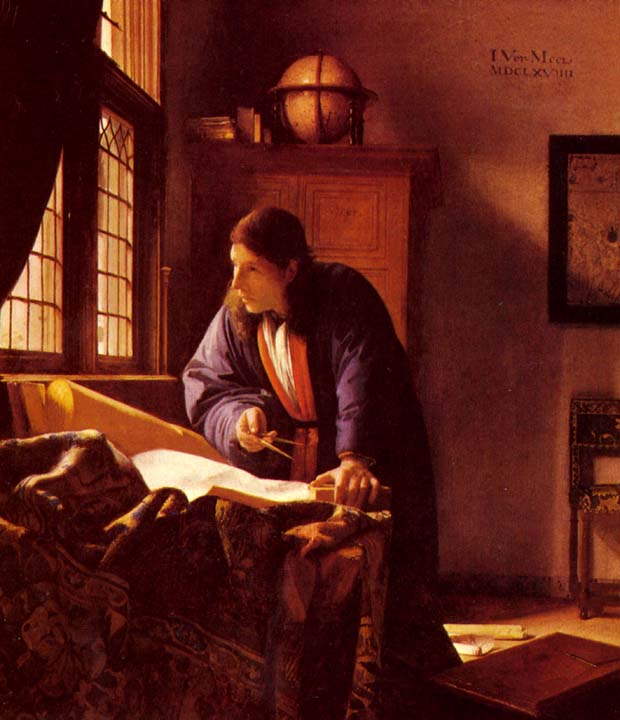
The Geographer is dated 1669 and signed by Vermeer, making it one of the rare works in his output that can be anchored securely in time. It is closely related to The Astronomer of the preceding year, sharing the same model, the same interior setting, and the same format, and the two works have been discussed as a pair since at least the eighteenth century when they appeared together in the same Amsterdam sale in 1713. The two paintings were described in that auction catalog as representing an astrologer and a geometrician, reflecting the vocabulary of the period rather than the precise disciplines depicted. The Geographer eventually entered the collection of the Stadel Museum in Frankfurt, where it remains today as one of the highlights of the Dutch and Flemish holdings. The suggestion that the figure depicted in both paintings may be based on Antoni van Leeuwenhoek is no more definitively proven for The Geographer than for The Astronomer, but it continues to attract scholarly interest because of the circumstantial connections between Leeuwenhoek and Vermeer and because of the documented fact that Leeuwenhoek served as executor of Vermeer estate after the painter death in 1675. Whether the identification is correct or not, the figure type clearly represents the kind of learned gentleman scholar who populated the intellectual life of seventeenth century Dutch cities.
The geographer is shown standing at a table covered with maps and navigational instruments, his body turned slightly as though interrupted in the midst of calculation or study. He holds a pair of dividers in his right hand, an instrument used to measure distances on maps, and his gaze is directed outward and slightly upward, as though he is reflecting on a problem rather than simply reading a document. This posture of alert contemplation gives the figure a quality of intellectual animation that is characteristic of Vermeer approach to depicting human thought and attention. Light enters from the left through a multi-paned window, falling across the geographer and picking out the texture of the large rolled chart that leans against the windowsill in the foreground. A celestial globe sits atop the cabinet in the background, linking this painting visually and thematically to its companion piece The Astronomer. The floor tiles recede into the background, providing spatial depth, while the table covering and the scattered papers create a zone of organized complexity in the foreground. Vermeer handling of the light as it falls across the white collar and sleeves of the scholar is particularly refined, demonstrating his ability to render the luminosity of fabric without losing the sense of three-dimensional form. The composition feels both momentary and timeless, capturing a specific posture of inquiry while suggesting the broader human endeavor of making sense of the physical world.
Geography and cartography occupied a position of enormous cultural importance in the Dutch Republic of the seventeenth century. The great Dutch trading companies, the VOC and the WIC, depended on accurate charts and navigational knowledge for the maintenance of their global commercial networks, and the production of maps had become a major industry centered in Amsterdam. Maps appeared in domestic interiors as objects of both practical and decorative value, and their presence in a painting could signal sophistication, worldliness, and participation in the culture of trade and exploration. By depicting a scholar at work with navigational tools and maps, Vermeer engaged with a subject that resonated deeply with his audience. The large rolled chart visible at the lower left of the composition has been identified by scholars as a sea chart of Europe and the Mediterranean region, connecting the interior scene to the broader world of Dutch maritime enterprise. The globe in the background, as in The Astronomer, reinforces the theme of comprehensive geographical knowledge, encompassing both the surface of the earth and the celestial sphere above it. The posture of the geographer, pausing in thought with his dividers raised, suggests that knowledge is not merely accumulated but actively worked through and tested. This emphasis on active inquiry rather than passive reception connects the painting to the empirical values of the Dutch scientific culture of the period and to the broader European tradition of representing the life of the mind as a dignified and worthy subject for pictorial representation.