Loading cart…
No products in the cart.

1669 · Oil on canvas · Rijksmuseum, Amsterdam, Netherlands
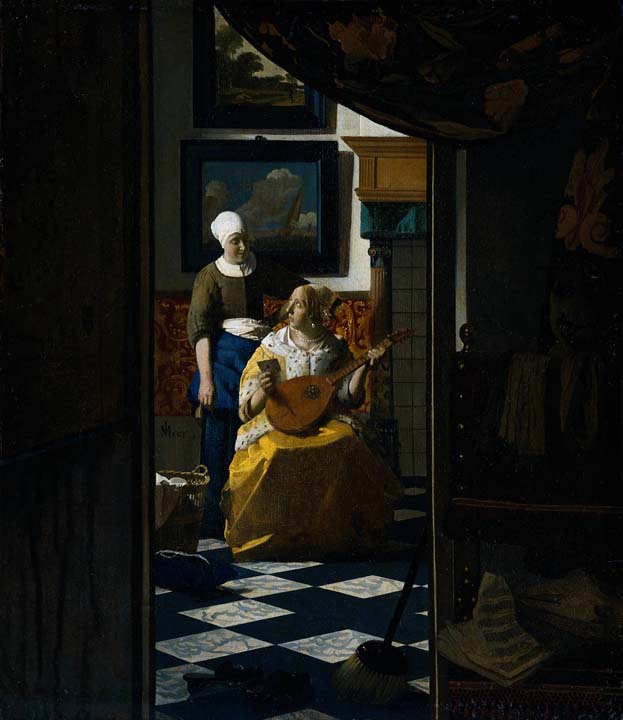
The Love Letter was painted around 1669 and represents one of Vermeer most compositionally inventive works from his later period. The painting uses a doorway or curtained threshold as a framing device to situate the viewer outside the main scene, looking in through an antechamber into the lit room beyond where the two figures stand. This kind of theatrical framing, sometimes called a doorkijkje in Dutch, was used by other Delft painters such as Pieter de Hooch, and Vermeer adoption and transformation of the device demonstrates his awareness of and engagement with the broader visual culture of his city and time. The painting appeared in an Amsterdam sale in 1892 before entering the Rijksmuseum collection, and its provenance prior to the nineteenth century is less fully documented than some of Vermeer other works.
The painting suffered significant damage during the twentieth century when it was stolen from the Westfries Museum in Hoorn in 1971, where it had been on loan. It was recovered some years later in damaged condition, and subsequent conservation treatment at the Rijksmuseum stabilized the paint surface and addressed areas of loss. The restoration history of the work has been documented in detail and provides a case study in the challenges of conserving seventeenth century Dutch paintings that have experienced trauma. Despite its difficult history, the painting retains its compositional clarity and much of its original coloristic quality, and it remains an important work for understanding the development of Vermeer spatial thinking in his later career.
The compositional structure of The Love Letter is among the most complex Vermeer ever devised. The foreground antechamber, with its rumpled map hanging on the wall, its upended shoes on the floor, and its chair partially draped with fabric, creates a zone of deliberate disorder that contrasts with the ordered and well-lit room visible through the doorway beyond. This contrast is not accidental. Vermeer uses the foreground clutter to establish the viewer position as an outsider, someone who has entered a private space without announcement, and the neatly arranged room with its two figures becomes a tableau of social interaction glimpsed rather than openly observed. The curtain drawn back at the left edge of the foreground reinforces this theatrical framing and invites comparison with stage scenery.
In the main room, the mistress of the house sits with a lute in her lap, a detail that associates her with music and by extension with the emotional register of love and longing. The maid stands beside her, having just delivered the letter, and the two figures exchange a glance that the viewer must interpret without the benefit of audible dialogue. The paintings on the wall behind the figures include a seascape and a landscape, objects that art historians have linked to the themes of travel, separation, and the hope of safe return. The light in the inner room is cool and even, typical of Vermeer north-facing studio light, and the color relationships between the yellow jacket of the mistress and the dark dress of the maid create a clear focal hierarchy that guides the eye toward the moment of letter delivery.
The Love Letter explores the social and emotional dynamics of correspondence in a society where written letters carried the full burden of maintaining relationships across distance. The painting stages the moment just after a letter has arrived, when the recipient has not yet had time to read its contents privately, and the maid presence creates a subtle social tension. Letters in seventeenth century Dutch households passed through multiple hands before reaching their intended recipient, and the maid role as messenger and witness to the moment of delivery was a recognized feature of domestic life. Vermeer captures this intermediate moment, suspended between the public act of delivery and the private act of reading, with a sensitivity to social nuance that is characteristic of his best work.
The symbolic objects in the painting reinforce and complicate the central theme. The lute resting in the woman lap is frequently associated in Dutch and Flemish painting with romantic feeling and the emotional life, and her interrupted music-making suggests that the arrival of the letter has displaced one form of emotional expression with another. The seascape visible on the wall behind the figures is a common symbol of the journey and return, and its presence in a scene about a love letter connects the private emotional experience of the woman to the broader context of Dutch maritime life and the separations it imposed on families and lovers. The painting is thus both a precise observation of a social moment and a carefully layered image of the emotional conditions of life in the Dutch Golden Age.