Loading cart…
No products in the cart.

Art Guides · Flowers & Still Life
Save articles to your collection
Log in or create a free account, and this article will be waiting in your Private Collection.
Log in or sign upA sunflower can be heavy with seeds. A white iris can separate itself from a field of violet. A few lily pads can hold a whole pond together. These famous flower paintings reward a closer look at what the flowers actually do inside the picture.
Our selection moves from Dutch bouquets to Impressionist gardens and O’Keeffe’s enlarged flower forms, taking in Van Gogh, Monet, Rachel Ruysch, Mary Cassatt and other painters along the way. Some flowers are cut and arranged; others are still growing. Their stories include gifts, experiments with colour and the patient observation of ordinary things.
Van Gogh’s Sunflowers, Irises and Almond Blossom and Monet’s Water Lilies are familiar starting points. Flower painting also includes the elaborate bouquets of Rachel Ruysch, Chardin’s quiet still life and the peonies of Manet, Morisot and Fantin-Latour. Gardens and flowering trees belong to the subject alongside flowers in vases. The selection also includes Redon’s pastel, identified by its actual medium.
This is a selected reading guide, not a measured popularity ranking or an exhaustive history. Each number identifies a particular painting, with its museum or collection reference. That distinction matters: Van Gogh painted several sunflower pictures, Monet returned to water lilies for years, and titles such as Flowers in a Vase recur across different artists and collections.
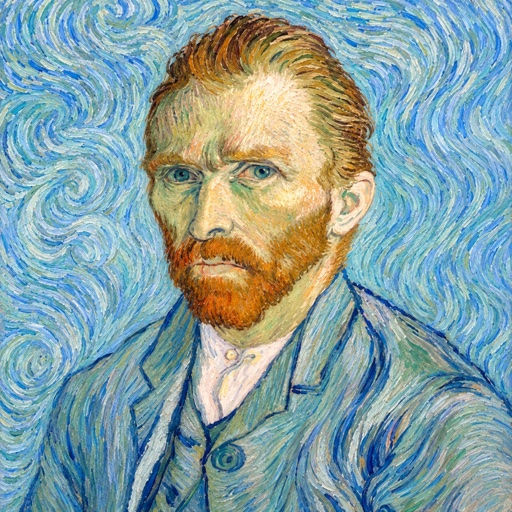 Explore the artistVincent van Gogh →
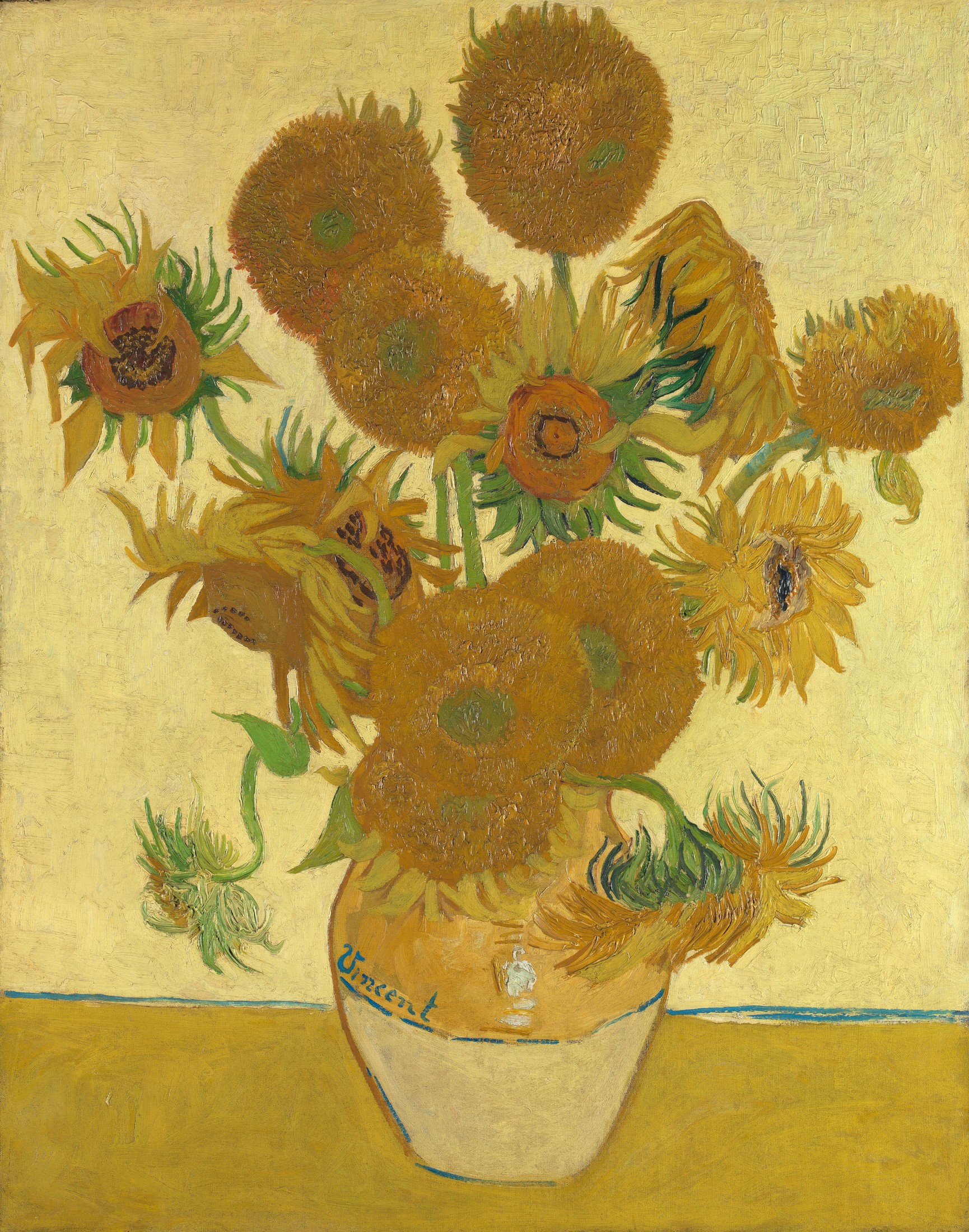
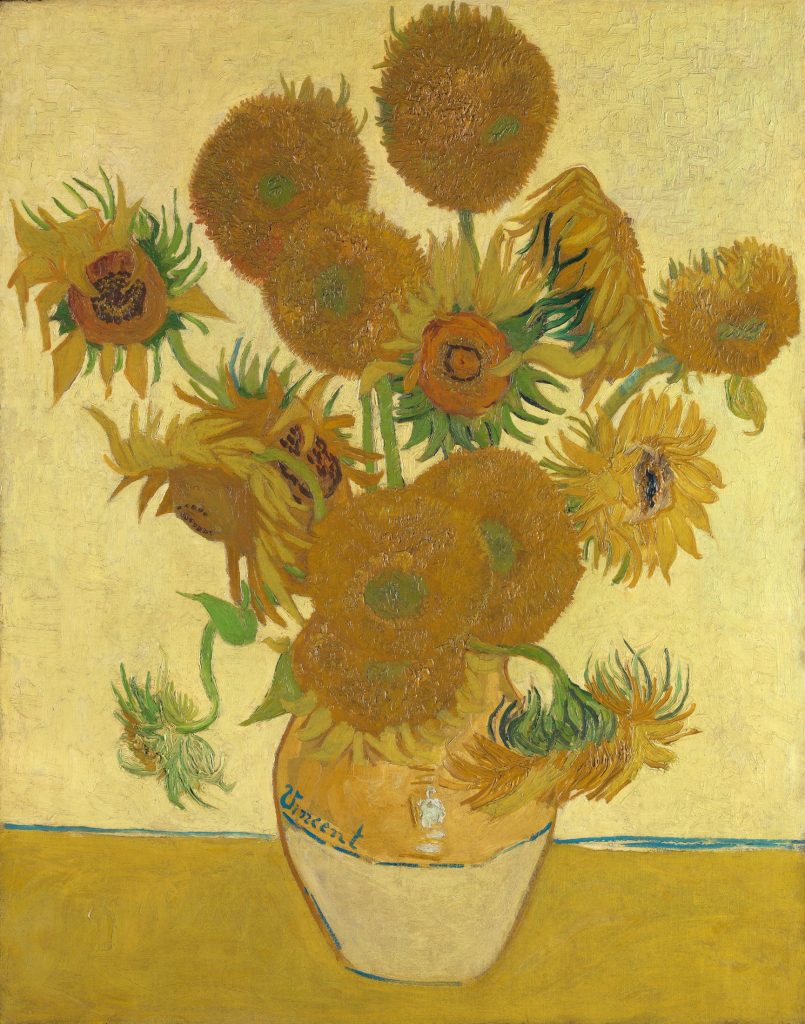
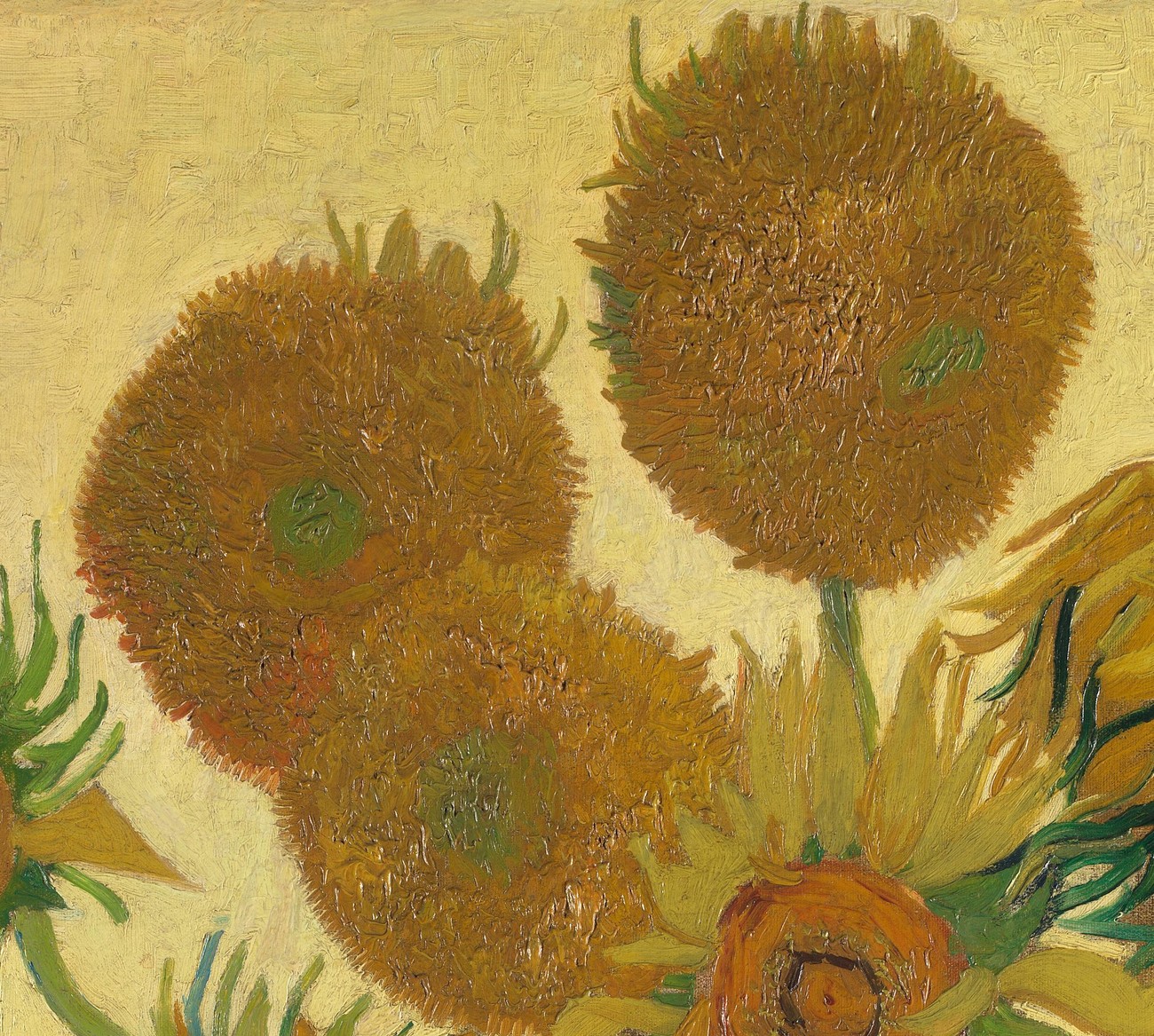
A yellow vase, a yellow table and a yellow wall leave the flowers almost nowhere to hide. Van Gogh makes the individual heads distinct through their edges and surfaces: petals flare outward, heavy seed heads bend, and thick marks gather around the centres. The painting is famous partly because it shows how much variety can live inside a restricted colour range.
The London canvas belongs to the sunflower pictures Van Gogh made in Arles in 1888, when he was preparing for Paul Gauguin’s visit. It is one version of a repeated subject, not the only painting called Sunflowers. The different stages of the blooms give this bouquet a sense of time passing within a single arrangement.
Look especially at the heads that have lost their petals. They retain a strong physical presence. Van Gogh does not need every flower to look freshly picked in order to make the whole painting feel alive.
Collection and research reference: National Gallery, London.
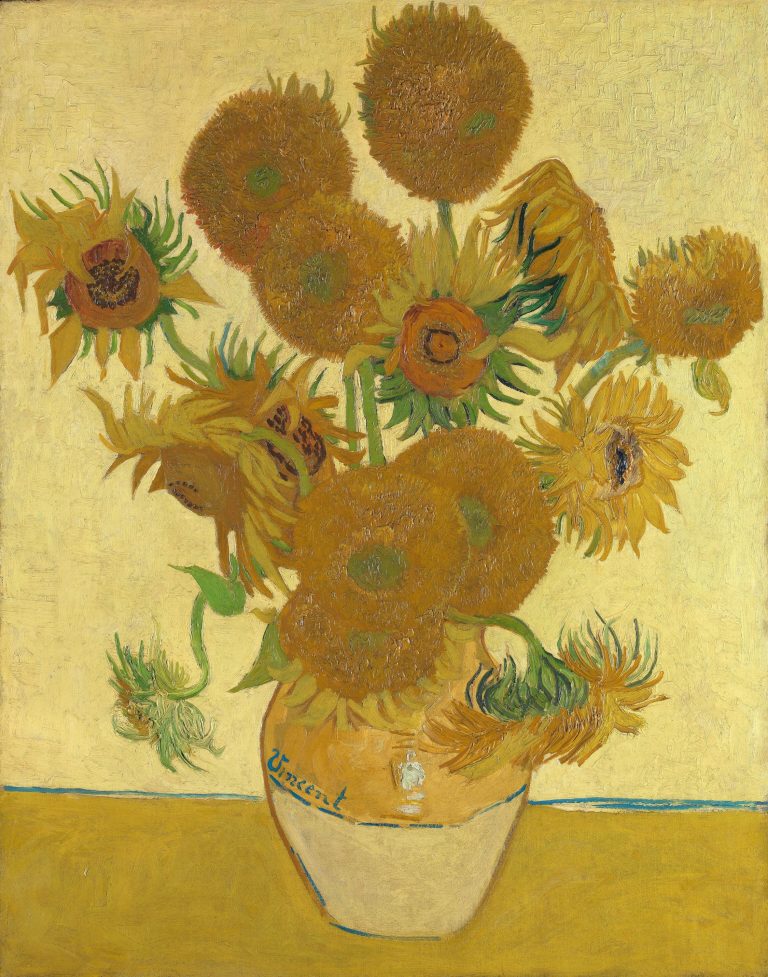
Vincent Van Gogh · oil on canvas, made to order
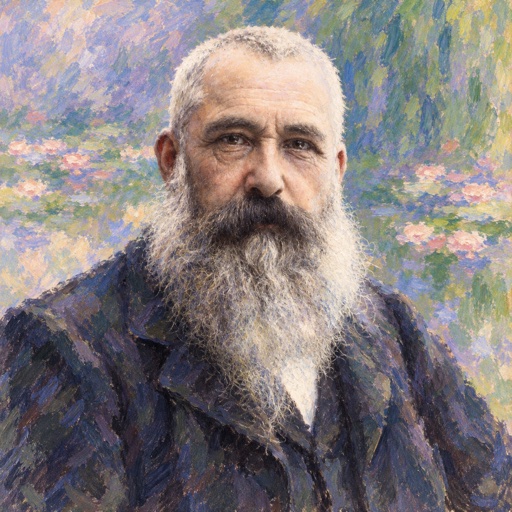 Explore the artistClaude Monet →
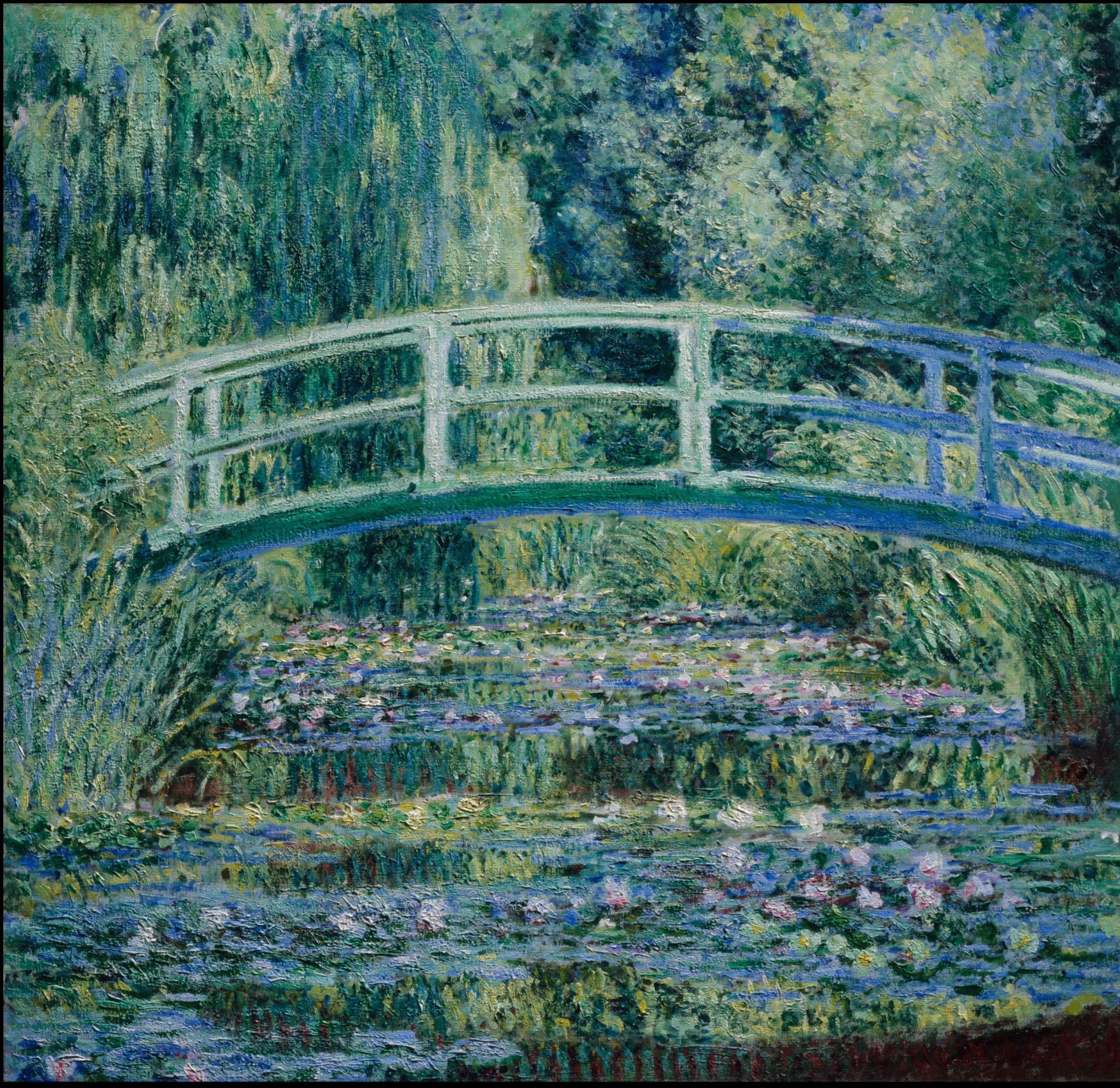
The flowers sit low on the water while the bridge crosses above them. Between those two levels, Monet fills the space with reflected greens, broken light and dark passages that seem to lead below the pond’s surface. The garden is enclosed, with little sky available to release our gaze.
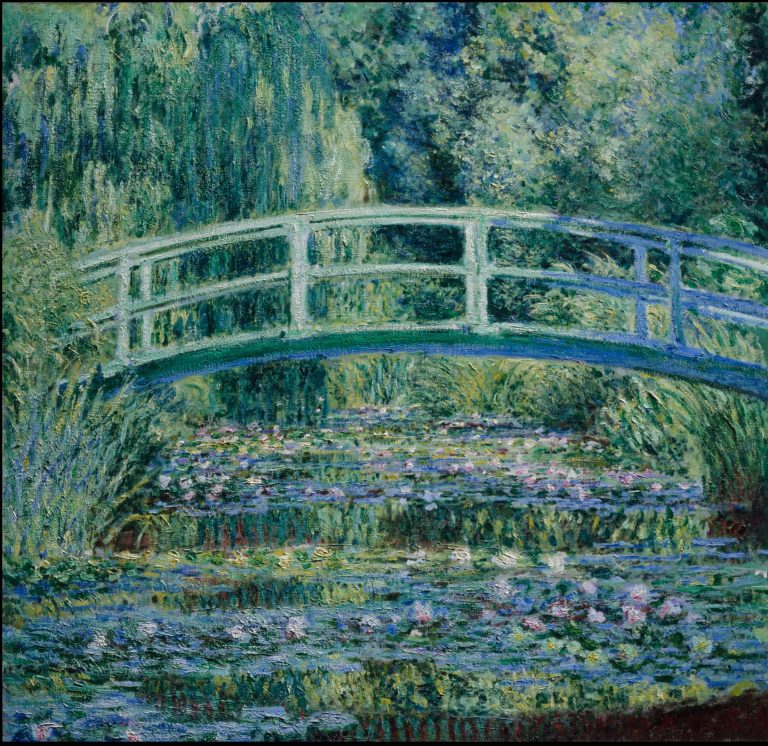
Monet created the water garden at Giverny and returned to it in many paintings. This example is Princeton’s Water Lilies and Japanese Bridge, dated 1899. It should be distinguished from the later Water Lilies canvases that omit the bridge, including the 1906 Chicago painting explored in our separate Water Lilies story.
The lilies have a practical role in the picture: their floating pads help us recognise the surface of water that might otherwise read as a wall of colour. Their small blossoms become points at which the eye can pause before moving back into the reflections.
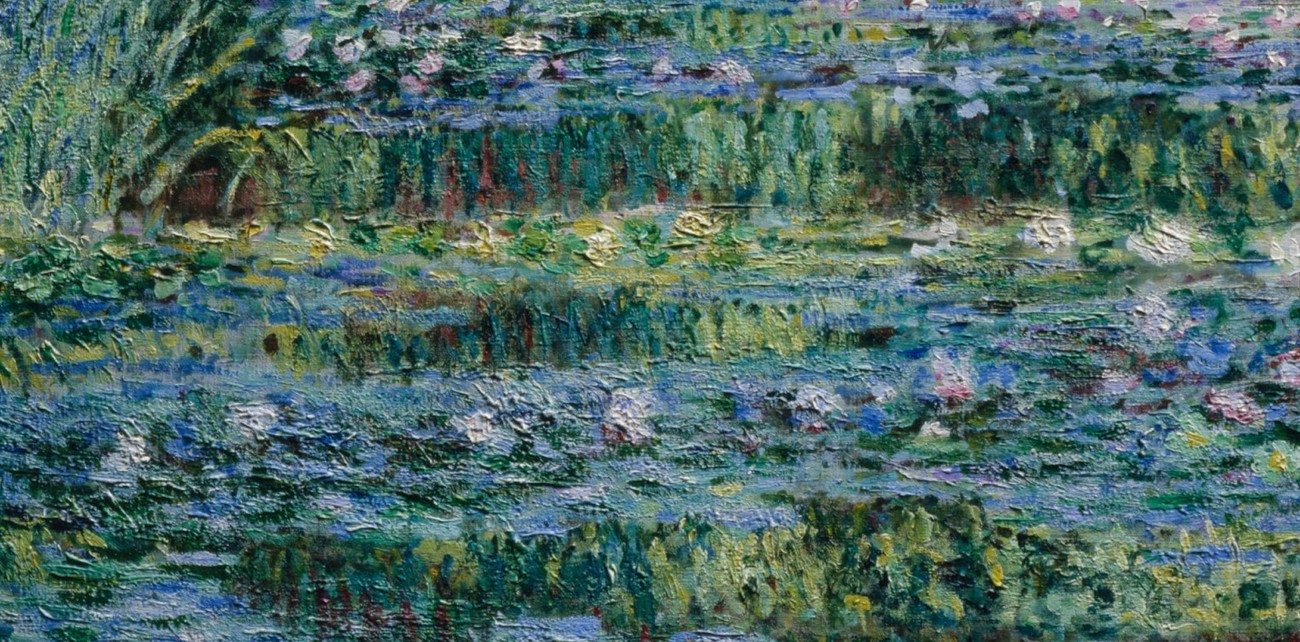
Collection and research reference: Princeton University Art Museum.
Claude Monet · oil on canvas, made to order
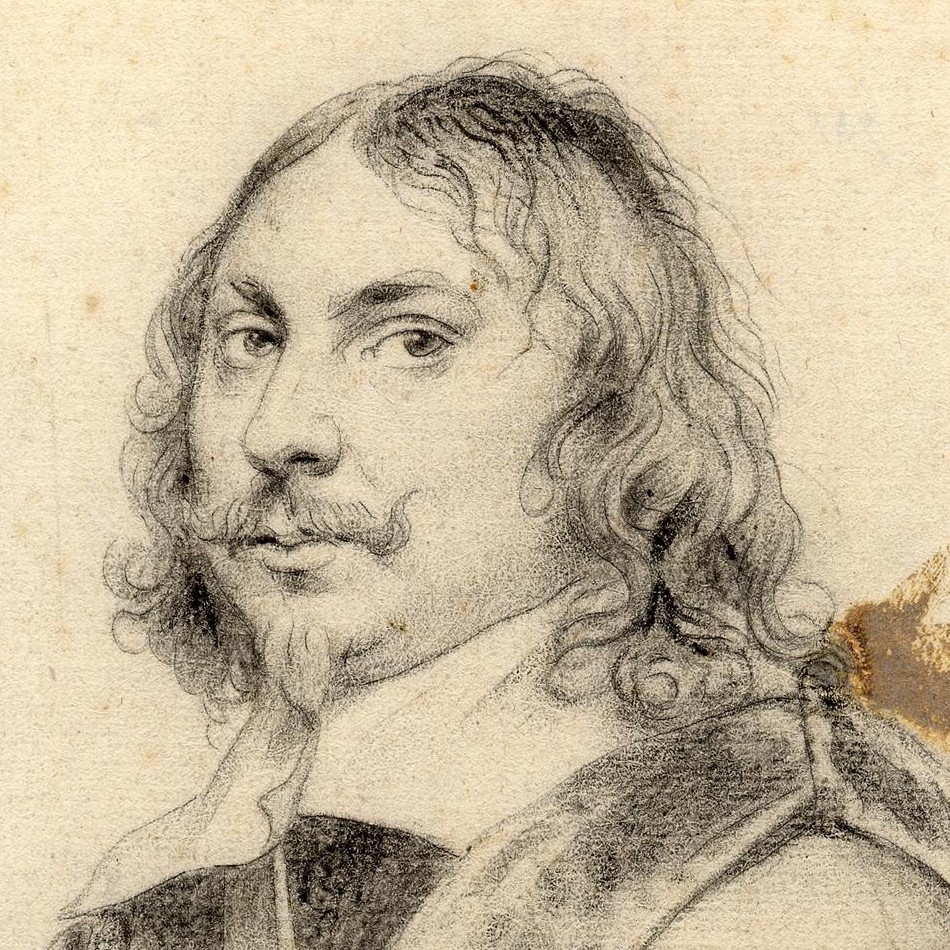 Explore the artistJan Davidsz. de Heem →
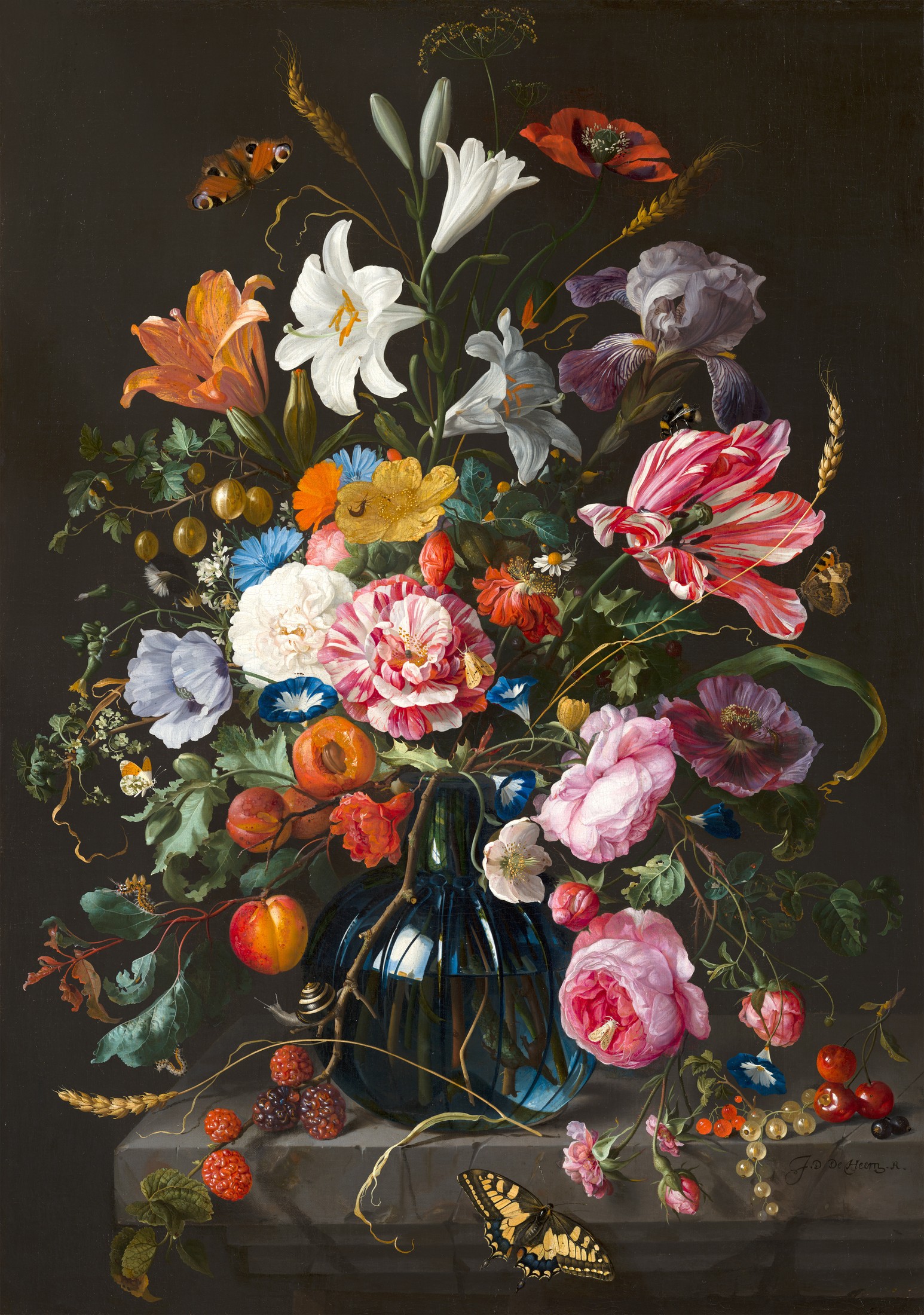
The arrangement spreads well beyond the vessel that holds it. A pale lily lifts the upper edge, striped petals turn sideways and thin stems move into the dark spaces around the bouquet. Near the base, fruit and small creatures make the ledge almost as busy as the flowers.
The Mauritshuis dates this canvas to about 1670. Its glass vase contains a small reflected view of the studio window, cloudy sky and objects on the sill. A painting that first appears to shut out the surrounding room quietly brings that room back inside its own centre.
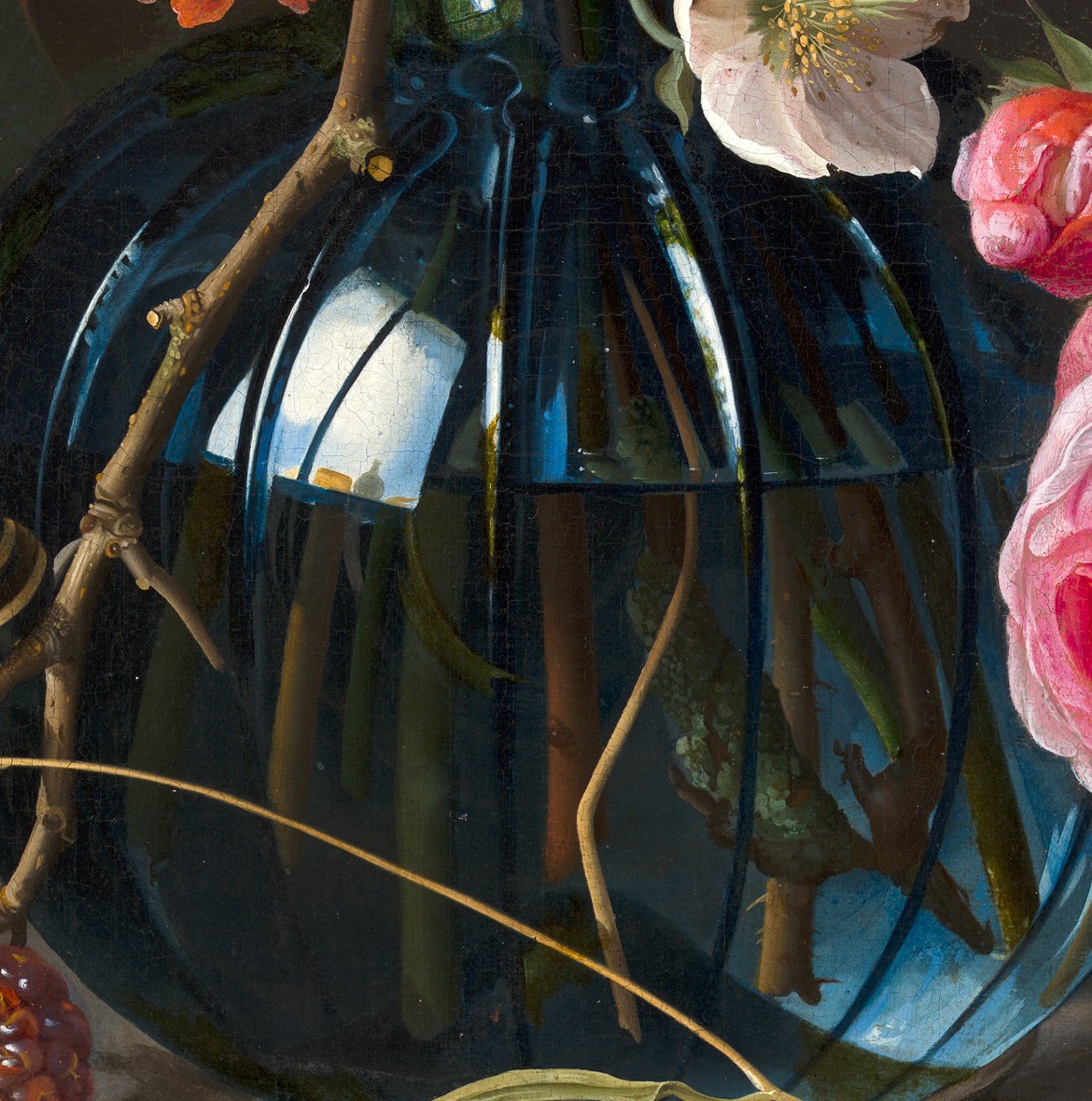
Look down before leaving the image. The insects change the scale of the encounter: what seems an extravagant display from a distance also contains life small enough to be overlooked. The museum identifies twelve different insects across the composition.
Collection and research reference: Mauritshuis, The Hague.
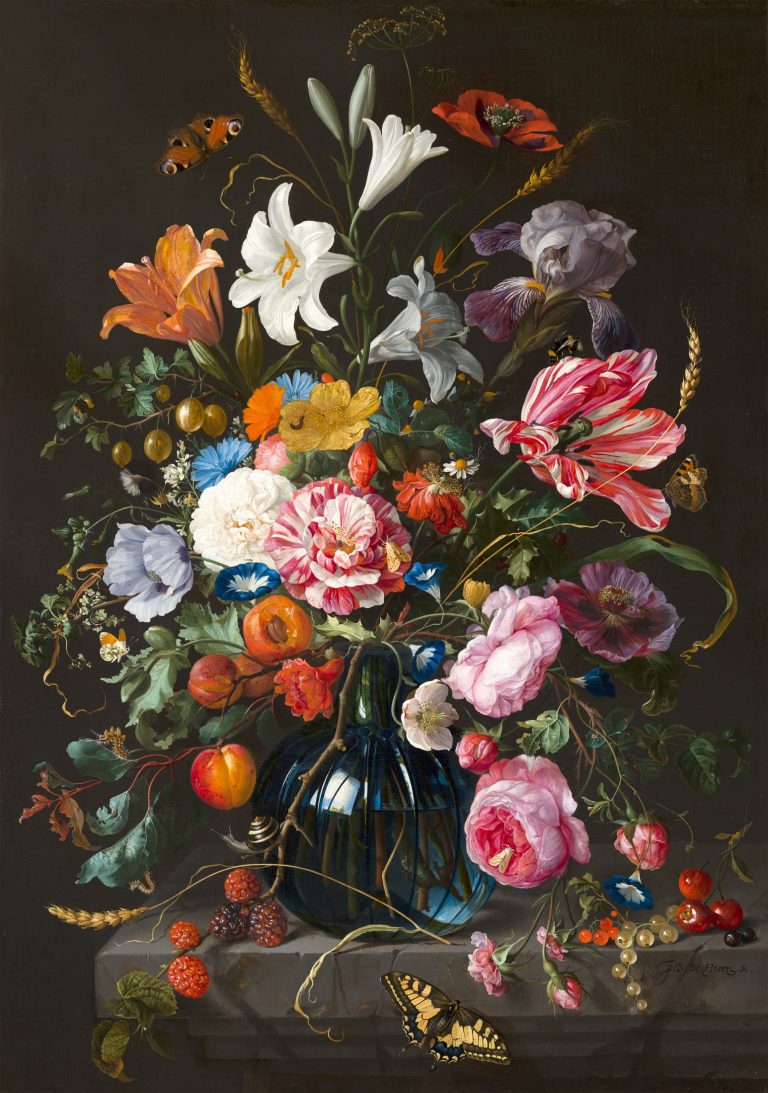
Jan Davidsz. de Heem · oil on canvas, made to order
Explore the artistVincent van Gogh →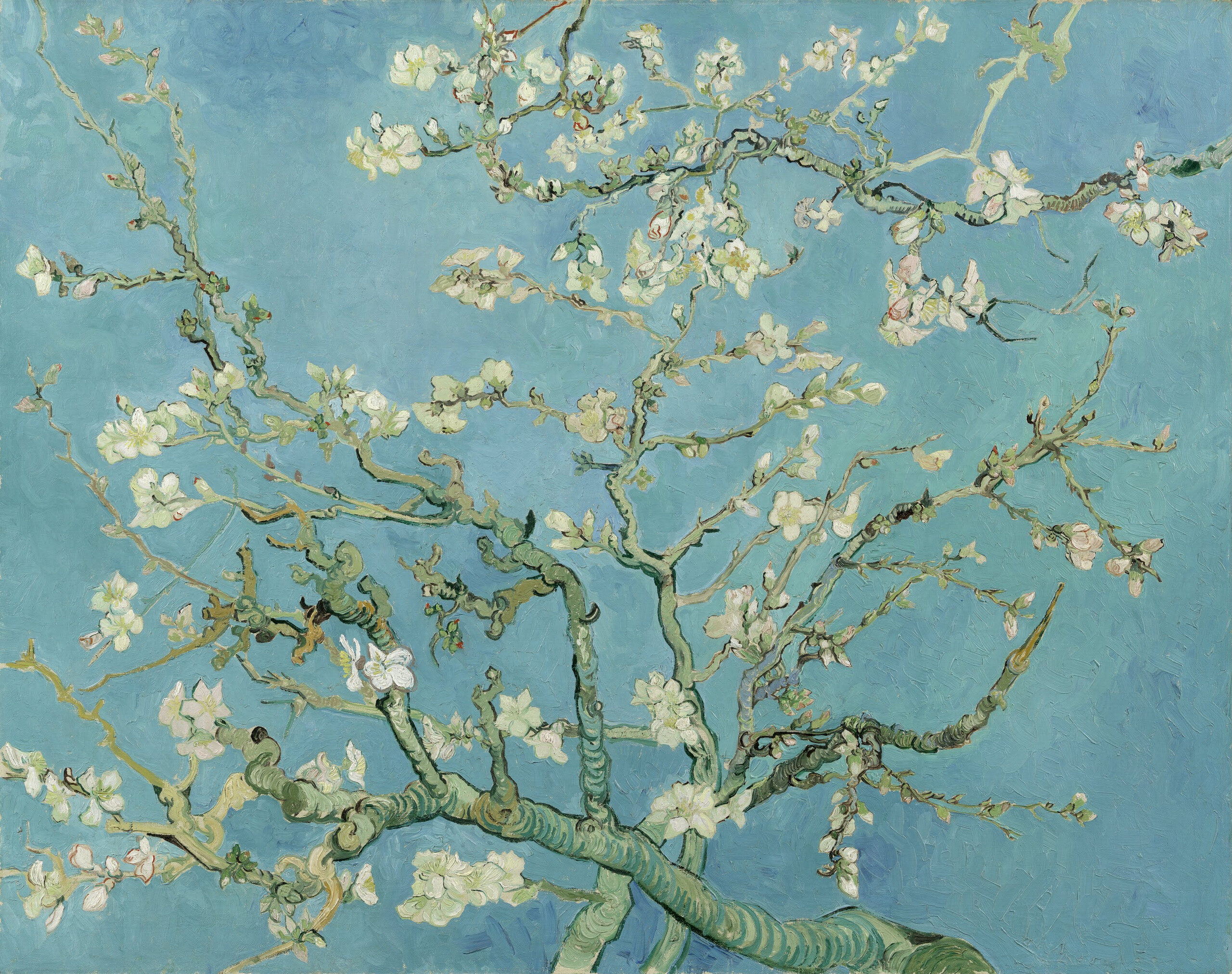
The branches arrive from outside the frame and spread across blue space. We see neither the base of the tree nor the ground beneath it. White petals, small buds and dark branching lines make the picture feel open, even though the flowering limbs fill much of its surface.
Van Gogh painted Almond Blossom for his newborn nephew Vincent Willem, the son of Theo and Jo. The early flowering tree made a fitting gift for a beginning. The painting’s association with new life is therefore grounded in its purpose, rather than inferred from blue and white alone.
A closer view shows how firmly the flowers belong to the twisting wood. Delicacy comes from the contrast between the pale petals and the strong outlines of the branches. The blooms do not float free as decoration; they emerge from something visibly growing.
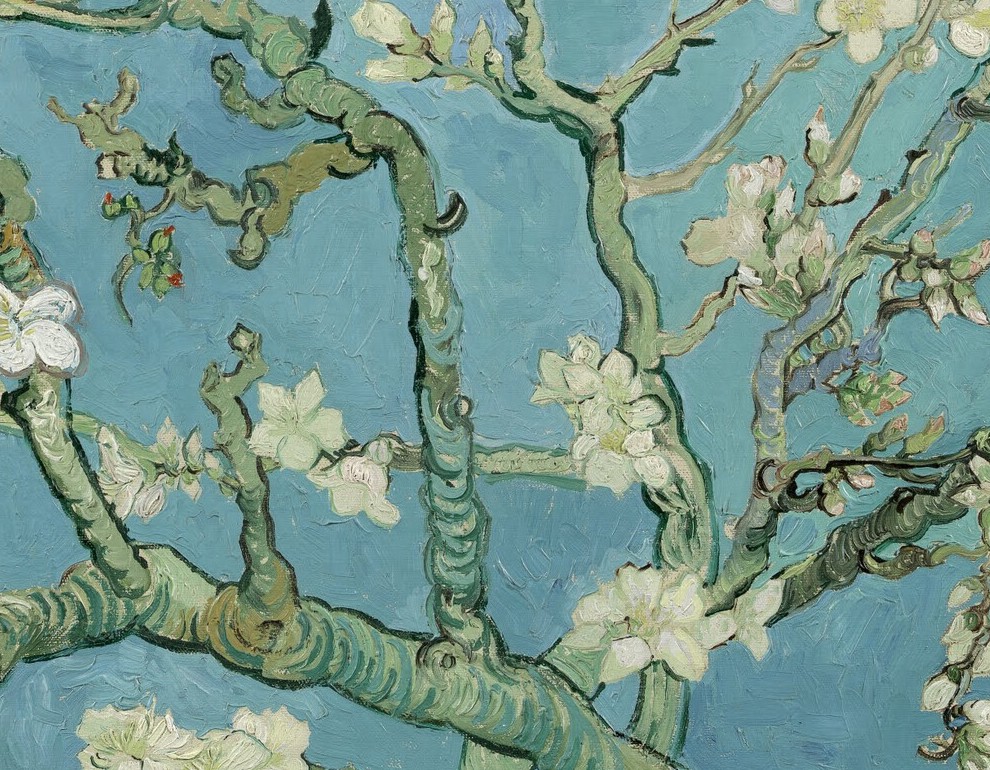
Collection and research reference: Van Gogh Museum, Amsterdam.
Vincent Van Gogh · oil on canvas, made to order
 Explore the artistRachel Ruysch →
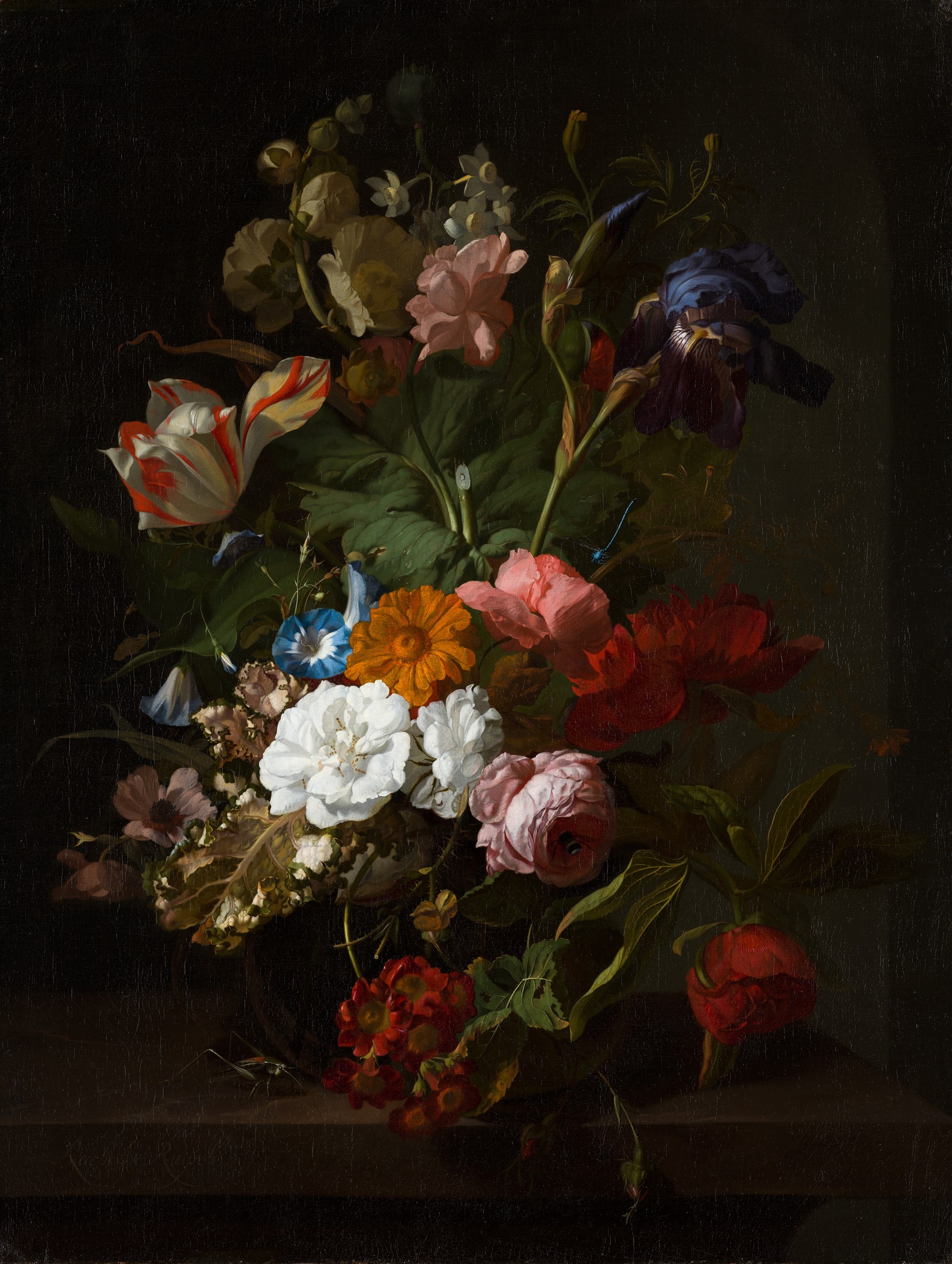
This is a different Ruysch painting from the glass-vase composition also discussed in this guide. It belongs to the Mauritshuis as inventory 151 and is signed and dated 1700. Its flowers are not all at the same point in their lives.
An iris droops at the upper right. A tulip on the left is beginning to come apart. In the centre, a flower has been cut away, leaving a stem that releases drops onto the leaves below. The museum identifies the missing bloom as probably an opium poppy, so that identification should remain qualified.
The gap is an active part of the design. Rather than filling every opening with another perfect flower, Ruysch lets darkness enter the middle of the arrangement. It gives the bouquet depth while making its changing condition difficult to ignore.
Collection and research reference: Mauritshuis, The Hague.
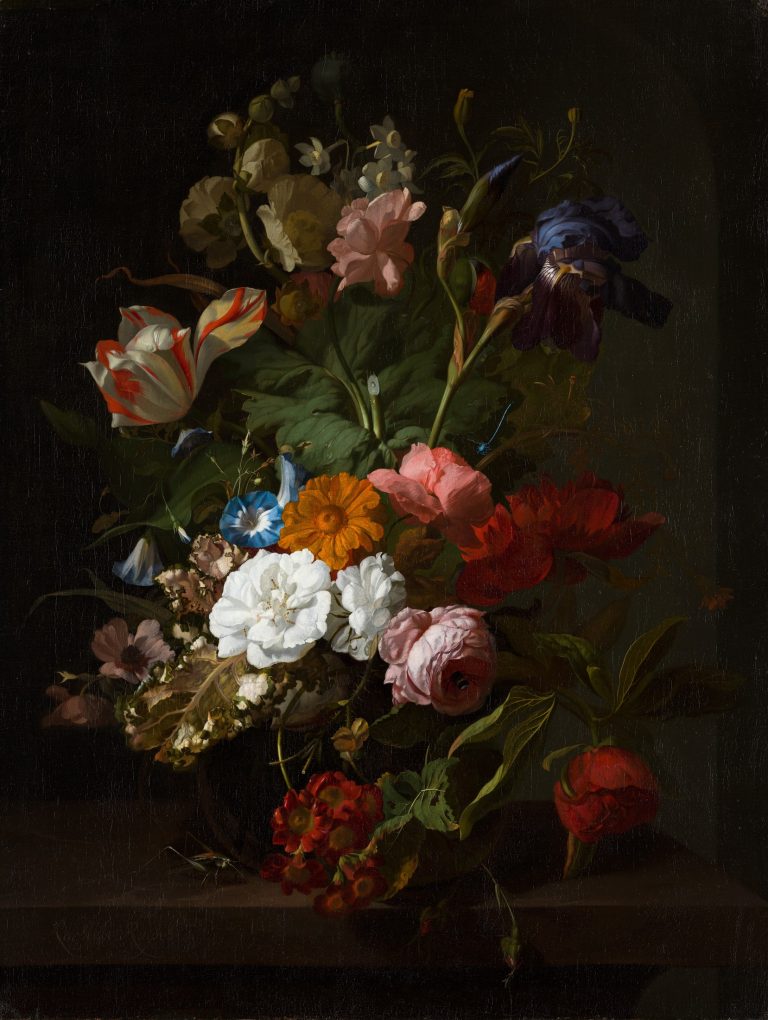
Rachel Ruysch · oil on canvas, made to order
 Explore the artistGeorgia O’Keeffe →
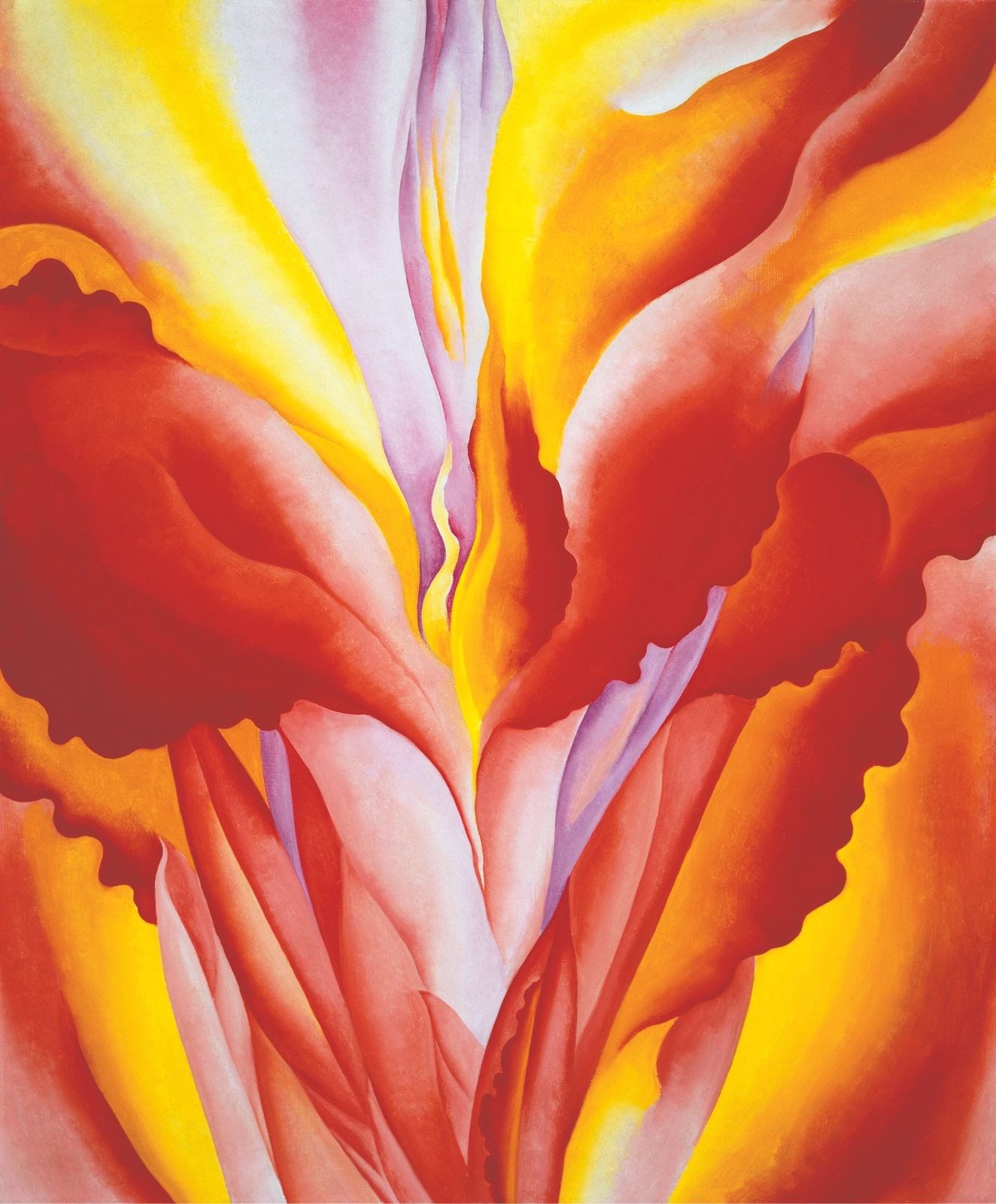
No vase establishes the flower’s size. O’Keeffe brings its folds so close that petals become broad passages of red, orange, pink and pale light. The centre draws us inward, but the edges keep carrying the flower beyond the limits of the frame.
The Arizona painting is often reproduced with a 1924 date. Access O’Keeffe, the museum’s catalogue resource, currently dates this particular work to 1925 to 1928 and explains the earlier label in its research notes. Other paintings called Red Canna exist, so the title alone is not enough to identify it.
Compared with the small specimens in Bosschaert’s basket, this is a different proposition: a flower can occupy our whole field of vision. Its structure remains the subject even as the enlarged curves approach abstraction.
Collection and research reference: University of Arizona Museum of Art, Tucson.
Explore the artistVincent van Gogh →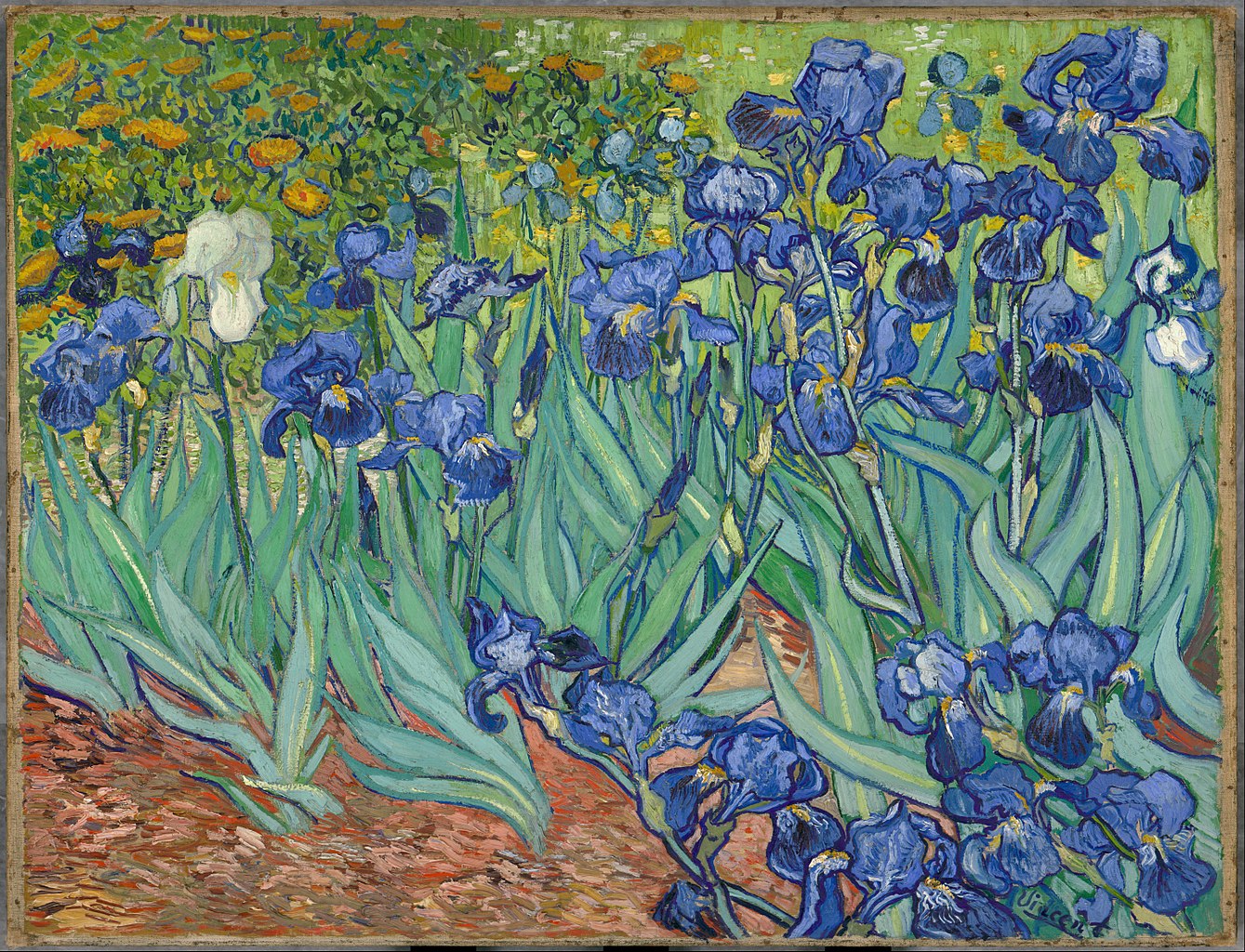
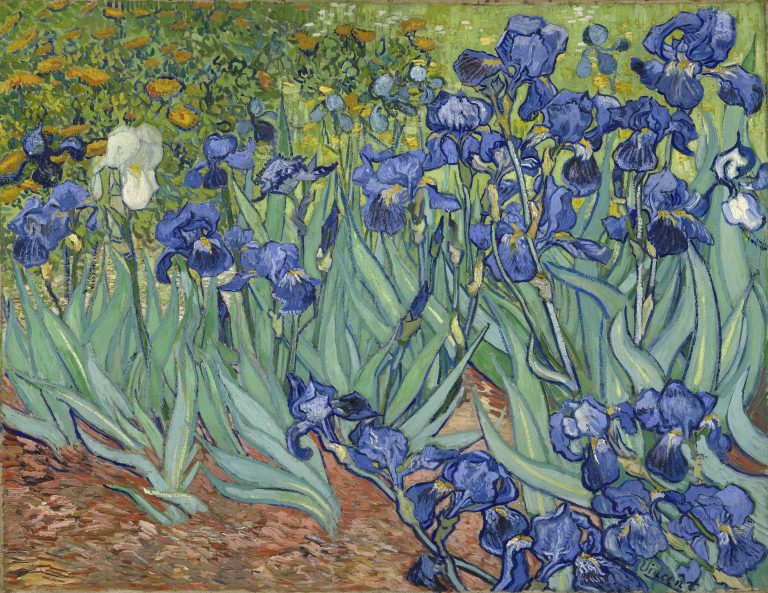
Instead of placing a bouquet on a table, Van Gogh brings us close to a growing bed of irises. Sword-shaped leaves rise between curled flowers; brown soil and orange plants remain visible at the edges. The stems do not become a neat row. Each one seems to find its own route upward.
He began the painting in the garden of the hospital at Saint-Rémy in May 1889. The Getty notes the possible influence of Japanese prints on its cropped composition and broad areas of colour. A single white bloom stands apart from the blue-violet flowers, but the painting supplies no fixed explanation that makes it a coded self-portrait.
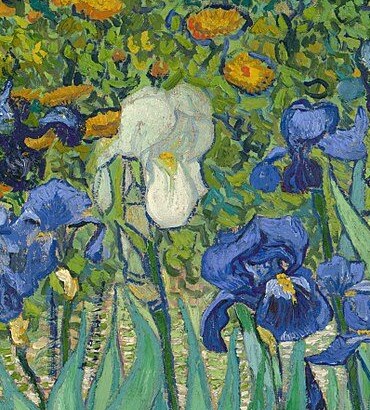
The visual difference is enough to hold our attention. Follow the pale flower back down into its leaves and it becomes part of the same crowded living bed, both distinct and connected.
Collection and research reference: J. Paul Getty Museum, Los Angeles.
Vincent Van Gogh · oil on canvas, made to order
 Explore the artistFerdinand Georg Waldmüller →
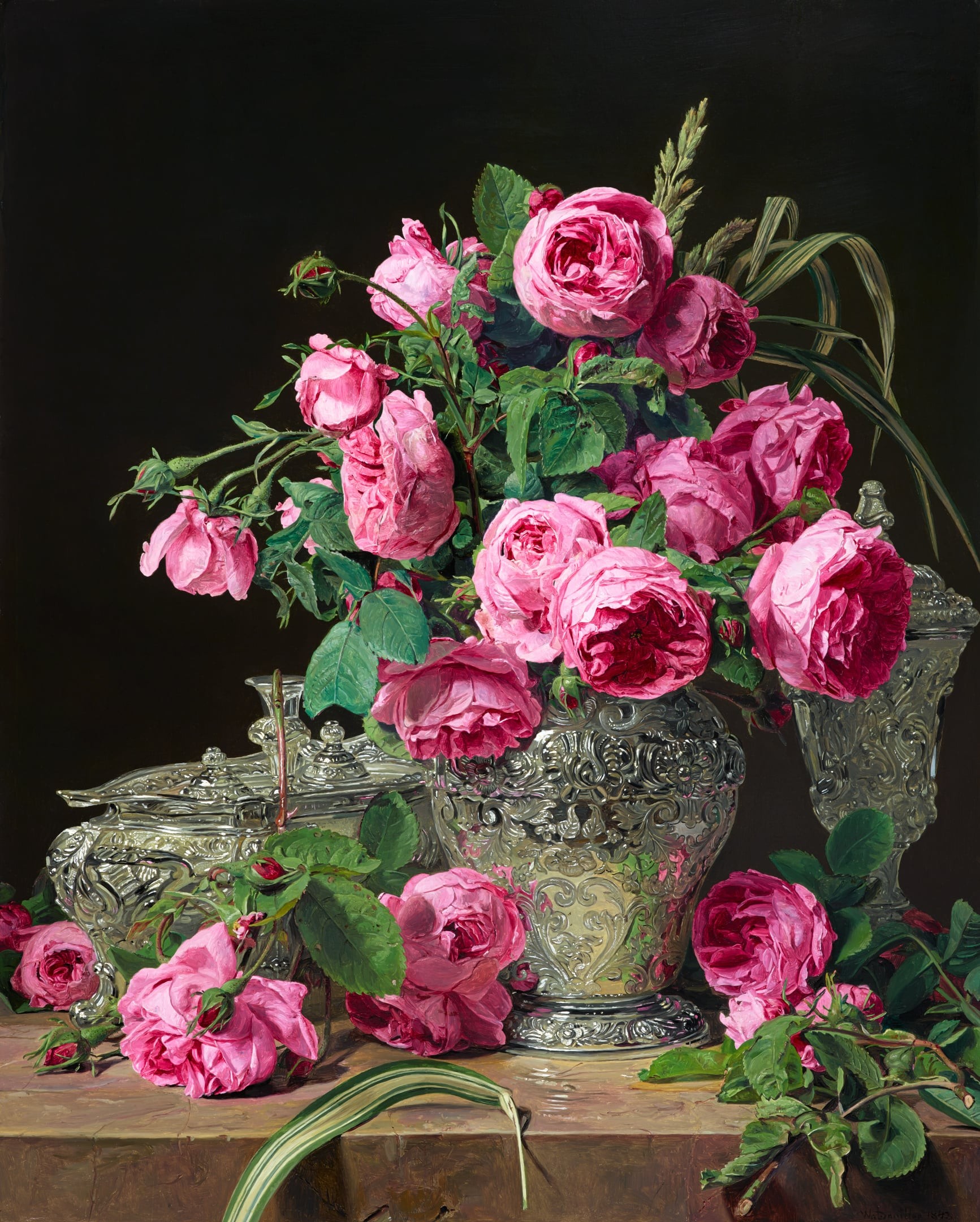
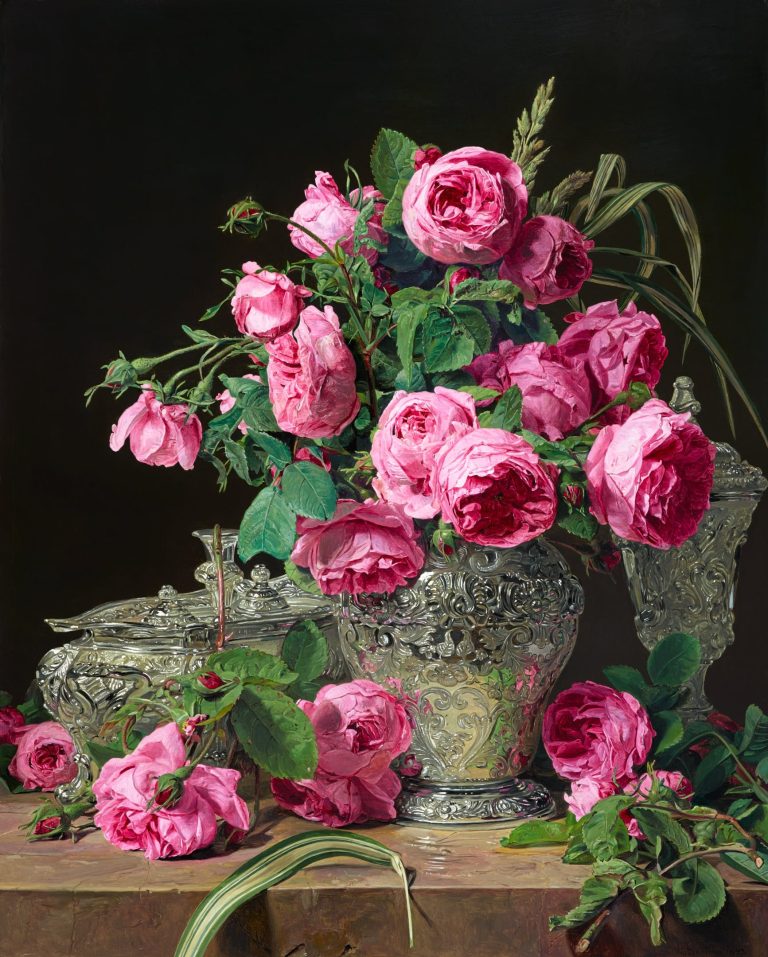
Pink is everywhere, but no two rose heads meet the light in quite the same way. Some turn outward, others bend into shadow and several lie below the vessel. The dark background leaves their pale edges unusually exposed.
The Princely Collections records this as an 1843 oil painting on panel, measuring 48 by 39 centimetres. Its vessel is as carefully described as the roses: a decorated surface and bright reflections give the container a presence beyond its practical task of holding stems.
The fallen flowers prevent the upper bouquet from becoming the only event in the picture. Moving downward, we meet a second arrangement across the ledge. Leaves, curling stems and loose blossoms make its edge feel occupied rather than empty.
Collection and research reference: The Princely Collections, Vaduz–Vienna.
Ferdinand Georg Waldmüller · oil on canvas, made to order
Explore the artistClaude Monet →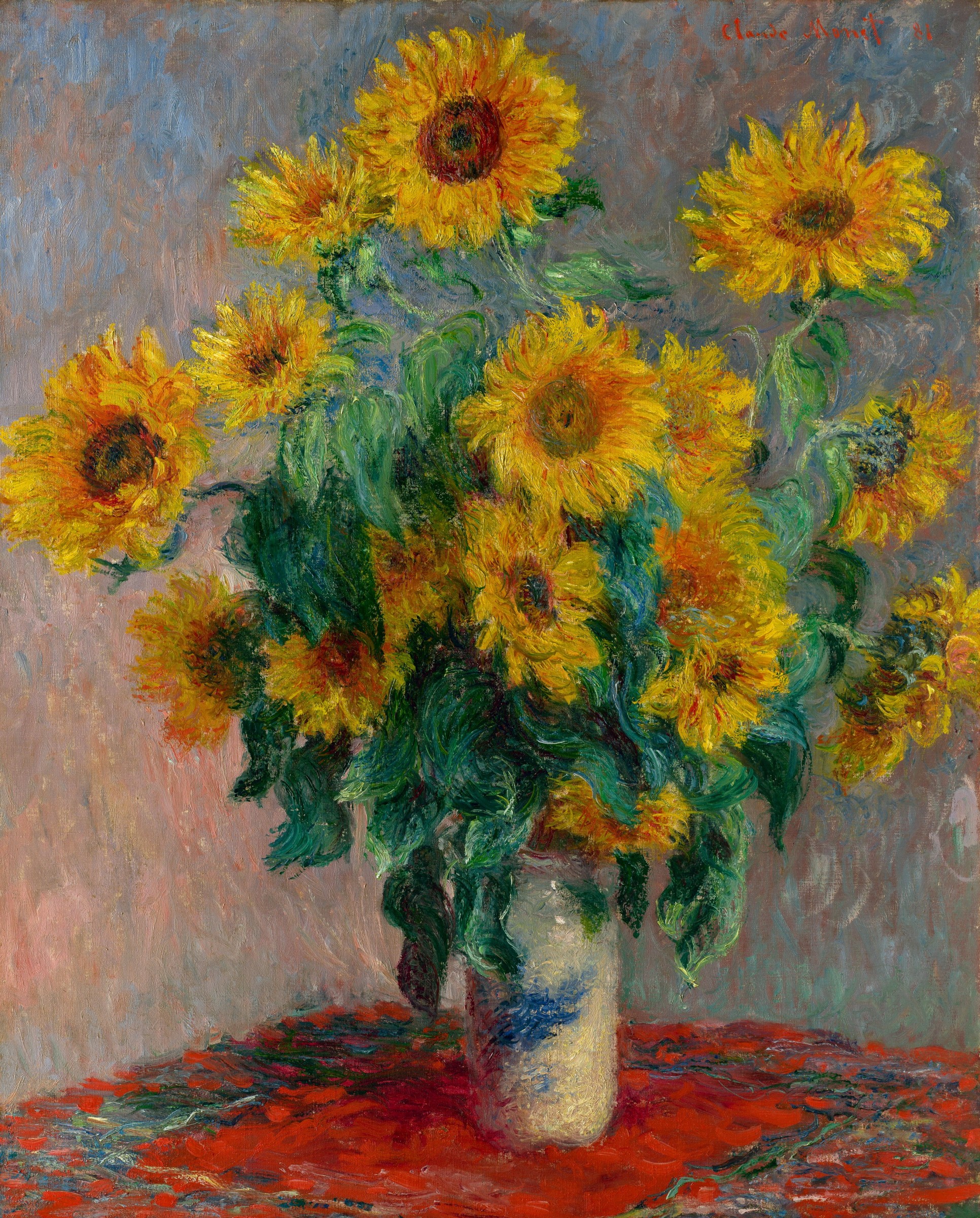
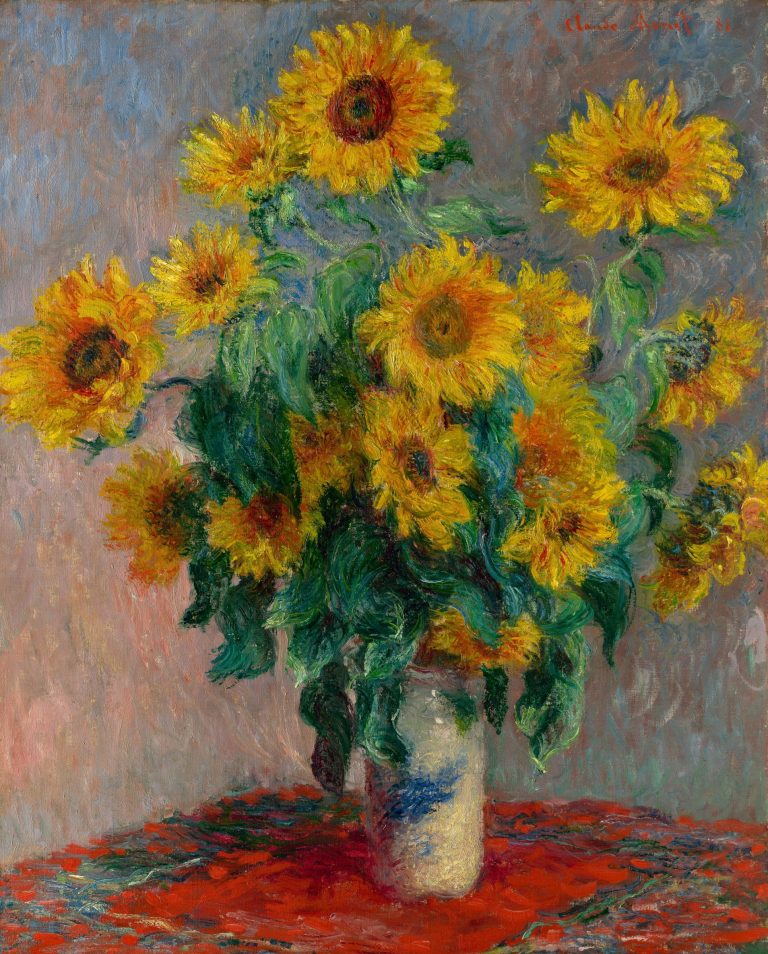
Compare this bouquet with Van Gogh’s yellow room near the start of the guide. Monet gives the flower heads a cool blue-grey setting, a decorated vase and a lively red surface beneath them. Yellow becomes one participant in a wider exchange of warm and cool colours.
The flowers grew along the path to Monet’s garden at Vétheuil. He showed the painting at the Impressionist exhibition of 1882. The Met also records Van Gogh’s later interest in a sunflower painting by Monet, discussed with Gauguin, which makes the comparison between the two artists more than a modern pairing of similar subjects.
Monet’s stems and leaves contribute to the bouquet’s outward movement. Some heads turn toward us and others turn away, so the arrangement feels irregular without losing its balance. The vase remains a firm base for that activity.
Collection and research reference: The Metropolitan Museum of Art, New York.
Claude Monet · oil on canvas, made to order
 Explore the artistMary Cassatt →

Cassatt places a heavy cluster of lilacs at a window, where the setting is almost as active as the flowers. Diagonal and upright lines pass behind the bouquet. Purple blossoms and green leaves spread over that firmer structure, while the dark vase anchors them to the sill.
This is one of Cassatt’s relatively rare pure still lifes. The Met dates it to about 1880 to 1883 and connects its subject with her interest in the effects of sunlight through a window. The painting shows another part of the artist’s practice beyond the women and children for which she is best known.
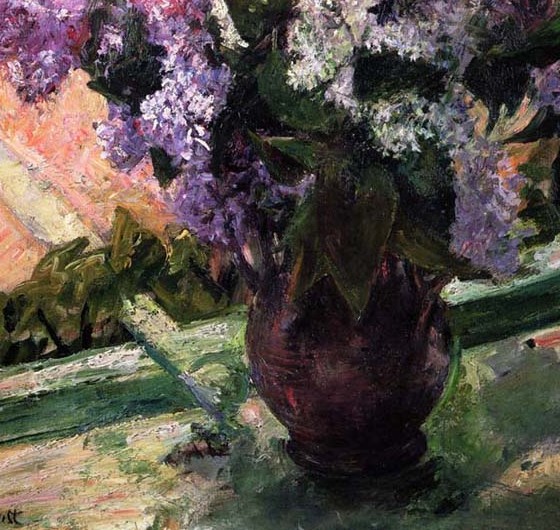
The window does not function as a neutral backdrop. Its lines help us feel the bouquet’s looseness, while the light gives different portions of the lilacs different degrees of clarity. Flowers become a way to study a place where inside and outside meet.
Collection and research reference: The Metropolitan Museum of Art, New York.
Mary Cassatt · oil on canvas, made to order
 Explore the artistAmbrosius Bosschaert the Elder →
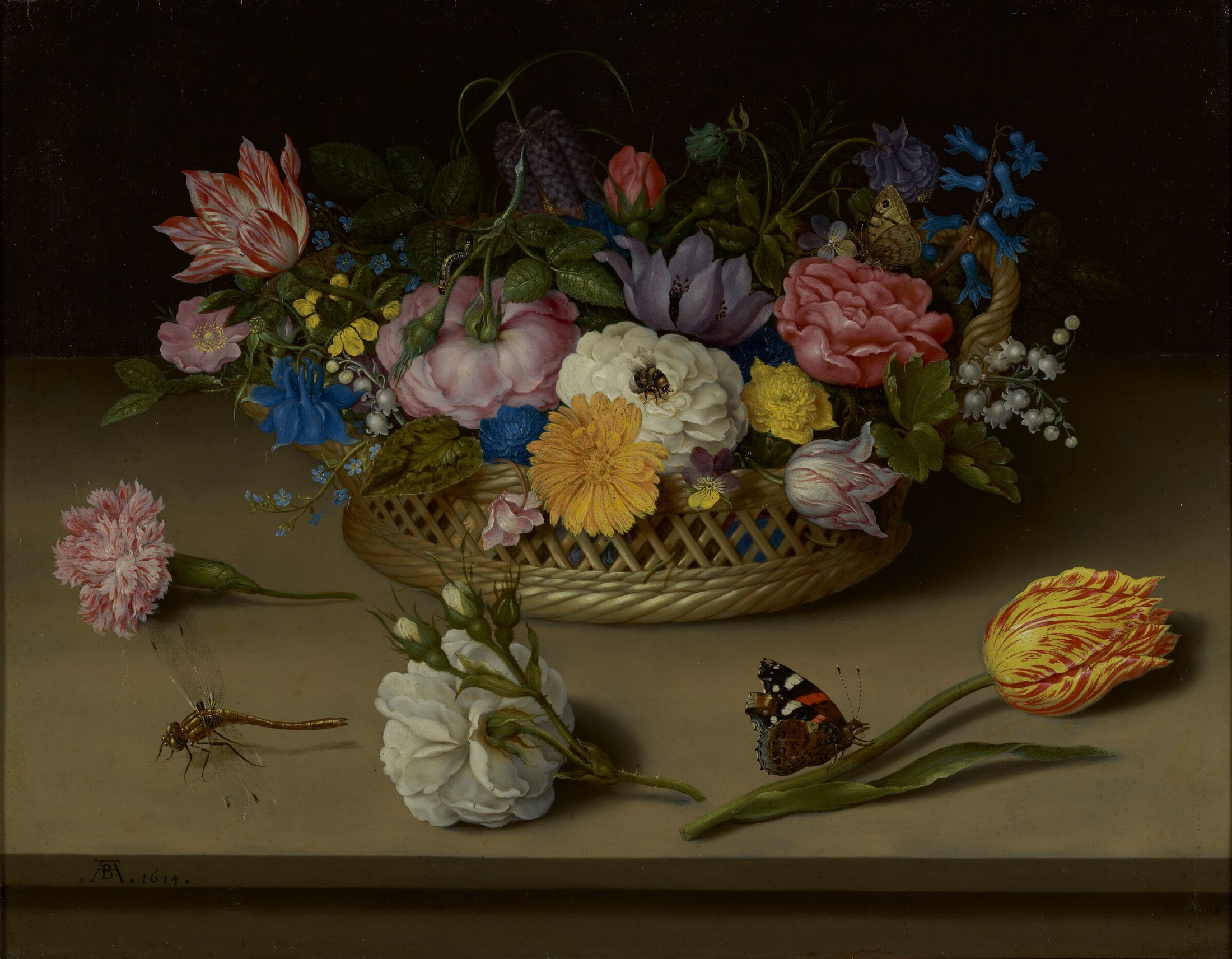
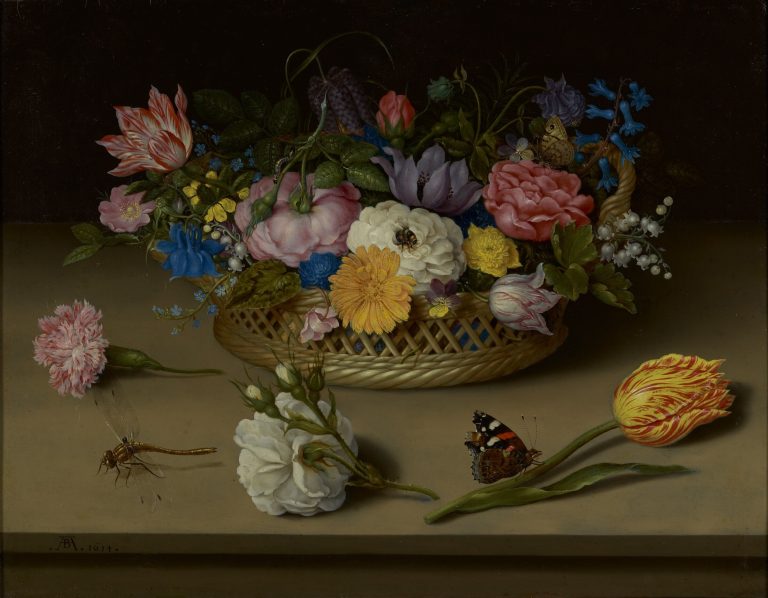
Here the flowers stand in a basket rather than a glass vase. Its woven sides offer a rough, regular texture beneath the differently shaped petals. In front, a pale rose turns away from us, a striped tulip lies to the right and tiny insects interrupt the bare surface.
Bosschaert brings together flowers that do not all bloom at the same time. The Getty therefore presents this as a carefully assembled image, not simply a record of a bouquet picked on one morning. Painted in 1614 on copper, the small work supports unusually precise attention to thorns, wings and opening buds.
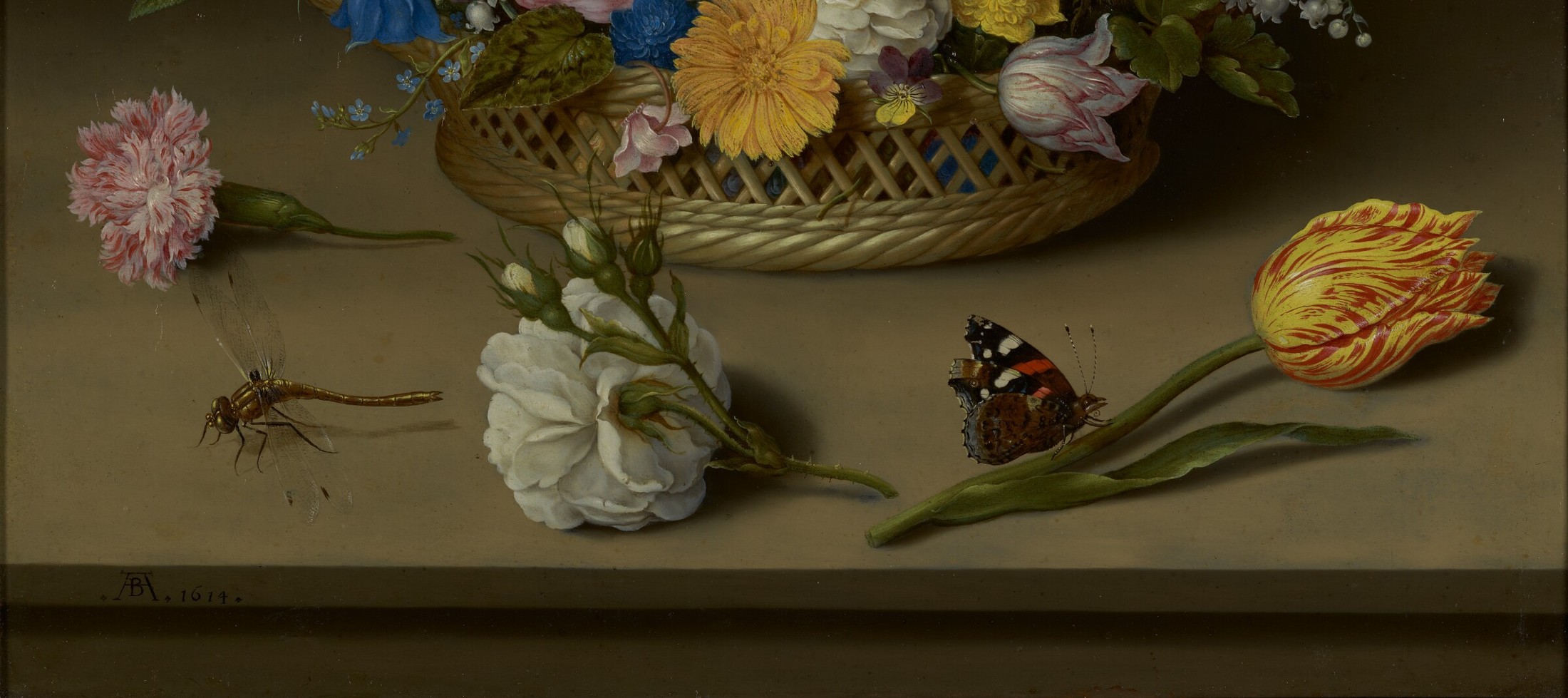
The loose foreground flowers invite a different kind of looking from the crowded basket. We can follow a complete stem, see a blossom from the side and compare a delicate wing with the edge of a petal. The arrangement makes room for both botanical description and thoughts about things that do not last.
Collection and research reference: J. Paul Getty Museum, Los Angeles.
Ambrosius Bosschaert the Elder · oil on canvas, made to order
 Explore the artistBerthe Morisot →
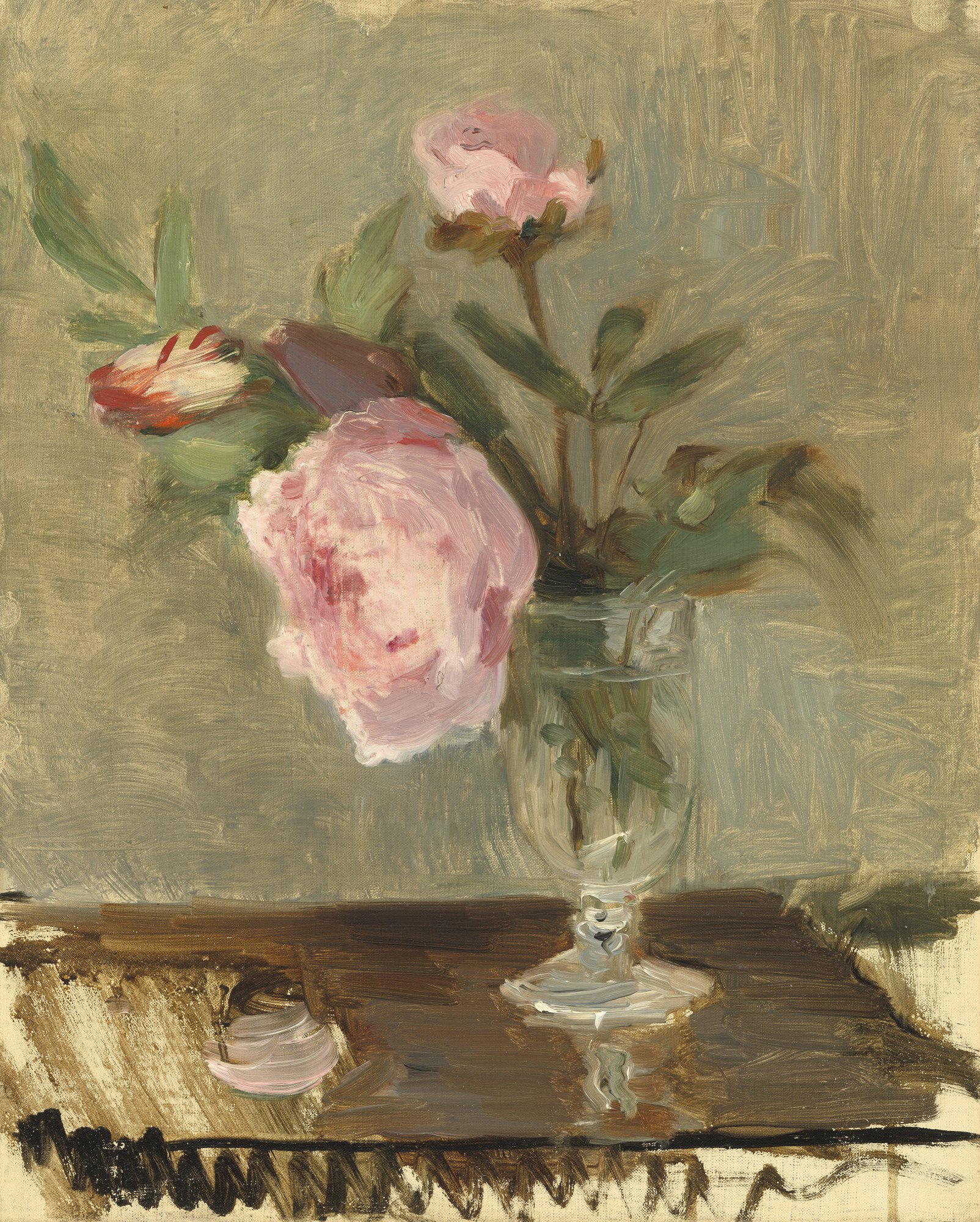
A peony bends over the rim of a clear glass. Another bloom rises above it, with smaller flower shapes and leaves spreading toward the left. The vessel is modest enough to resemble something brought to a table for ordinary use rather than a display selected for a ceremonial bouquet.
Morisot’s brushwork remains visible across the flowers, tabletop and background. The pale glass is held together by relatively few marks. Some areas near the bottom retain the exposed character of the support, which prevents the whole image from closing into a polished illusion.
The National Gallery of Art dates the painting to about 1869. A small fallen petal beside the glass gives the flowers a life beyond their upright stems. The subject is simple, but the handling keeps the encounter immediate and particular.
Collection and research reference: National Gallery of Art, Washington, DC.
Berthe Morisot · oil on canvas, made to order
 Explore the artistGustav Klimt →
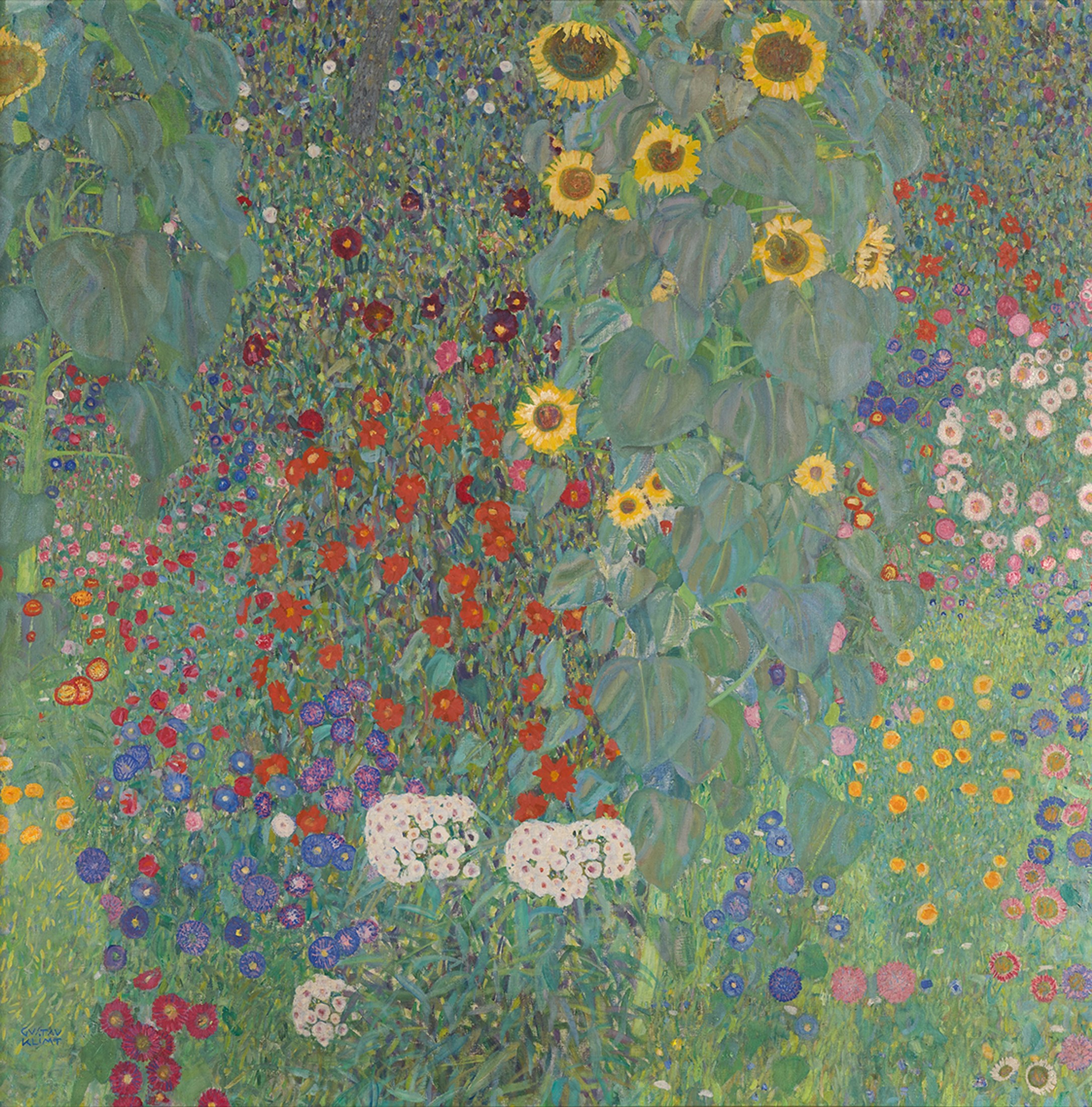
At first the garden looks almost like a patterned surface. Small spots of white, red, yellow and purple fill the lower area, while larger sunflower heads rise above them. There is no broad sky or path to guide us safely around the planting. We are brought straight up to its profusion.
The Belvedere’s current research dates this painting to 1906, although 1907 appears in older captions. Its English title is Cottage Garden with Sunflowers, also translated as Farm Garden with Sunflowers. It is distinct from Klimt’s separate Bauerngarten, or Flower Garden, of 1907.
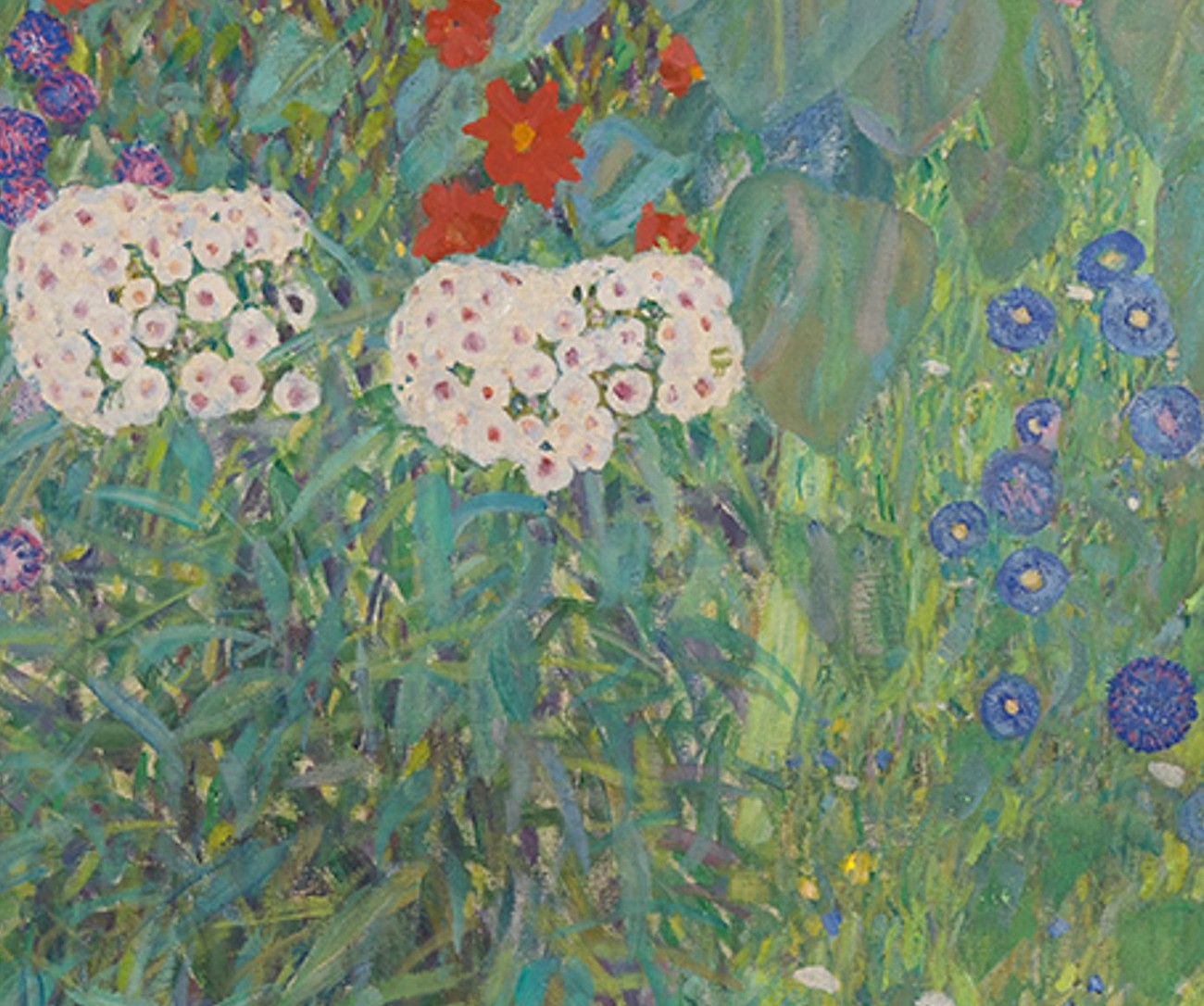
The different sizes of flowers keep the surface from becoming a uniform pattern. Large heads establish a loose upper structure; smaller blooms pull our attention sideways and downward. Klimt allows us to recognise a garden and to enjoy its colours as an arrangement across canvas at the same time.
Collection and research reference: Belvedere, Vienna.

Gustav Klimt · oil on canvas, made to order
 Explore the artistHenri Fantin-Latour →
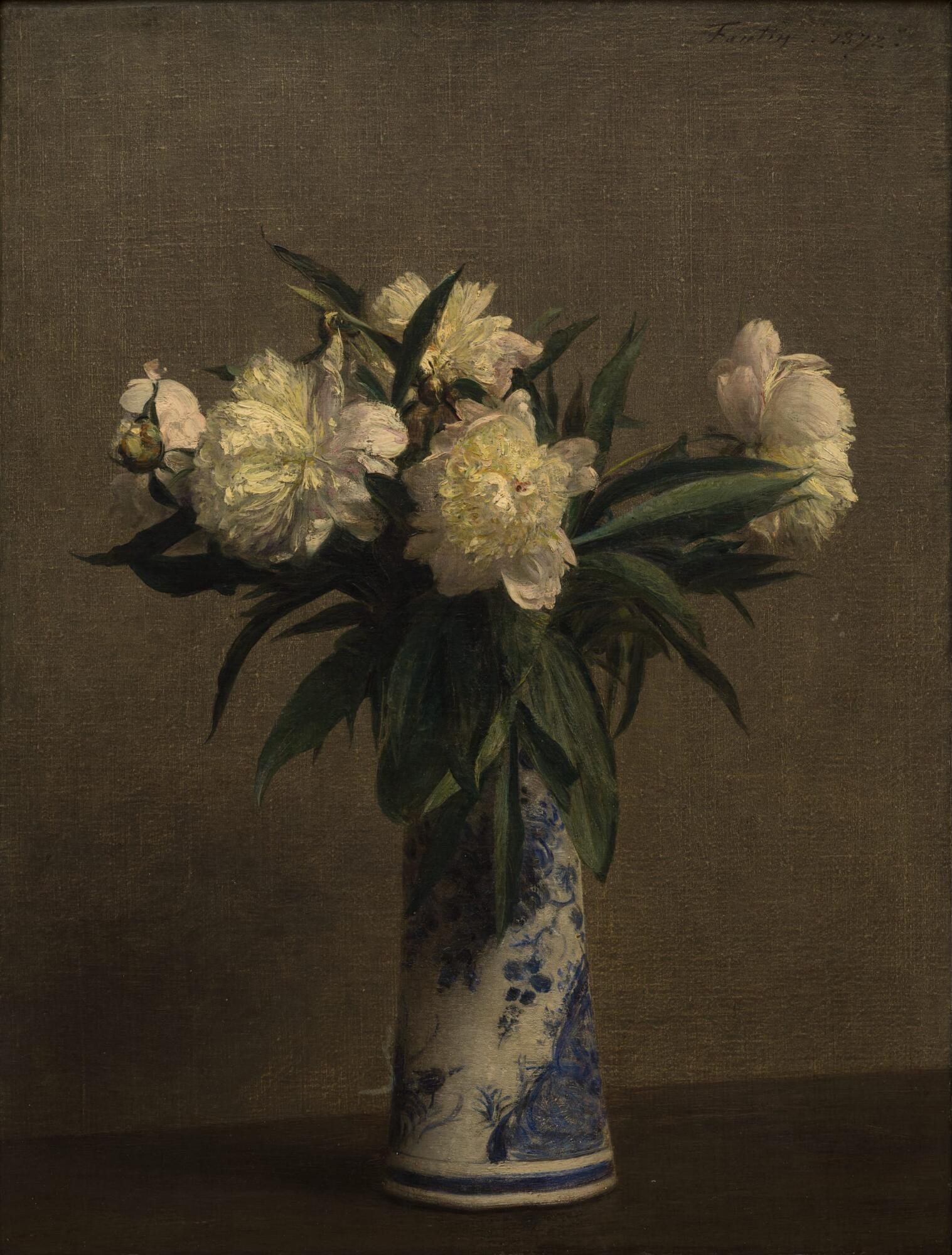
Fantin-Latour gives the pale blossoms room to separate from one another. Dark leaves appear between their heads, and the narrow vase supports the spread without competing with it. The background is quiet enough for a bent petal or a thin stem to become a significant event.
The Hammer Museum dates this oil painting to 1872. Its blue-and-white vessel makes a useful comparison with Chardin’s earlier vase, but Fantin’s flowers occupy a different kind of space: their light heads seem to emerge gradually from a darker surrounding atmosphere.
The painting invites close looking without requiring an elaborate symbolic story. Compare the edges of the white flowers with the darker leaves. Some boundaries are crisp and others nearly disappear, allowing the bouquet to feel soft without becoming indistinct.
Collection and research reference: Hammer Museum, Los Angeles.

Henri Fantin-Latour · oil on canvas, made to order
Explore the artistClaude Monet →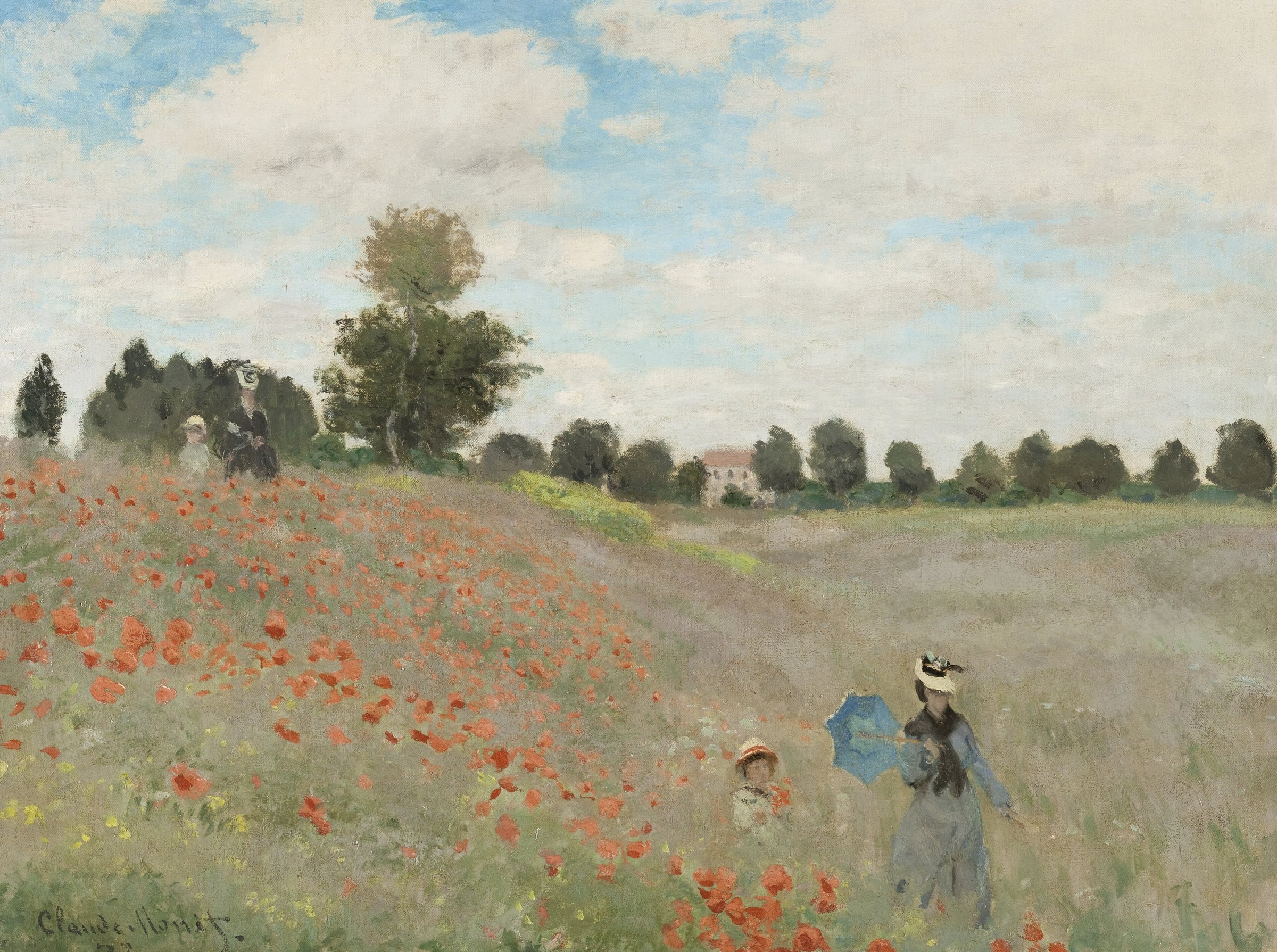
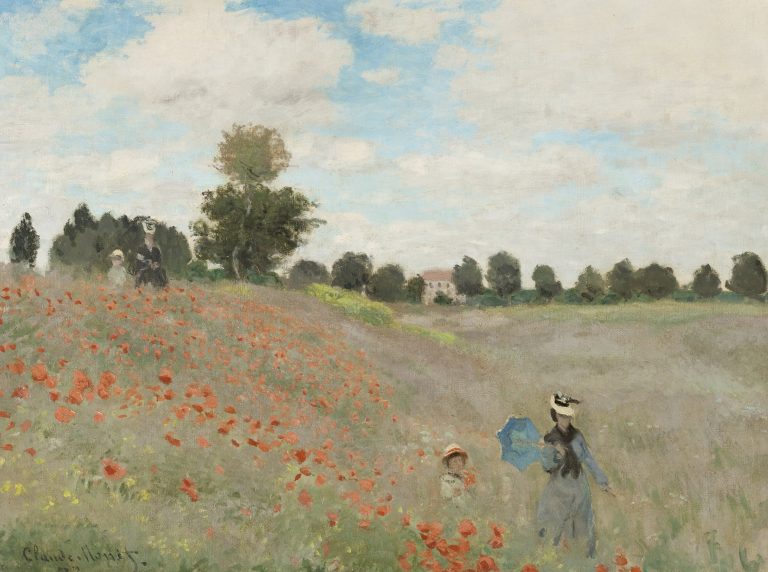
These flowers cannot be counted as easily as those in a vase. Red marks spread across the sloping field, growing larger and more widely separated near the viewer. Two pairs of figures help to carry our gaze through the landscape, but the poppies establish its most insistent rhythm.
Monet painted the scene in 1873 and included it in the first Impressionist exhibition in 1874. The Musée d’Orsay notes how the enlarged marks in the foreground prioritise the visual impression over precise botanical description. What looks almost abstract close up becomes a flowering field when seen as a whole.
The painting widens the idea of a flower picture. Blossoms can organise an entire landscape rather than appear as a collected object. The red does not merely decorate the grass; it helps create distance, movement and the sensation of a summer walk.
Collection and research reference: Musée d’Orsay, Paris.
Claude Monet · oil on canvas, made to order
 Explore the artistJean-Baptiste-Siméon Chardin →

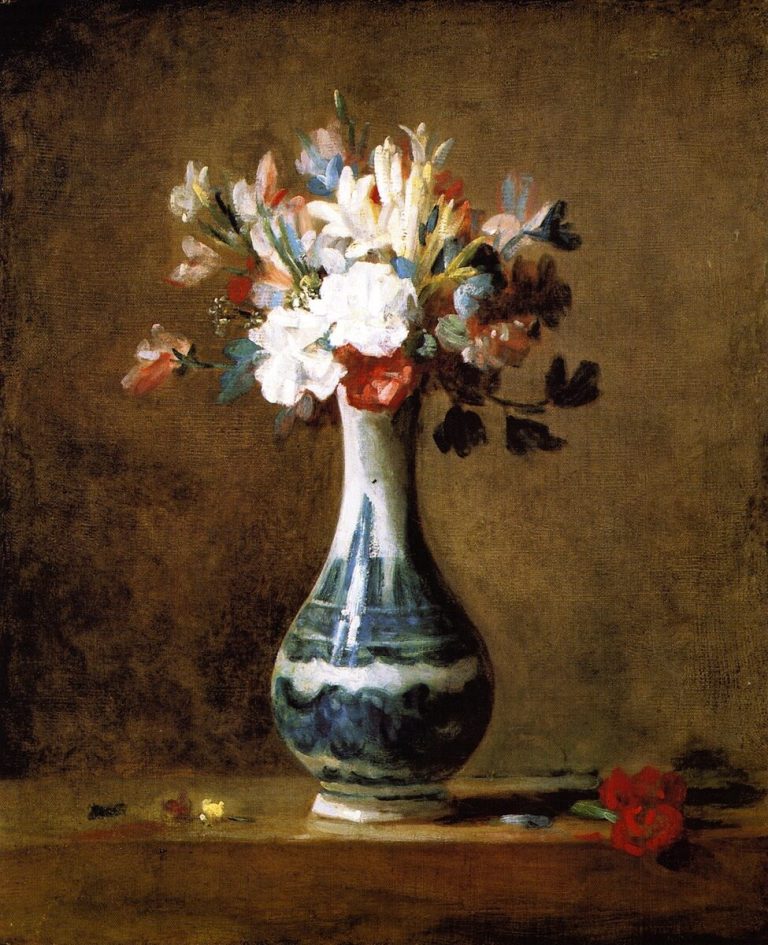
Compared with Ruysch’s deep shadows, Chardin’s subdued room asks the eye to adjust. The vase rests on a plain ledge. The flowers do not compete through sharp outlines or an extraordinary number of specimens. Their colours settle into the surrounding greys and browns.
The National Galleries of Scotland identifies this as Chardin’s only surviving flower painting and dates it to about 1750 to 1760. Carnations, tuberoses and sweet peas are among the flowers described in its collection literature. The individual blooms remain recognisable without acquiring the hard clarity of a botanical diagram.
Spend a moment looking away from the brightest petals. Small changes in the background make the vase feel rounded, while fallen flowers soften the ledge. Nothing spectacular has happened, yet the arrangement becomes more substantial the longer we stay with it.
Collection and research reference: National Galleries of Scotland, Edinburgh.
Jean-Baptiste-Simeon Chardin · oil on canvas, made to order
 Explore the artistOdilon Redon →
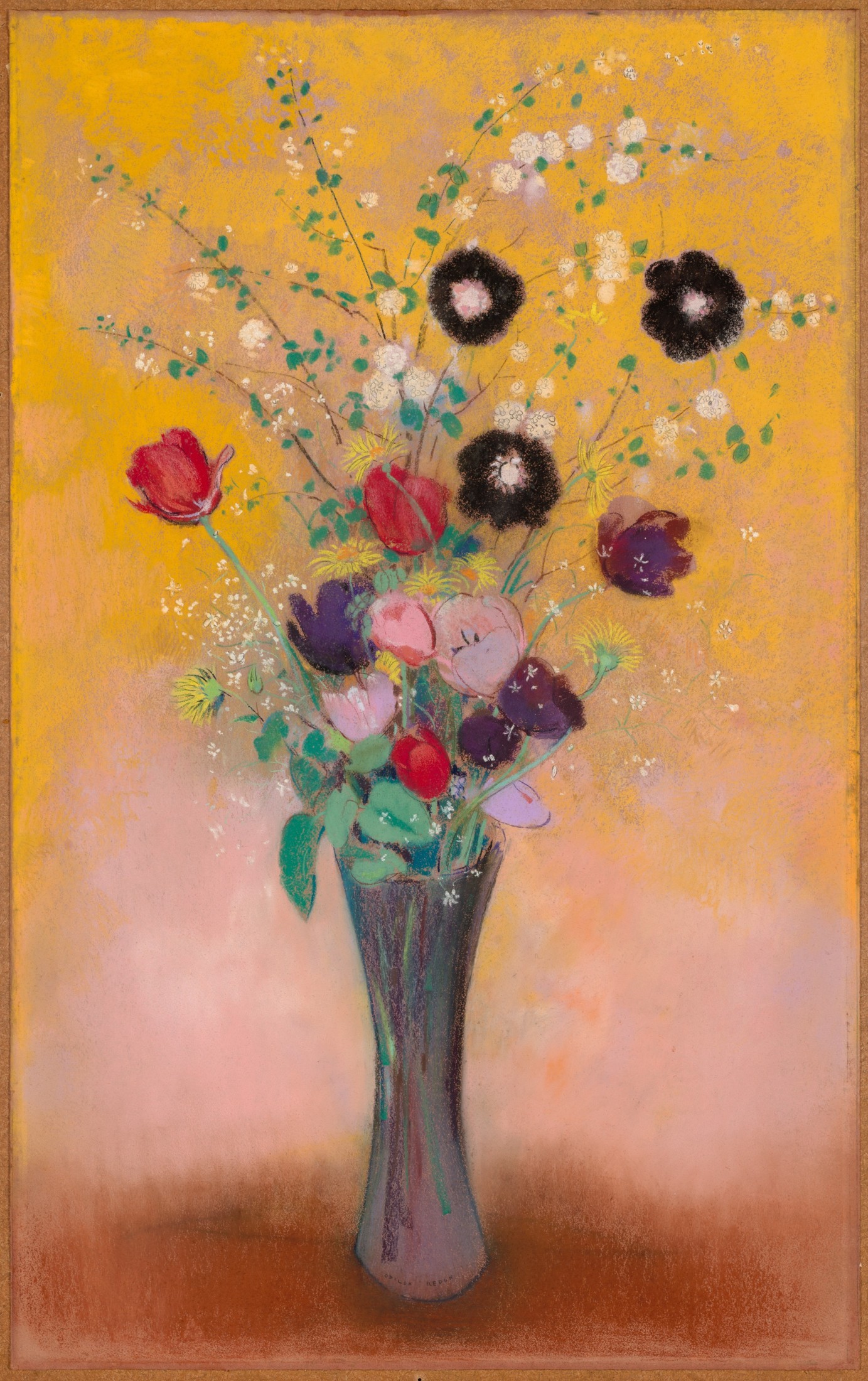
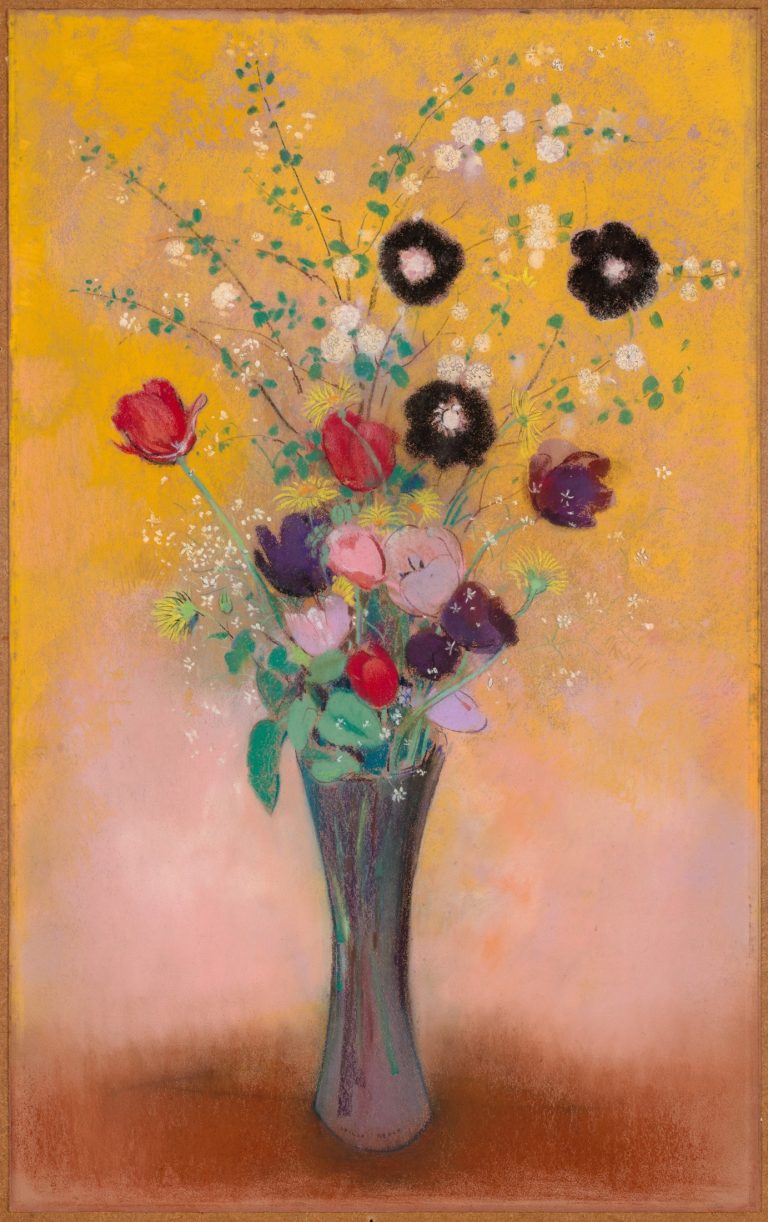
Redon leaves a great deal of space between his flowers. Yellow, red and dark rounded heads seem to hover against a glowing orange background, while a long, narrow vase holds the arrangement near the bottom. The setting offers little sense of a specific room.
This work is pastel, not oil paint. Cleveland dates it to 1916 and records the sheet at 84.1 by 58 centimetres. The distinction matters to its appearance: the coloured surface has a powdery softness that differs from the heavy oil paint in Van Gogh’s seed heads.
Rather than turning every blossom into a sharply described specimen, Redon allows some forms to remain suggestions. Their intervals are part of the pleasure. The eye moves through the luminous space around the flowers as much as through the flowers themselves.
Collection and research reference: Cleveland Museum of Art.
Odilon Redon · oil on canvas, made to order
 Explore the artistMartin Johnson Heade →

The orchid opens close to us, but the scene behind it drops away into mist and vegetation. Three hummingbirds gather around a nest on the same spreading branch. The flower is large in the foreground without being separated from the living setting around it.
Heade painted this small work in oil on wood in 1871. It joins close attention to a flower with the depth and atmosphere of a landscape. The National Gallery of Art’s educational material relates his orchid and hummingbird subjects to his study of South American environments.
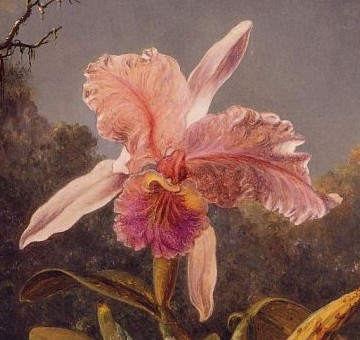
Notice how the curved petals and the birds’ narrow beaks offer different kinds of delicacy. The arrangement gives the orchid a commanding scale, but the nest and tiny birds keep interrupting any attempt to treat it as an isolated decorative specimen.
Collection and research reference: National Gallery of Art, Washington, DC.
Martin Johnson Heade · oil on canvas, made to order
 Explore the artistÉdouard Manet →
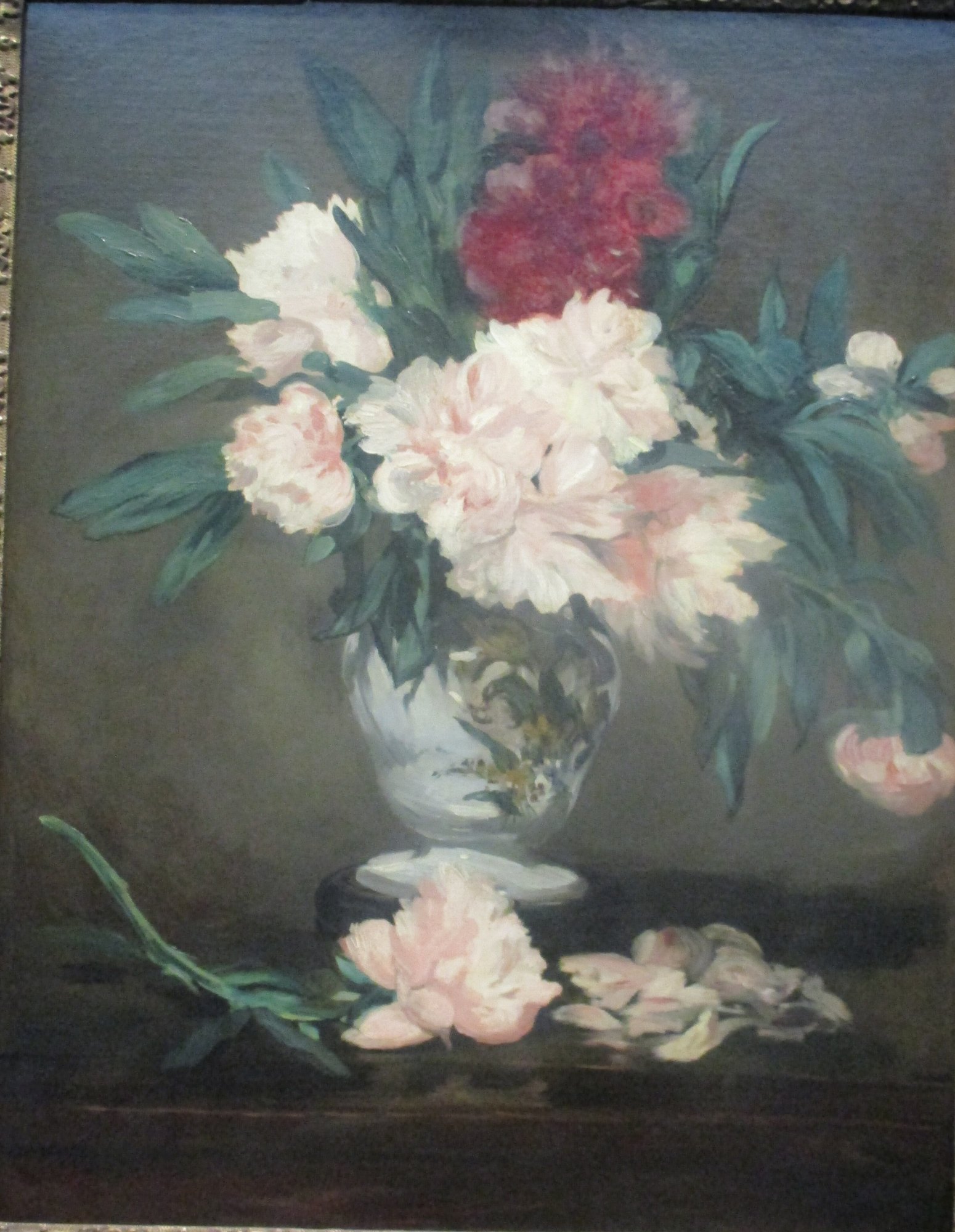
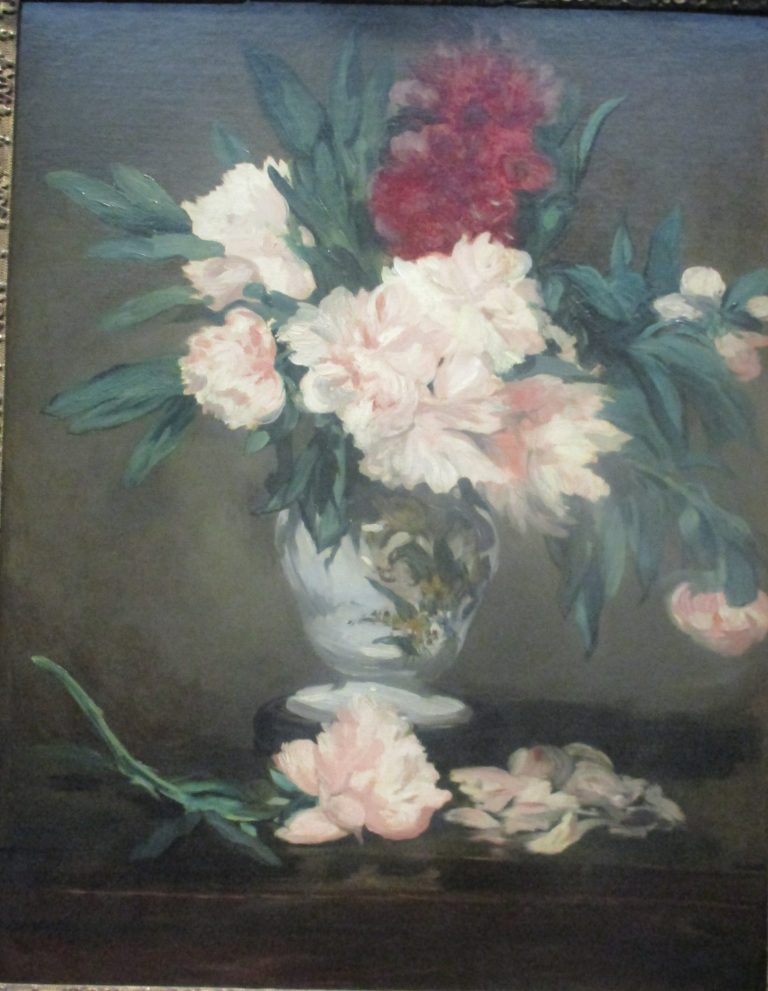
The large white and pink peonies seem almost too heavy for their stems. Against the dark background, their light petals break into broad patches of paint. The decorated vessel holds the upright flowers, while another group lies on the surface beneath it.
Manet painted several peony still lifes in 1864 and 1865. The canvas shown here is the Musée d’Orsay’s 1864 Vase of Peonies on a Pedestal. It should not be confused with the Met’s narrower Peonies, which is a different arrangement.
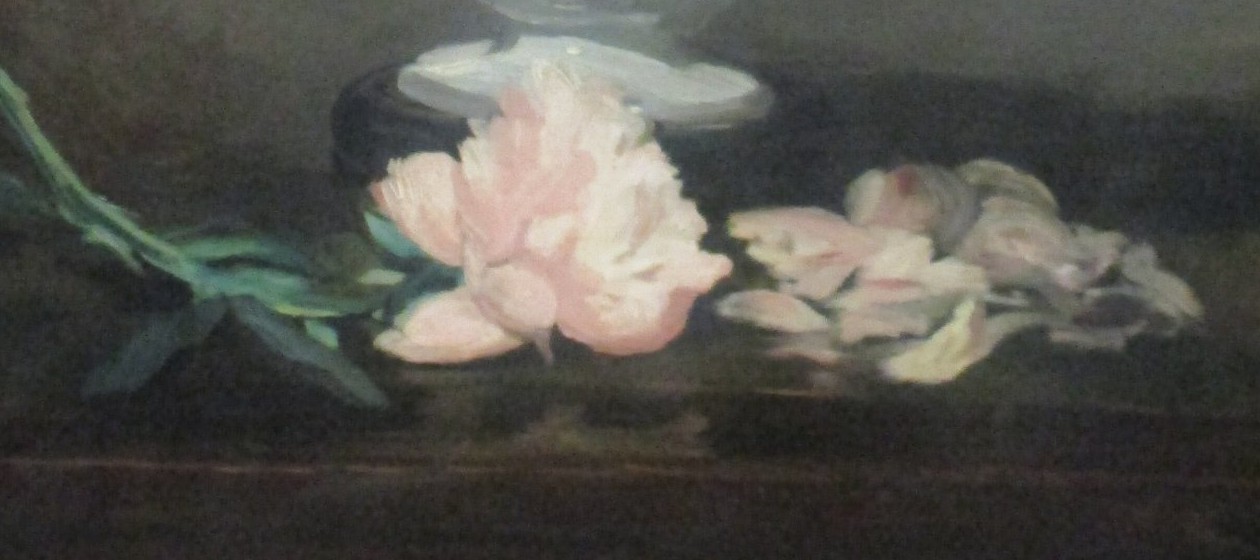
The flowers below the vase change the balance of the picture. Their sideways position lets us see petals that are harder to distinguish in the crowded bouquet. Upright growth and cut, resting stems become two different ways to describe the same kind of flower.
Collection and research reference: Musée d’Orsay, Paris.
Edouard Manet · oil on canvas, made to order
Explore the artistRachel Ruysch →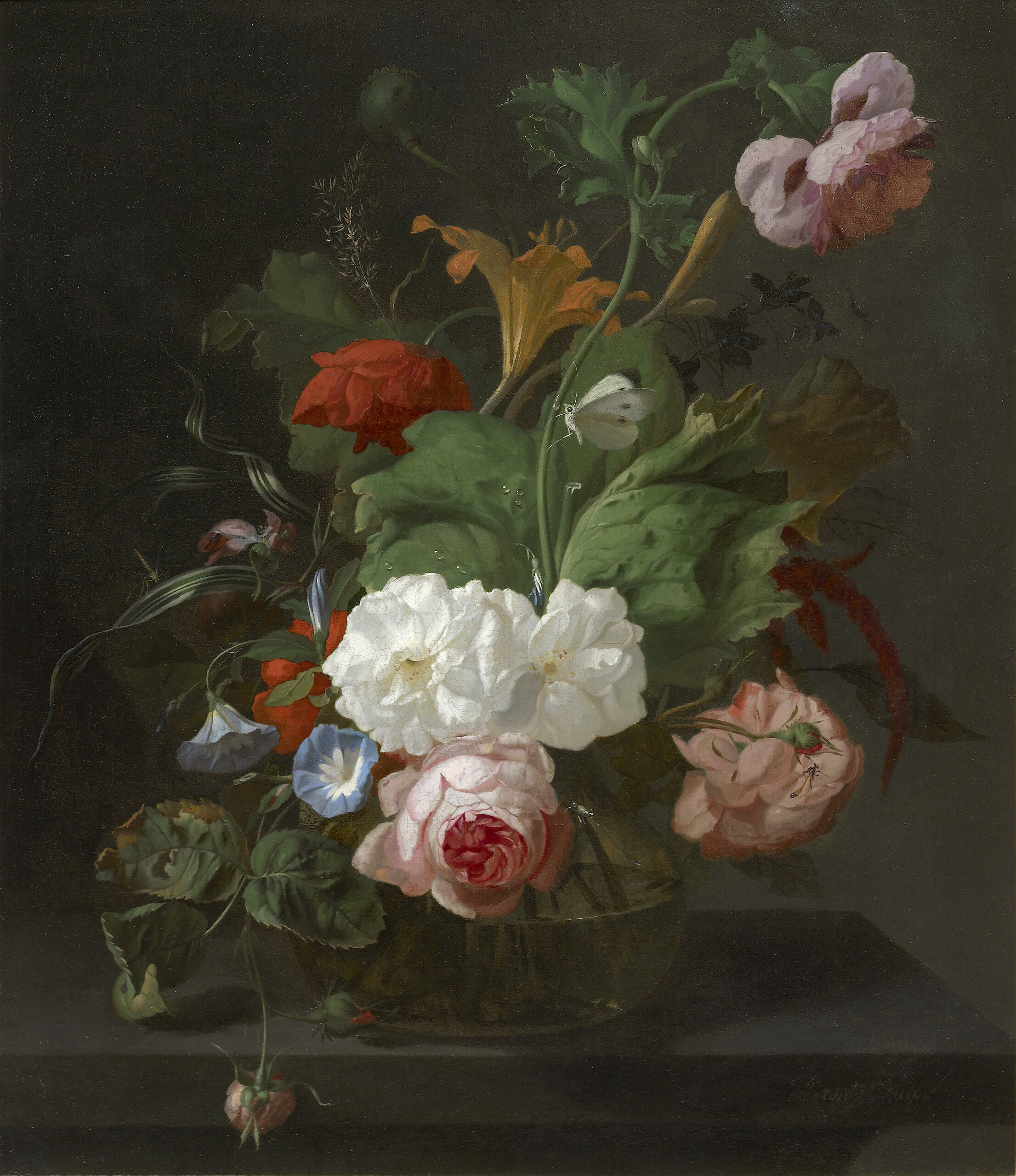
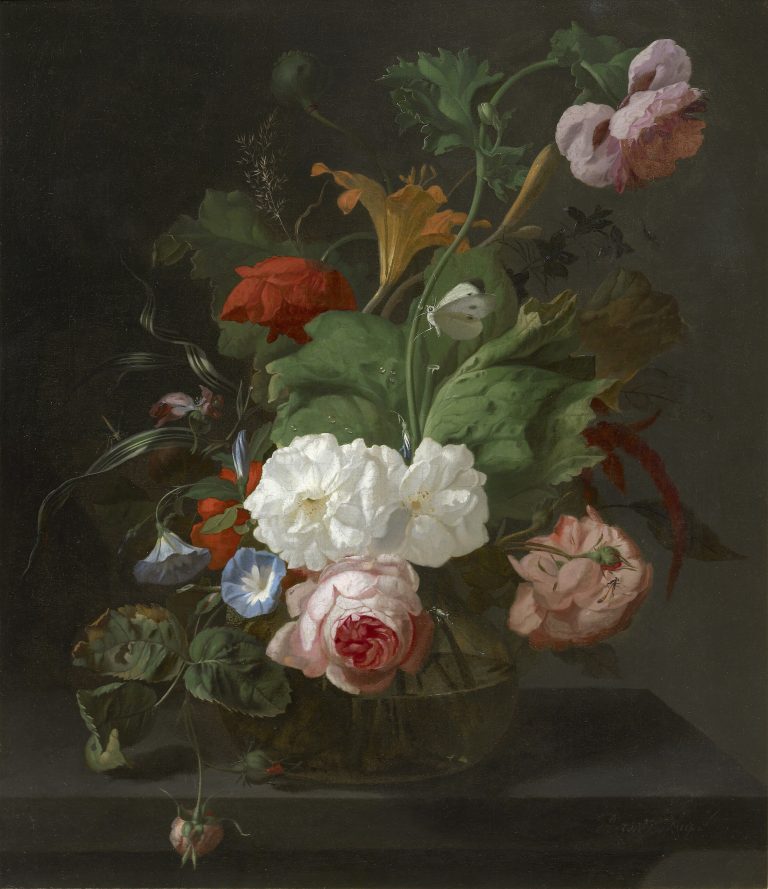
A light rose opens near the centre, while taller stems turn away into shadow. The glass vase is much less conspicuous than the flowers it supports. Below the main cluster, blue and pale blooms trail toward the ledge, extending the arrangement beyond a simple upright triangle.
Ruysch makes abundance depend on intervals. Dark gaps allow separate petals and stems to remain legible, and a small flower near the stone edge gives the lower part of the painting something to hold. We move between a large display and details that require a slower look.
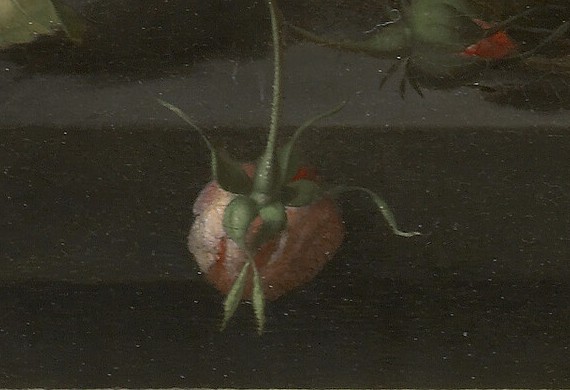
The precise version matters here. This is the composition recorded under the historical loan number L191 and associated with Hoogsteder & Hoogsteder, not the Mauritshuis’s different Vase with Flowers of 1700, inventory 151. Ruysch painted many bouquets; shared titles do not make their dates, dimensions or ownership interchangeable.
Collection and research reference: Private collection; recorded as Mauritshuis loan L191.
Rachel Ruysch · oil on canvas, made to order
Explore the artistClaude Monet →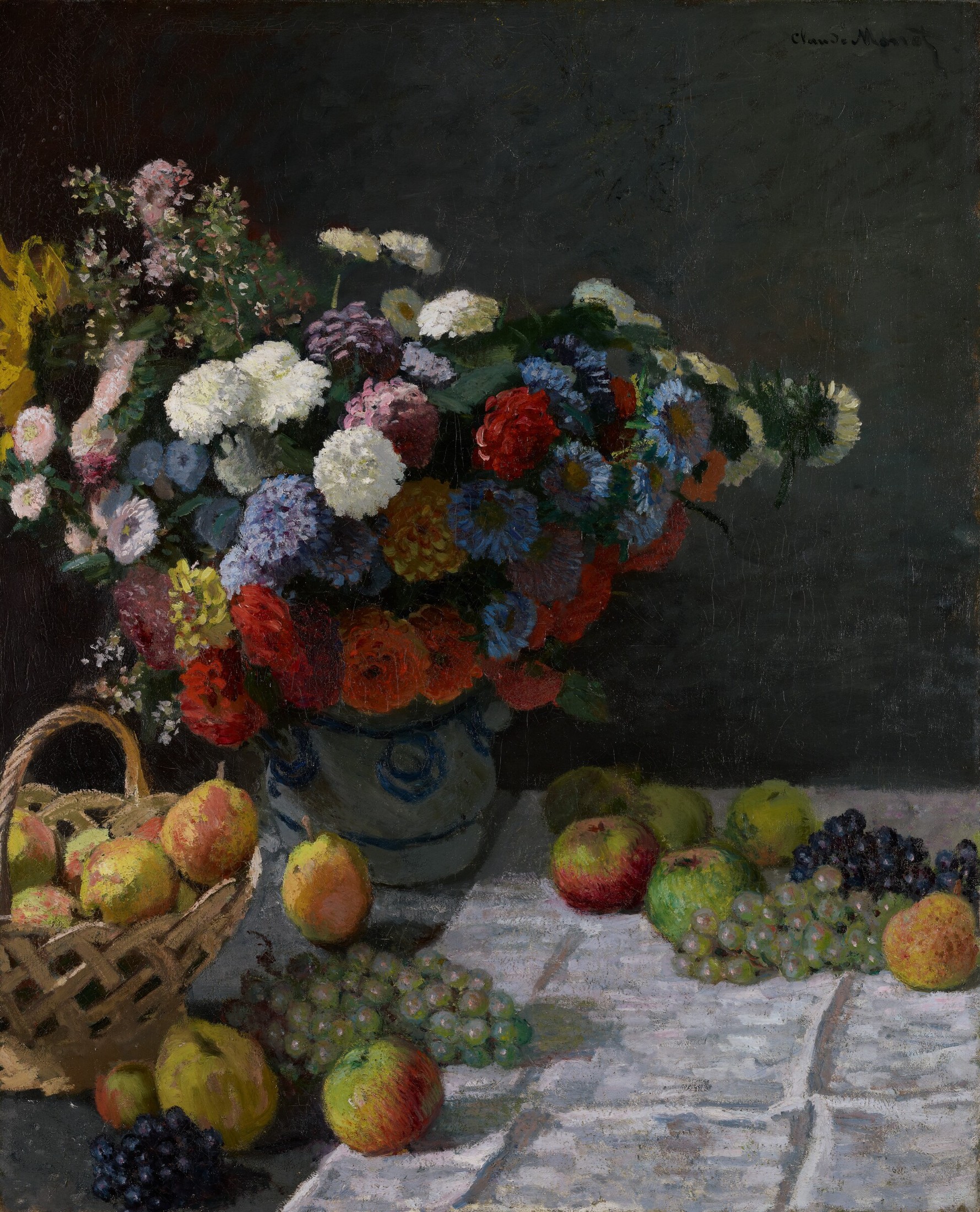
Monet gives the bouquet company. A basket of fruit fills the lower left, apples sit on the light cloth and grapes spread across the right. These objects bring the flowers into a larger arrangement of different weights, textures and colours.
The Getty dates the painting to 1869, before the first Impressionist exhibition. The dark setting differs from the open field of Poppies, but the handling already encourages comparisons across surfaces: flower heads break into many small touches, fruit holds broader patches of colour and the cloth carries larger changes of light.
The tall vase draws the eye upward while the low basket pulls it back toward the table. Flowers do not need to fill the whole picture to remain its highest point. This is a useful example of how a floral still life can share its structure with fruit and household objects.
Collection and research reference: J. Paul Getty Museum, Los Angeles.
Claude Monet · oil on canvas, made to order
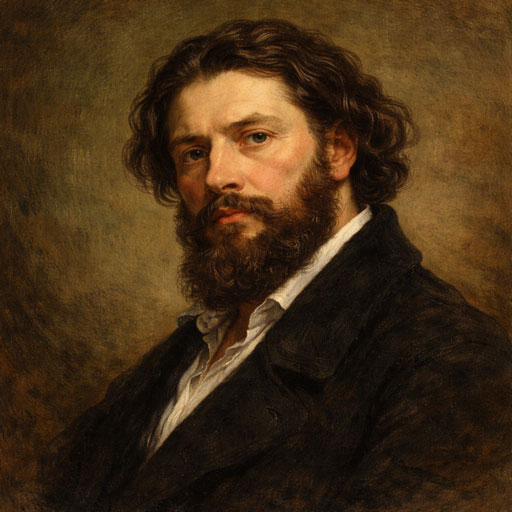 Explore the artistGustave Courbet →
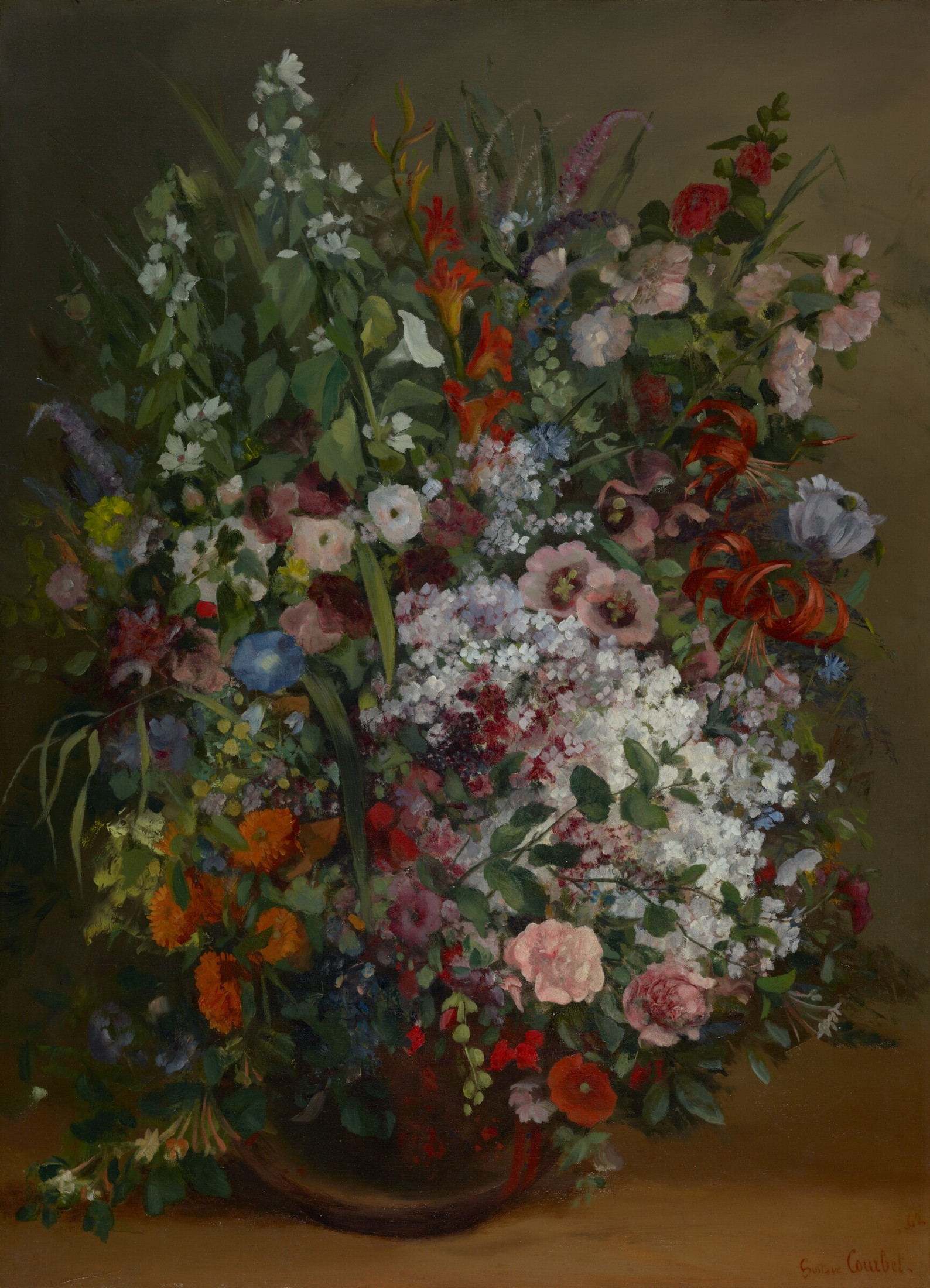
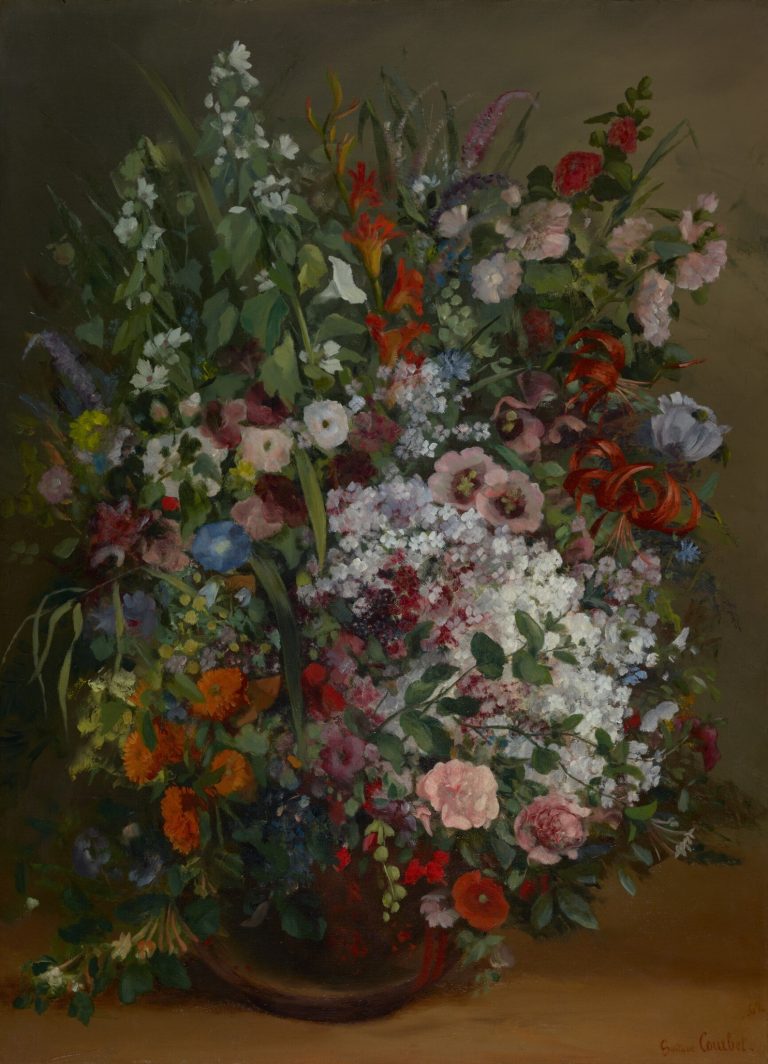
The flowers press against one another without becoming a smooth, polished surface. Pale heads crowd the right, while darker reds and greens hold the left together. The vase provides a rounded base, but much of our attention stays with the changing density of the paint above it.
Courbet took up flower painting enthusiastically during an extended stay near Saintes in western France in 1862. His friend Étienne Baudry’s gardens and botanical resources gave him material to work with. The Getty connects this bouquet with Dutch flower painting, while noting Courbet’s broader handling and use of a palette knife.
That contrast is worth keeping in view. A Realist painter can observe flowers seriously without giving every petal a hard outline. Here the masses of colour and the thickness of the paint help describe the bouquet’s abundance.
Collection and research reference: J. Paul Getty Museum, Los Angeles.
Gustave Courbet · oil on canvas, made to order
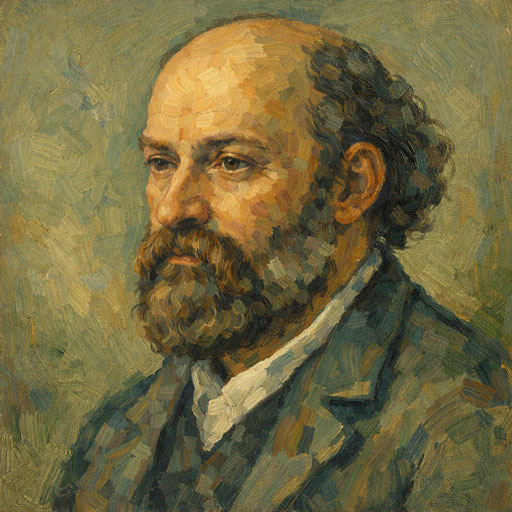 Explore the artistPaul Cézanne →
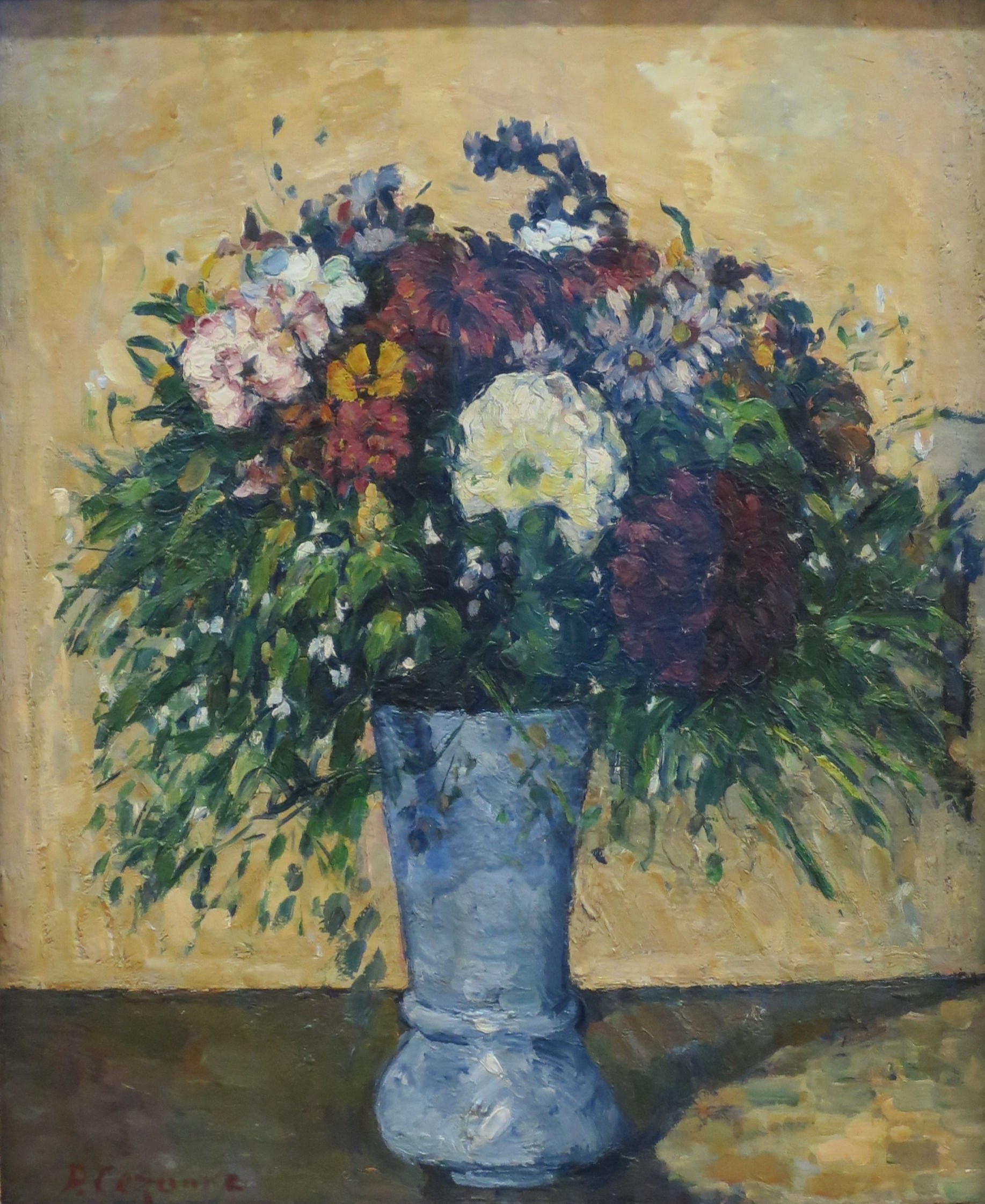
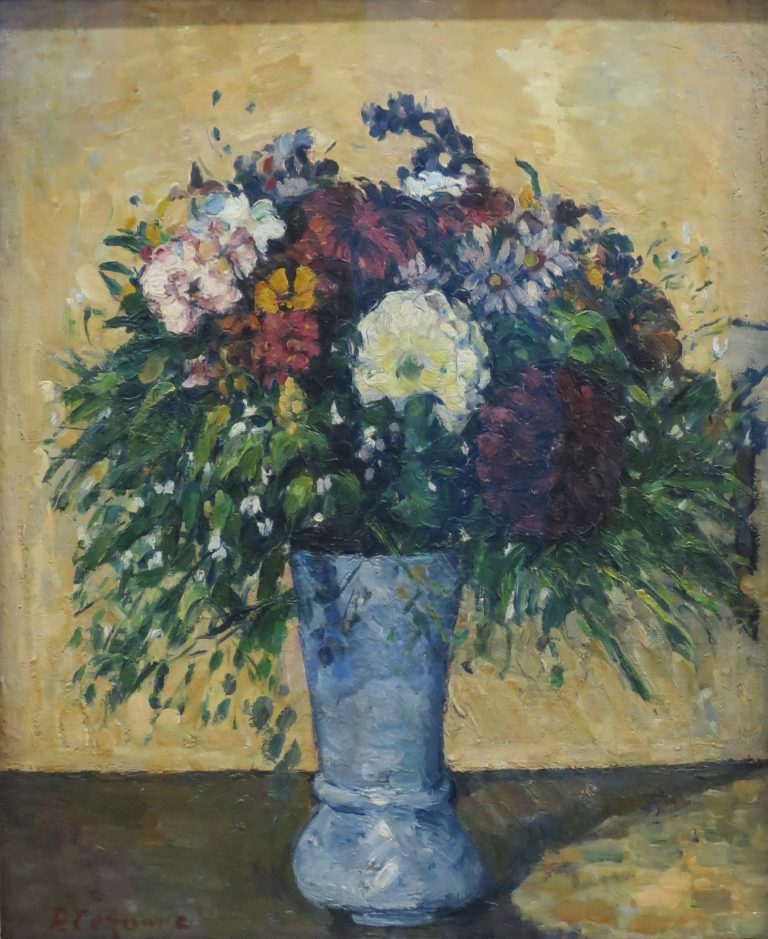
Cézanne’s vase is a substantial object. Its rounded foot and cool blue body occupy the lower part of the painting, while the bouquet spreads above it in patches of white, red, green and blue. The flowers are not all described with the same sharpness. Colour helps establish their place before individual species become clear.
The Société Paul Cézanne catalogue identifies this Hermitage painting as Fleurs dans un vase and dates it to about 1877. Earlier dates also appear in the literature. It is not the later Blue Vase in the Musée d’Orsay, despite the similar English titles and the shared colour of the vessel.
The table edge and the background remain active around the bouquet. Instead of offering an empty stage for bright petals, they join the same construction of coloured planes. The arrangement becomes a way to consider how a painting holds solid things together.
Collection and research reference: State Hermitage Museum, Saint Petersburg.
Paul Cezanne · oil on canvas, made to order
 Explore the artistJuan de Zurbarán →
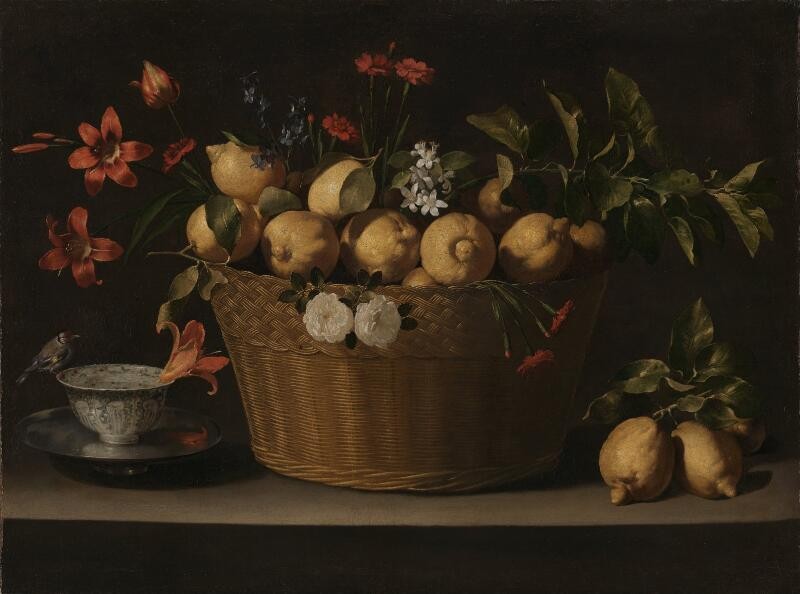
The lemons arrive with their leaves still attached. Among them and around the basket, flowers introduce smaller flashes of red, blue and white. To the left, a goldfinch sits on the rim of a bowl, above water that holds a floating lily. The basket may dominate the title, but flowers help organise the whole still life.
The National Gallery dates the painting to about 1643 to 1649. Its artist is Juan de Zurbarán, the son of Francisco de Zurbarán. That distinction matters when searching for the work: the famous surname belongs to two painters.
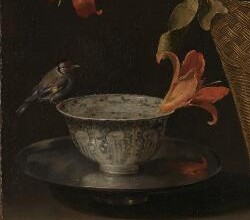
Here there is a stronger basis for a religious reading than in a bouquet whose purpose is unknown. The Gallery relates the water and lily to the Virgin Mary’s purity, and the goldfinch to Christ’s Passion. Those associations belong to its interpretation of these particular objects; they do not turn every painted bird or flower into the same symbol.
Compare the regular weave of the basket with the curling leaves and rough lemon skins. Juan gives each surface a different character, while the low bowl and reflective tray keep the broad arrangement from resting on the basket alone.
Collection and research reference: National Gallery, London.
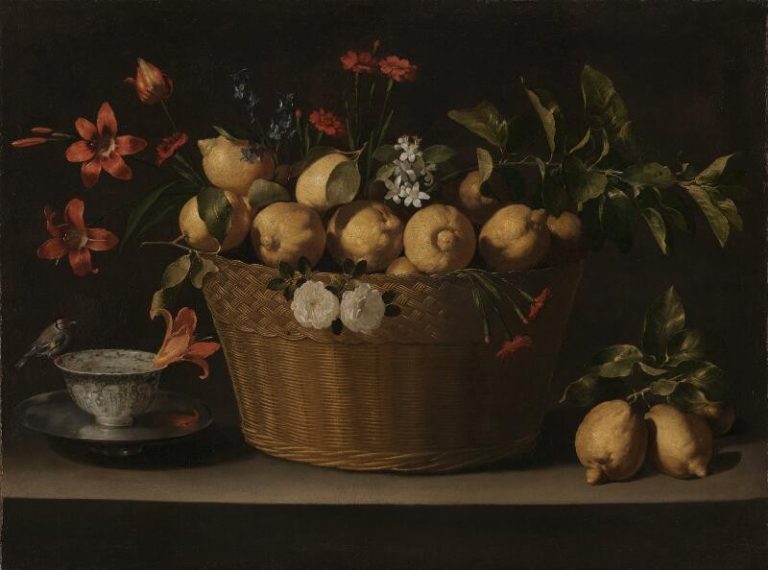
Juan de Zurbarán · oil on canvas, made to order
A flower can carry an association, organise a patch of colour or do both. Before reaching for a dictionary of symbols, ask whether the painter has supplied a story, an occasion or a visible contrast that supports the interpretation.
Van Gogh and Monet’s sunflowers: start with the backgrounds. Van Gogh limits the setting to yellow, while Monet surrounds yellow heads with cooler colour and a patterned table. The same flower produces two very different relationships between bouquet and room.
Manet, Morisot and Fantin-Latour’s peonies: compare the vessels and the space around them. Manet’s tall arrangement spills into flowers lying below; Morisot uses a small clear glass; Fantin’s pale heads open above a slender decorated vase. Flower type alone tells us little about the finished picture.
Ruysch and Chardin’s bouquets: look at how light reaches their objects. Ruysch separates flowers from a deep dark setting, while Chardin draws petals, vase and background into a quieter range of tones. Neither needs to look like the other to make a flower feel convincingly present.
Vincent van Gogh, Claude Monet, Rachel Ruysch, Henri Fantin-Latour and Martin Johnson Heade are useful starting points. Mary Cassatt, Berthe Morisot, Édouard Manet, Chardin and Paul Cézanne also painted flowers, each bringing a different handling of light, structure or paint to the subject.
A floral still life usually shows cut flowers arranged in a vase, on a table or among other objects. Flower painting is a broader description: it can also include growing irises, a field of poppies, a flowering tree or Monet’s water garden.
Van Gogh painted several sunflower compositions in Paris and Arles and made repetitions of some arrangements. The London painting shown here dates to 1888. A work called Sunflowers should be identified by its date, collection and composition rather than treated as one unique image.
No. Monet returned to his water garden at Giverny in many paintings. The 1899 Water Lilies and Japanese Bridge in this guide belongs to Princeton University Art Museum. It differs from later canvases that concentrate on the pond’s reflections and omit the bridge.
Flowers can suggest growth, beauty, abundance or the passing of time, but their meaning depends on the work. Van Gogh’s Almond Blossom was made for a newborn nephew, which gives its association with new life a documented context. A wilting flower may invite thoughts about transience without proving that every bouquet is a coded message.
Rachel Ruysch, Mary Cassatt, Berthe Morisot and Georgia O’Keeffe are represented. Ruysch’s two bouquets reward comparison, while Cassatt’s window, Morisot’s small glass and O’Keeffe’s enlarged Red Canna offer very different ways to look at flowers.
No. Most are oil paintings, but Bosschaert painted his Flower Still Life on copper, Waldmüller’s Roses is oil on panel, and Redon’s 1916 Vase of Flowers is pastel. O’Keeffe’s Red Canna is oil on canvas mounted to Masonite. The material is identified beneath each title.
ByMuseum’s Flowers and Still Life collection brings together available flower and still-life reproductions. Each artwork page provides the current size and frame options. The guide identifies the historical original separately from the reproduction offered for sale.
Enjoyed this story?
Save articles to your collection
Log in or create a free account, and this article will be waiting in your Private Collection.
Log in or sign upThis expanded selection was prompted by DailyArt Magazine’s floral still-life list. New entries follow the museums’ own records and independent close looking. Red Canna is reproduced with its museum credit.
Direct museum or scholarly references appear beneath every painting. Dates and collection names follow those records, including approximate dates where the record remains approximate. Collection ownership does not guarantee that a work is currently on display.
Full compositions remain intact; detail images are faithful crops. New image records retain their sources, credits and descriptive metadata. Historical painting and portrait credits are recorded with the images.

Man Writing a Letter
Gabriel Metsu, c. 1664
The gallery list
Every painting is already 50% off. Join the list and we will send you an extra $15 code, plus first access to new collections.
No spam. Unsubscribe anytime. · Privacy Policy
Welcome
Your $15 code is on its way. Explore the gallery while you wait.