Loading cart…
No products in the cart.

Art Guides · Neoclassicism
Save articles to your collection
Log in or create a free account, and this article will be waiting in your Private Collection.
Log in or sign upNeoclassical painting was art with a mission. In the 1740s, workmen digging at Pompeii and Herculaneum uncovered whole Roman towns frozen under volcanic ash, and Europe fell in love with the ancient world all over again. Painters turned away from the pink frivolity of the Rococo and gave their public heroes, duty and sacrifice, in sharp lines, cool colours and settings like a Roman stage. Then came the French Revolution and Napoleon, and these paintings became propaganda. This guide explores ten famous Neoclassical paintings, chosen using November 2026 search data and our catalogue, from a sworn oath to an emperor crowning himself.
Jacques-Louis David has eight of them. Start with the top three, or read the whole list below.
The style took its ideas from Johann Joachim Winckelmann, a German scholar who wrote in 1755 that the greatness of Greek art lay in its "noble simplicity and quiet grandeur". Neoclassical painters aimed for exactly that: clear outlines, smooth surfaces with no visible brushstrokes, figures arranged like ancient sculpture, and stories from Greek and Roman history that taught a moral lesson. The movement ran from about 1760 to 1830, and its leader, Jacques-Louis David, became painter to the Revolution and then to Napoleon. His pupil Jean-Auguste-Dominique Ingres carried it on.
 Explore the artistJacques-Louis David →
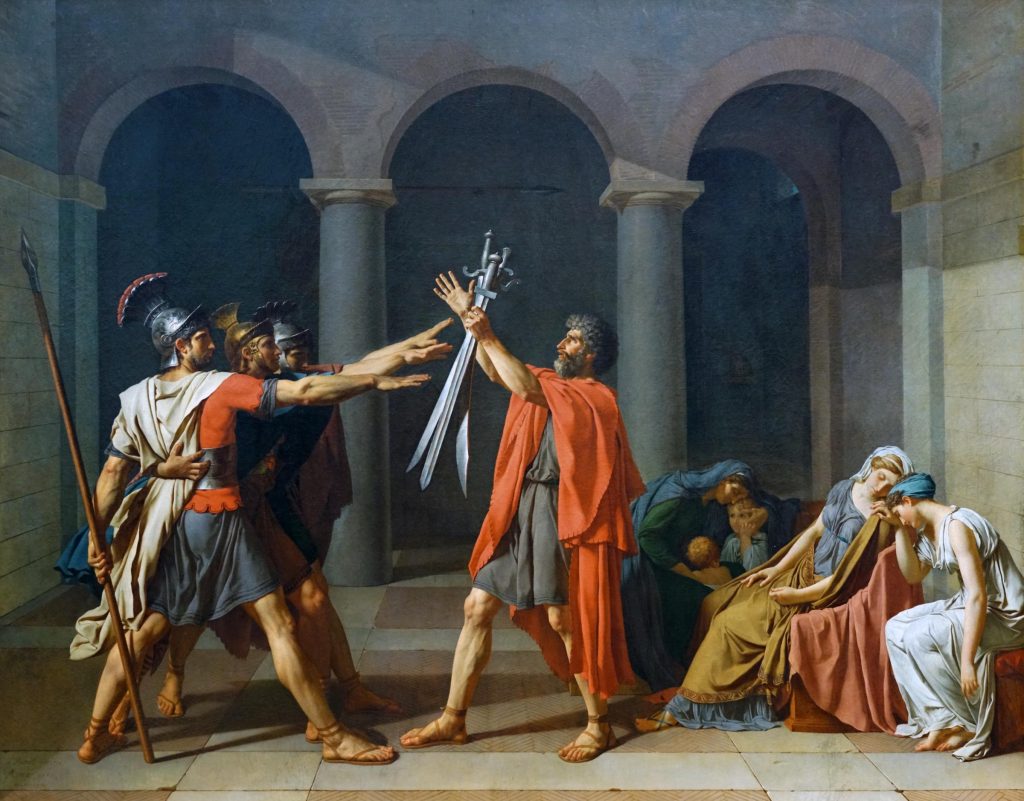
Rome and its neighbour Alba Longa are at war. To settle it, each city chooses three champions to fight to the death: the three Horatii brothers for Rome, the three Curiatii for Alba. In the centre, their father holds up three swords and the brothers stretch out their arms to swear they will win or die. Their bodies are hard and straight as the columns behind them.
Now look right. The women have crumpled. One sister, Camilla, is engaged to one of the Curiatii. Another woman is a Curiatii sister married to a Horatius. Whoever wins, they lose. David painted it in Rome for King Louis XVI, and when it was shown in Paris in 1785 it was an immediate success. Four years later the Revolution began, and its message of putting your country before your family took on a new meaning.
Collection reference · Musée du LouvreArtwork image from the ByMuseum catalogue.
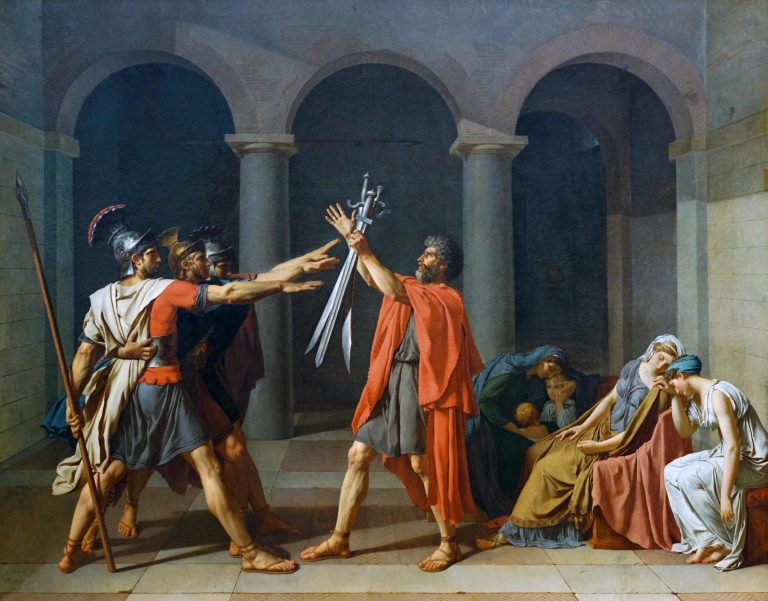
Jacques-Louis David · oil on canvas, made to order
Explore the artistJacques-Louis David →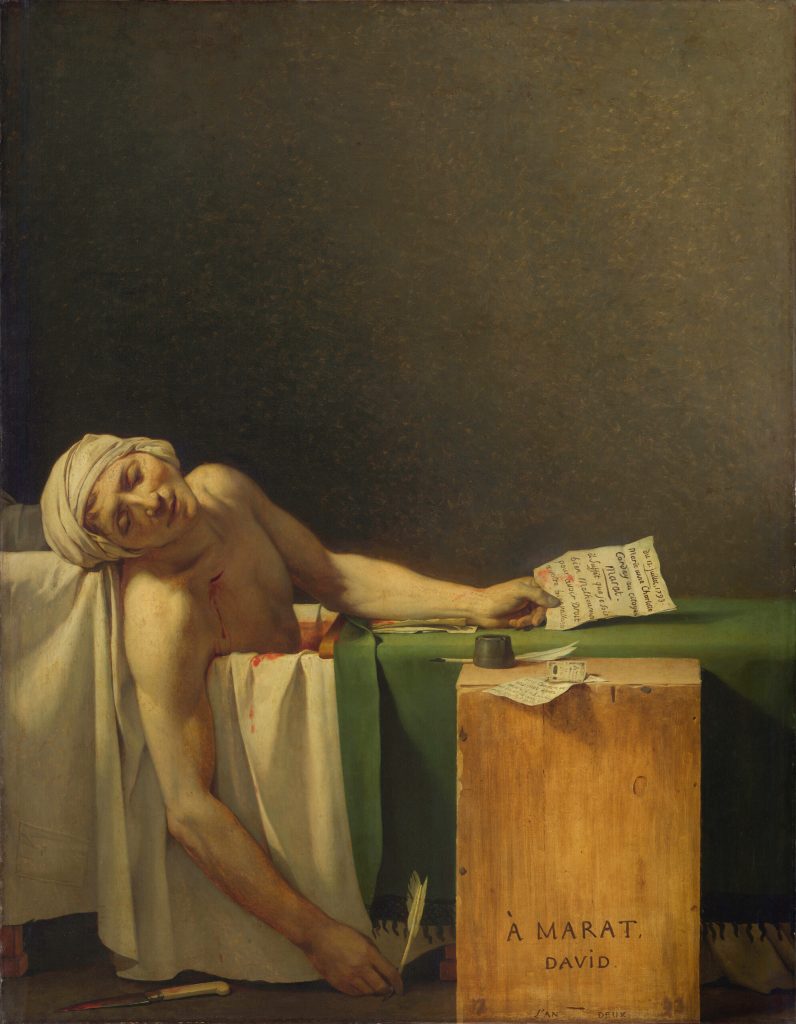
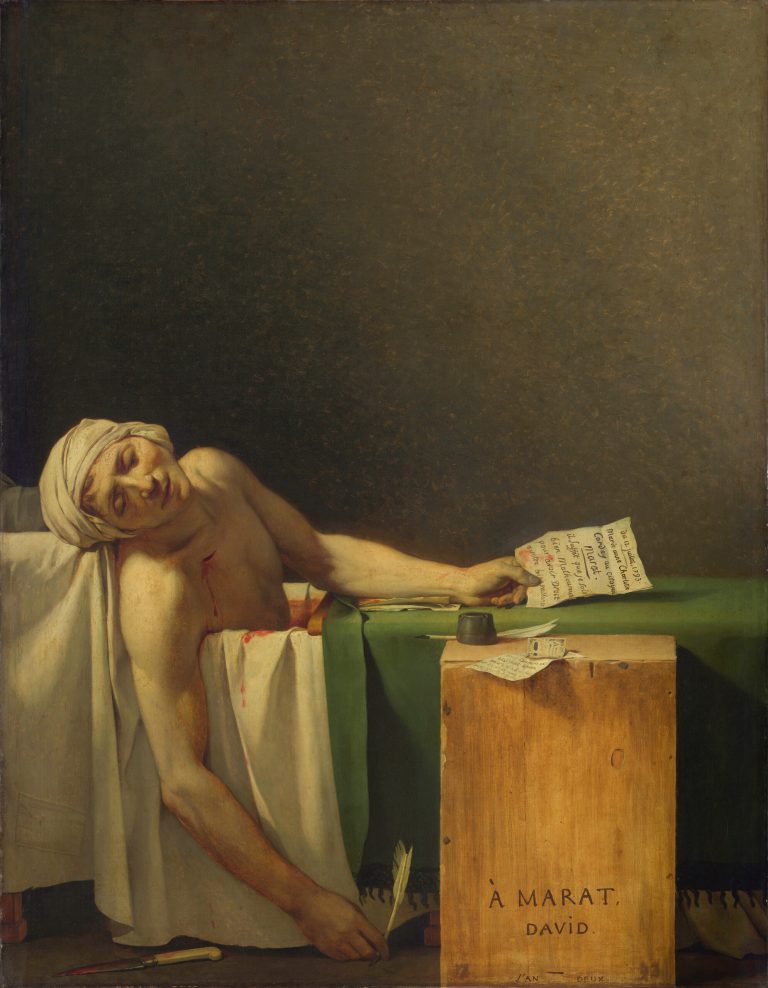
On 13 July 1793 a young woman called Charlotte Corday talked her way into the Paris apartment of Jean-Paul Marat, one of the most violent voices of the Revolution, claiming she had names of traitors to give him. Marat had a painful skin disease and worked sitting in a medicinal bath. As he wrote down her list, she stabbed him in the chest. She was guillotined four days later.
David was Marat's friend and saw him the day before he died. Within months he turned the murder into a modern martyrdom, with Marat's body posed like Christ taken down from the cross. Corday's letter is still in his hand; the blood-stained knife lies on the floor. On the wooden crate he painted his own dedication, "To Marat, David". The top half of the canvas is almost empty, and that silence is what makes it unforgettable.
Collection reference · Royal Museums of Fine Arts of BelgiumArtwork image from the ByMuseum catalogue.
Jacques-Louis David · oil on canvas, made to order
Explore the artistJacques-Louis David →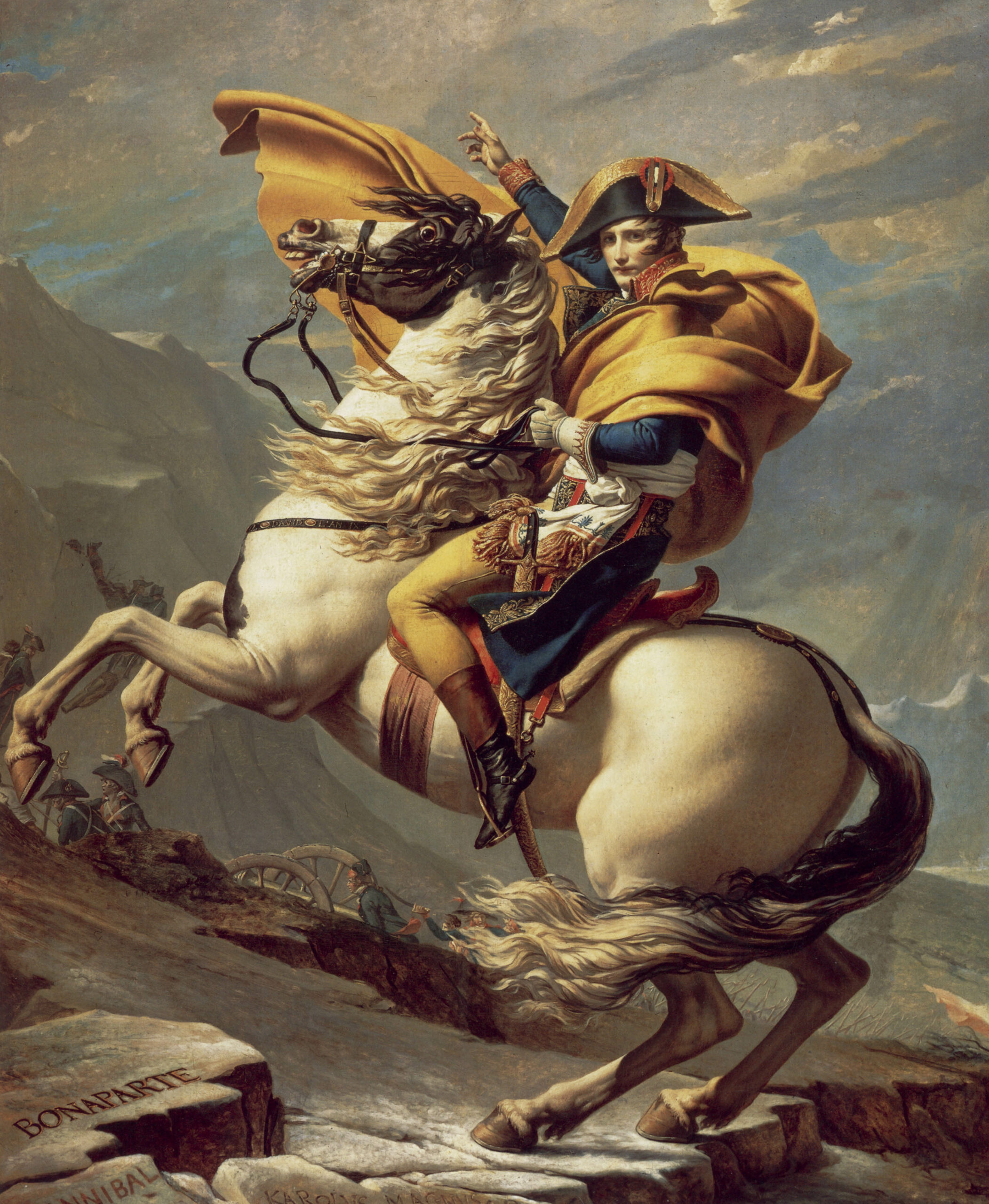
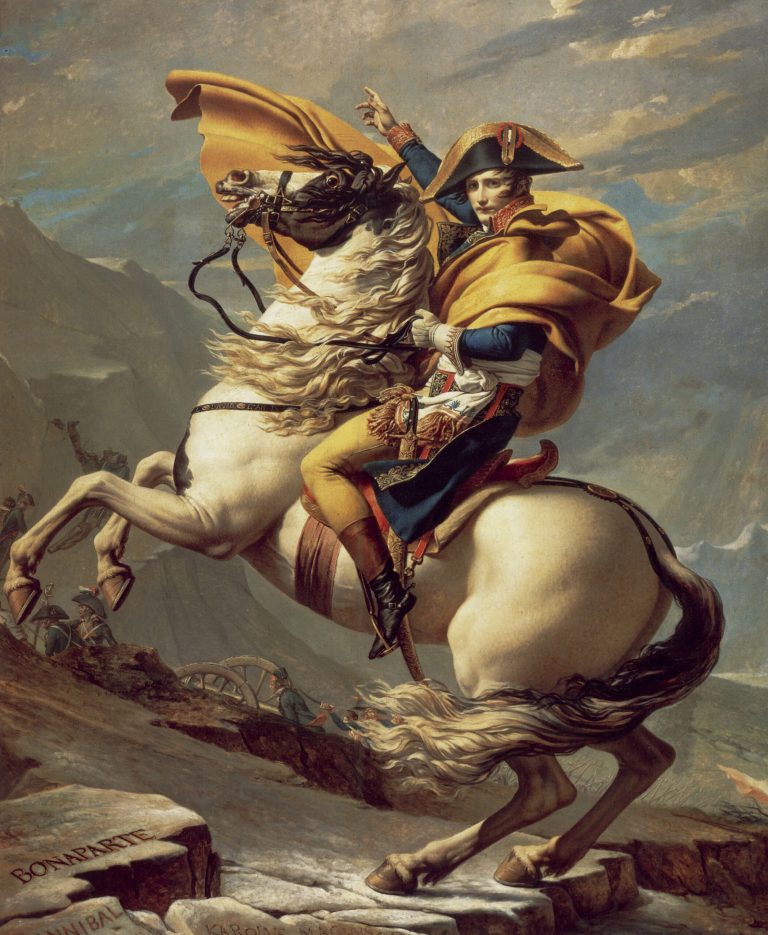
In May 1800 Napoleon led his army across the Great St Bernard Pass to surprise the Austrians in Italy. In reality the weather was fine, and Napoleon was led across on a mule by a guide. That is not what he wanted the world to see. He asked David to show him "calm on a fiery horse", and refused to sit for it, saying nobody asked whether great men's portraits looked like them.
So David borrowed Napoleon's uniform, perched his own son on a ladder as the model, and created pure legend: a rearing horse, a wind-whipped cloak, a hand pointing to the summit. On the rocks, beneath Napoleon's name, are carved those of Hannibal and Charlemagne, earlier conquerors who crossed the Alps. The first version was ordered by the King of Spain, and there are five in all. Fifty years later Paul Delaroche painted the mule.
Collection reference · Château de MalmaisonArtwork image from the ByMuseum catalogue.
Jacques-Louis David · oil on canvas, made to order
Explore the artistJacques-Louis David →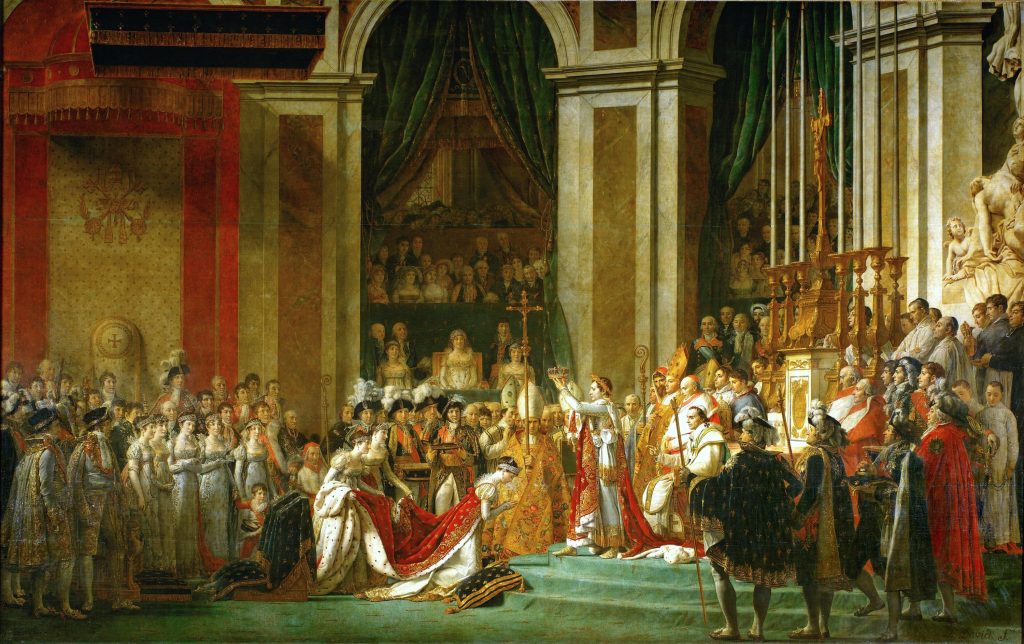
On 2 December 1804, in Notre-Dame de Paris, Napoleon became Emperor of the French. Pope Pius VII had come from Rome for the ceremony, but at the key moment Napoleon took the crown and placed it on his own head. David decided that was too much for a painting. He chose the next moment instead, when Napoleon crowns Josephine, who kneels before him.
It is huge, almost ten metres wide, with more than a hundred portraits. And it is full of polite lies. Napoleon's mother sits in the place of honour, although she stayed away in protest at quarrels in the family. The Pope was first shown with his hands on his knees; Napoleon had David change it so he raises a hand in blessing. David put himself in a gallery at the back, sketching. A second version is at Versailles.
Collection reference · Musée du LouvreArtwork image from the ByMuseum catalogue.
Jacques-Louis David · oil on canvas, made to order
Explore the artistJacques-Louis David →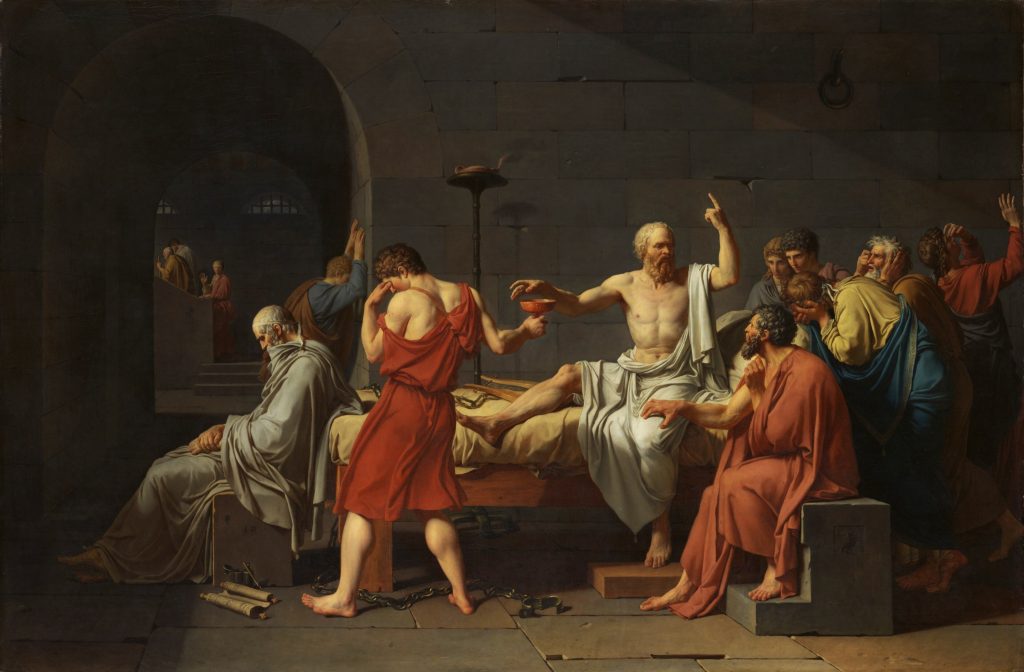
In 399 BC Athens sentenced the philosopher Socrates to death for corrupting the young and not honouring the gods. He could have escaped. Instead he spent his last day talking with his friends about the immortality of the soul, then drank the poison hemlock calmly. David shows him reaching for the cup without even looking at it, his other hand raised, still teaching.
Around him his followers break down. The disciple offering the cup turns his face away. At the foot of the bed sits Plato, turned away, though in fact Plato was young and not there that day; David made him old and present because Plato is the one who wrote the story down. When it was shown in 1787, the great English painter Sir Joshua Reynolds called it the finest effort of art since the Sistine Chapel.
Collection reference · The Metropolitan Museum of ArtArtwork image from the ByMuseum catalogue.
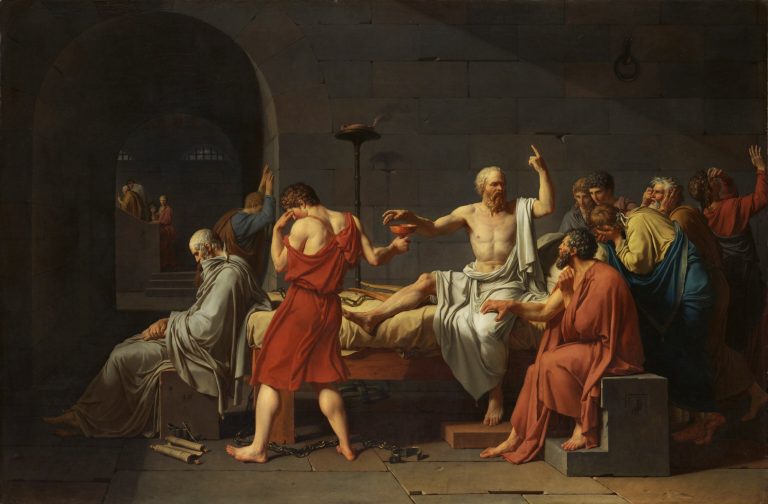
Jacques-Louis David · oil on canvas, made to order
 Explore the artistJean-Auguste-Dominique Ingres →
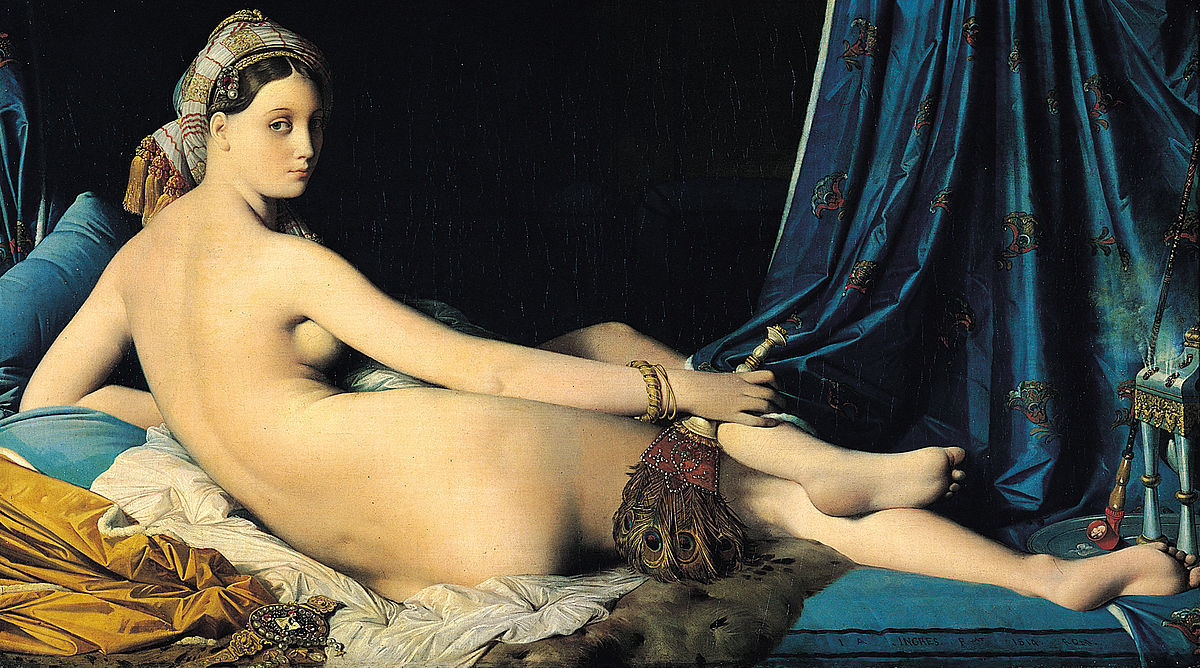
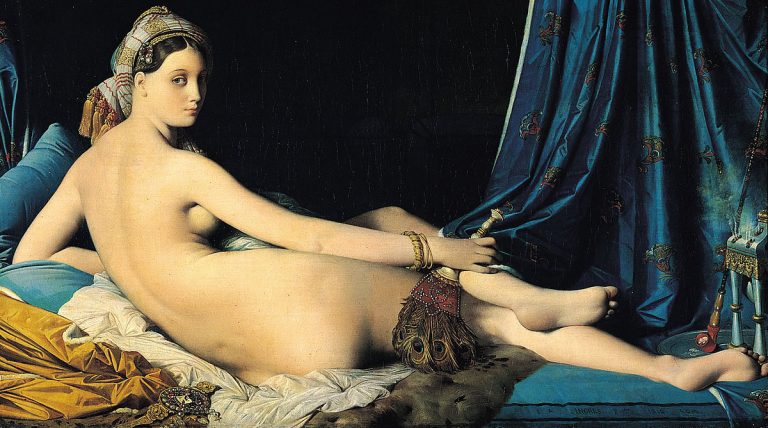
An odalisque was a woman of the Turkish harem, a fantasy figure for European painters. Ingres paints her from behind, lying on silk, looking back at us coolly over her shoulder with a peacock fan in her hand. The skin is smooth as porcelain, the lines long and flowing, the turban and curtains rich with colour.
And her body is impossible. When it was shown at the Paris Salon in 1819, critics complained that her back had two or three vertebrae too many. A later study made it five. Ingres stretched her on purpose, for the beauty of the line. It was ordered by Napoleon's sister Caroline, Queen of Naples, but her husband's fall in 1815 meant it was never delivered. It reached the Louvre in 1899.
Collection reference · Musée du LouvreArtwork image from the ByMuseum catalogue.
Jean-Auguste-Dominique Ingres · oil on canvas, made to order
Explore the artistJacques-Louis David →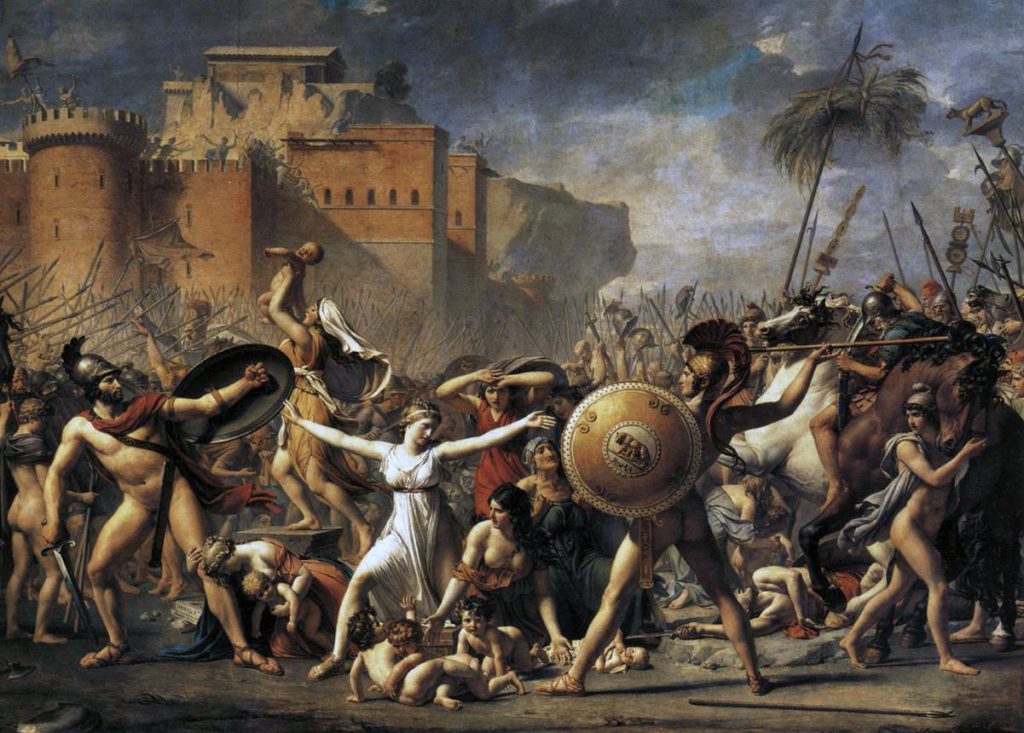
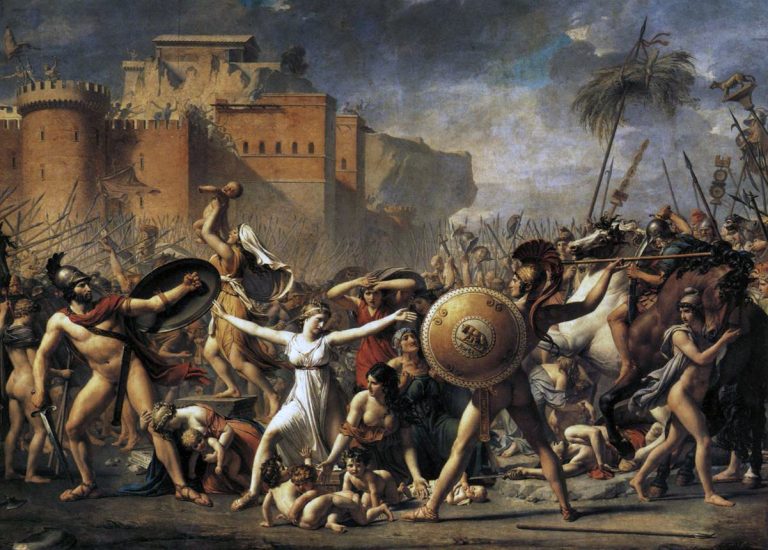
Years after the early Romans kidnapped the women of the Sabine people to be their wives, the Sabines come back for revenge. The battle is about to begin when the women rush between the armies with their children. In the centre, Hersilia, daughter of the Sabine king Tatius and wife of the Roman leader Romulus, spreads her arms between the two men she loves. The fighting stops.
David began planning it in prison in 1795, locked up as a supporter of the fallen Robespierre. A popular account says he painted it to honour his estranged wife, Charlotte, who came to visit him there. A painting about women ending a war between their families was his way of calling for peace in France. He showed it at the Louvre in 1799 and charged admission, and some 50,000 people paid to see it.
Collection reference · Musée du LouvreArtwork image from the ByMuseum catalogue.
Jacques-Louis David · oil on canvas, made to order
Explore the artistJacques-Louis David →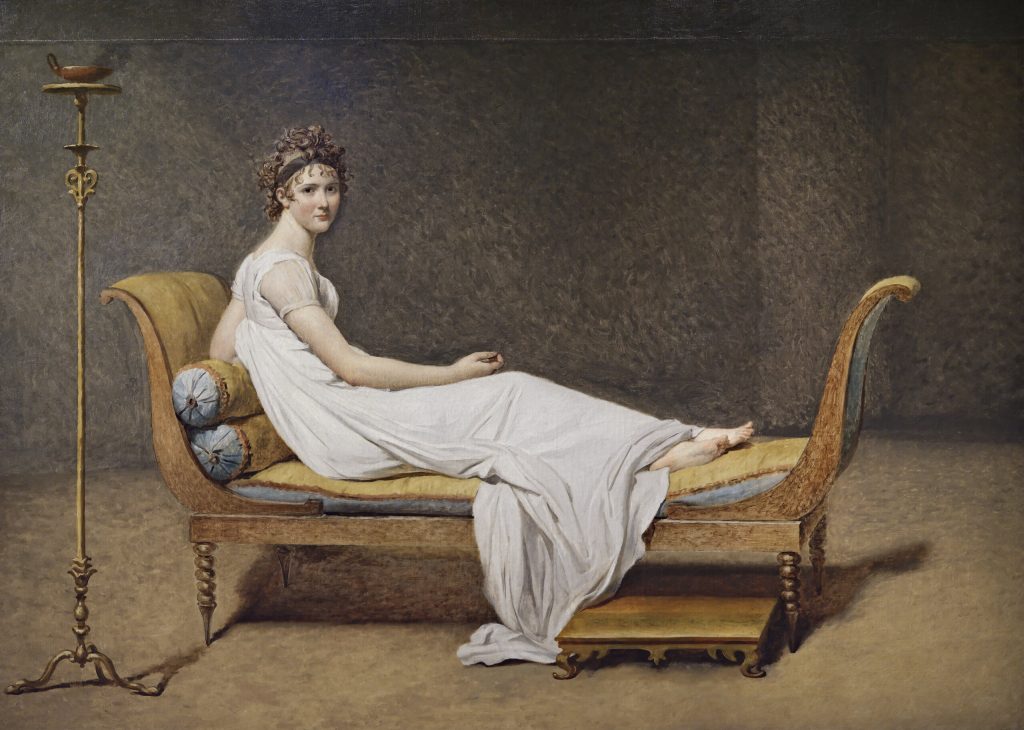
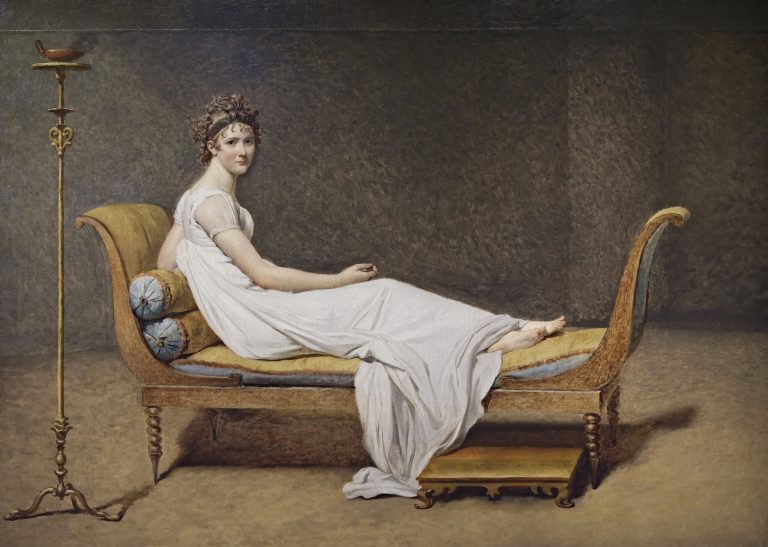
Juliette Récamier, wife of a rich banker, ran the most fashionable salon in Paris and was famous as the most beautiful woman of her day. David paints her as a modern goddess, barefoot in a white dress in the antique style, reclining on a Roman-style couch in an almost empty room. Only a tall bronze lamp keeps her company.
It was never finished. She was often late for sittings, grew impatient and asked his pupil François Gérard for another portrait at the same time. David may have stopped when he found out. Yet the bare, unfinished room is exactly what makes the painting feel so modern. The couch became so famous that a reclining sofa is still called a récamier.
Collection reference · Musée du LouvreArtwork image from the ByMuseum catalogue.
Jacques-Louis David · oil on canvas, made to order
Explore the artistJacques-Louis David →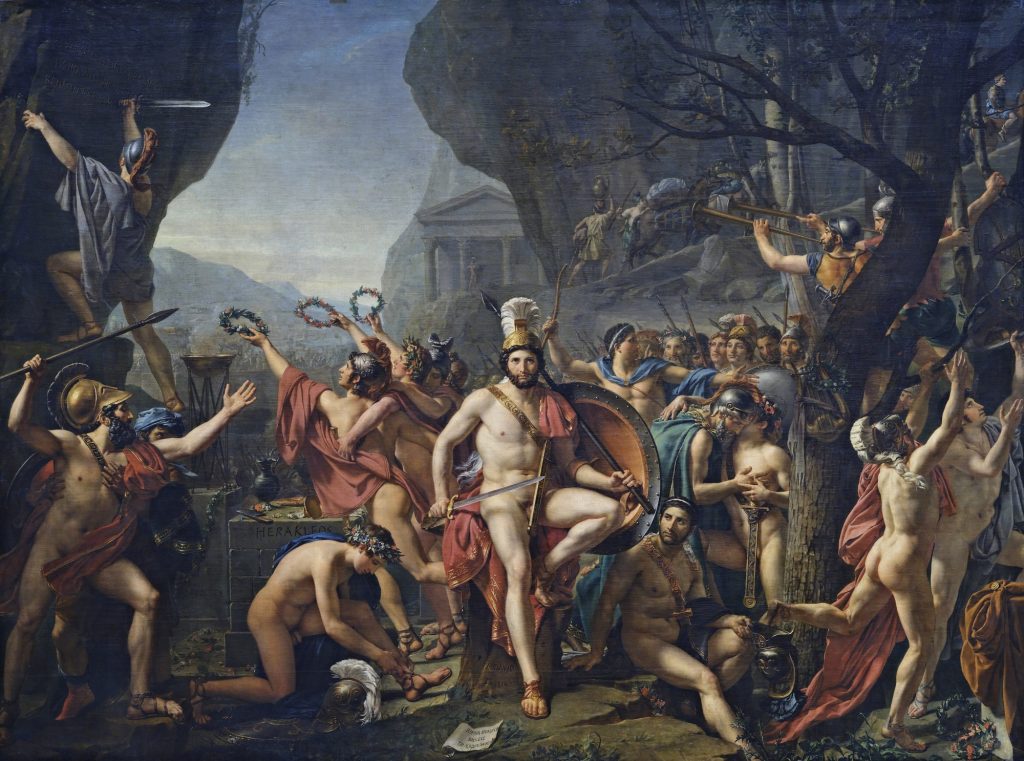
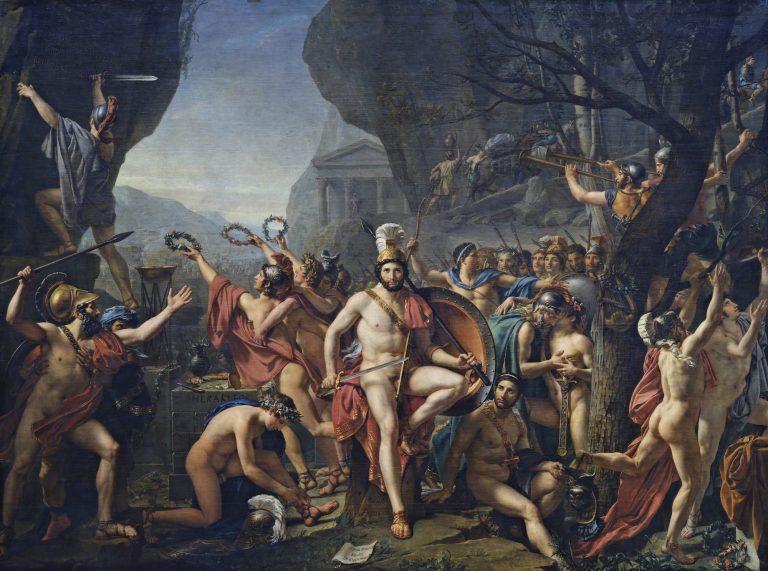
In 480 BC King Leonidas of Sparta and three hundred of his soldiers held the narrow pass of Thermopylae against the vast Persian army, knowing they would all die. David paints the hour before the end. Around Leonidas his men embrace, tie their sandals and grab their weapons. He sits at the centre, calm, already thinking past the battle.
On the left, a soldier carves the famous epitaph into the rock with his sword: passer-by, tell Sparta that we died obeying her laws. David had the idea around 1800, put it aside for Napoleon's commissions and finished it in 1814, just as Napoleon's empire was collapsing. Napoleon is said to have told him he was wrong to paint losers. It was the last great picture David painted in France before his exile.
Collection reference · Musée du LouvreArtwork image from the ByMuseum catalogue.
Jacques-Louis David · oil on canvas, made to order
Explore the artistJean-Auguste-Dominique Ingres →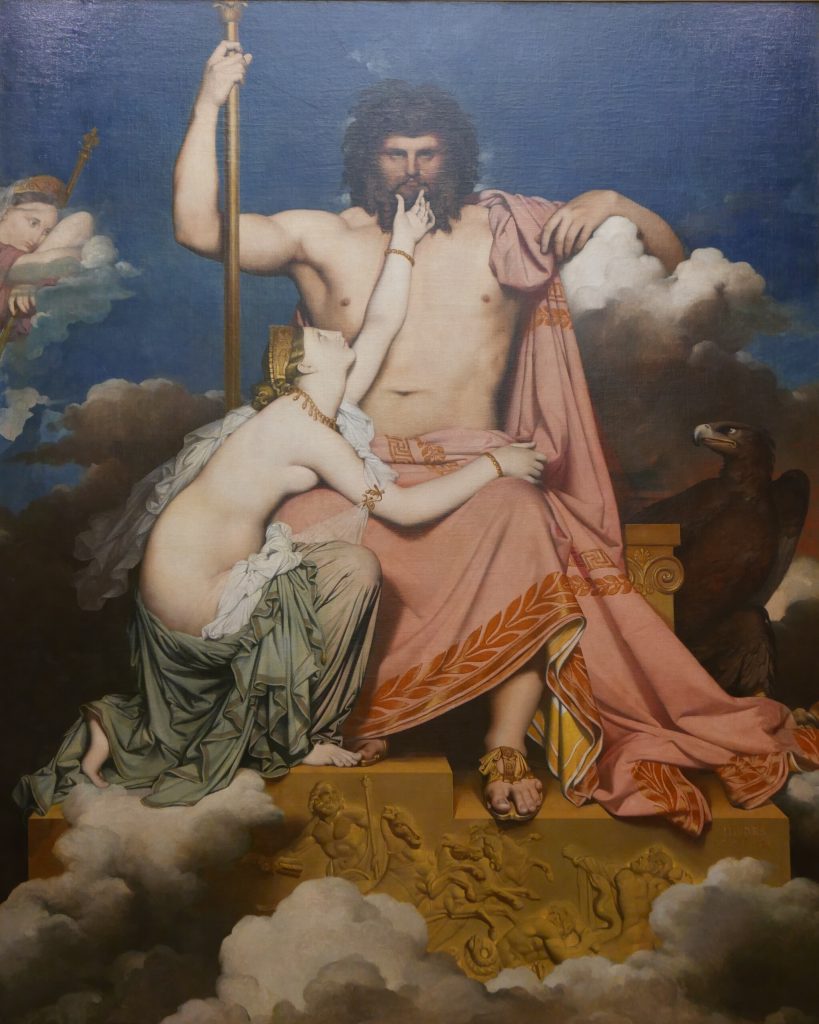
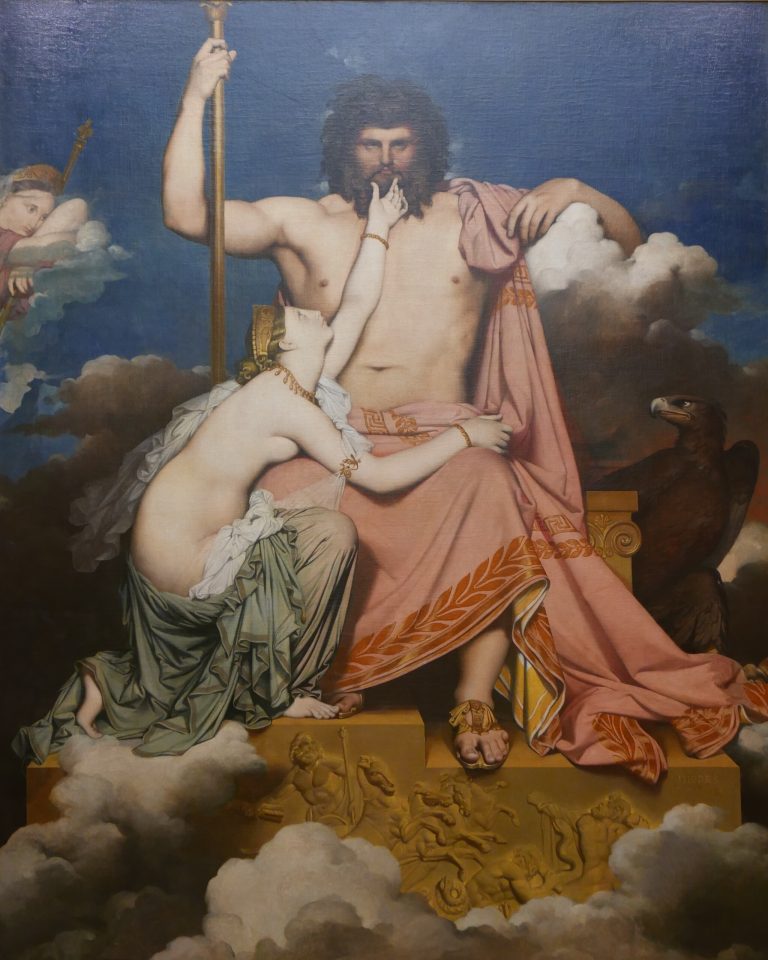
At the start of Homer's Iliad, the sea nymph Thetis goes to Jupiter, king of the gods, to beg him to help her son Achilles, who has been insulted by the Greek commander. She kneels at his side, one arm across his lap and the other hand reaching up to stroke his beard. Jupiter sits huge and still, like a marble statue.
Thetis is all curves, her neck swollen, her arm boneless, her skin glowing against his great, cold bulk. Ingres painted it in Rome to meet his obligations to the French Academy there, and critics were not kind to its strange anatomy. He kept it in his studio until the French state bought it in 1834. It now hangs in Aix-en-Provence. Today it is one of his most admired works.
Collection reference · Musée Granet collection guideArtwork image from the ByMuseum catalogue.
Jean-Auguste-Dominique Ingres · oil on canvas, made to order
The Oath of the Horatii by Jacques-Louis David, painted in 1784 and shown in Paris in 1785. It is now in the Louvre.
The style that dominated European art from about 1760 to 1830. Inspired by ancient Greece and Rome, it favours clear outlines, calm and balanced compositions, smooth finish and serious stories about duty, sacrifice and virtue.
They are almost opposites. Rococo is playful, curvy and pastel, about love and pleasure. Neoclassicism is serious, straight-lined and sober, about heroes and moral lessons. Compare the two in our ten famous Rococo paintings.
Jacques-Louis David led the movement, followed by his pupils Jean-Auguste-Dominique Ingres, François Gérard, Anne-Louis Girodet and Antoine-Jean Gros. Angelica Kauffman, Anton Raphael Mengs and Benjamin West were also important. In sculpture, Antonio Canova was the great name.
Romanticism. Painters such as Théodore Géricault and Eugène Delacroix put emotion, colour and drama ahead of calm and order. Ingres and Delacroix spent decades as rivals.
Most of the paintings above are in the Louvre in Paris. The Death of Marat is in Brussels, The Death of Socrates in the Metropolitan Museum in New York, Jupiter and Thetis in Aix-en-Provence, and the versions of Napoleon Crossing the Alps are at Malmaison, Versailles, Berlin and Vienna. All ten are available from us as hand-painted oil reproductions.
Explore more works in our Neoclassical collection. Every painting above is available as a hand-painted oil reproduction.
Enjoyed this story?
Save articles to your collection
Log in or create a free account, and this article will be waiting in your Private Collection.
Log in or sign upOrder is guided by monthly US Google search volume for each painting's name (OpenSEO, November 2026), chosen from paintings in our catalogue. The Death of Marat and Napoleon Crossing the Alps tie, as do The Coronation of Napoleon and The Death of Socrates, and Madame Récamier and Leonidas at Thermopylae. We do not publish the figures.
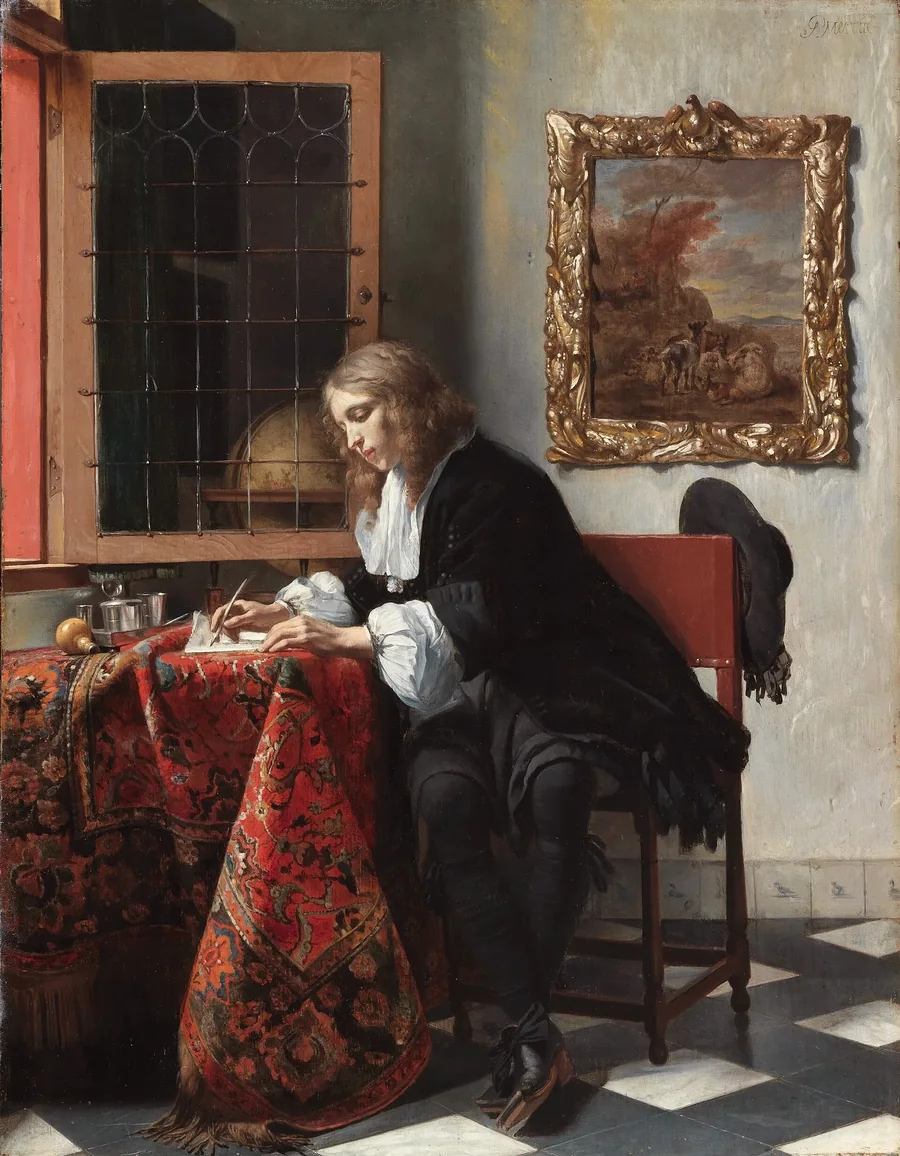
Man Writing a Letter
Gabriel Metsu, c. 1664
The gallery list
Every painting is already 50% off. Join the list and we will send you an extra $15 code, plus first access to new collections.
No spam. Unsubscribe anytime. · Privacy Policy
Welcome
Your $15 code is on its way. Explore the gallery while you wait.