Loading cart…
No products in the cart.

1801 (Vienna version) · Oil on canvas · Belvedere, Vienna (Kunsthistorisches Museum loan)
Save articles to your collection
Log in or create a free account, and this article will be waiting in your Private Collection.
Log in or sign up Explore Jacques-Louis David →
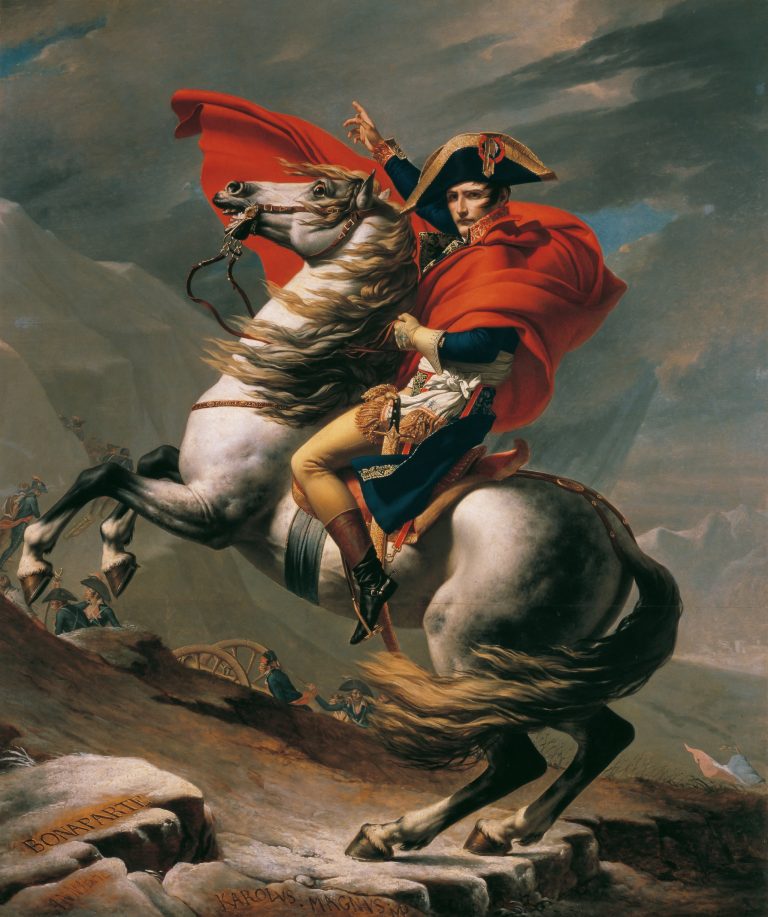
In Napoleon Crossing the Alps, Jacques-Louis David painted Napoleon Bonaparte on a rearing horse, pointing up the Great St Bernard Pass. The real crossing took place in May 1800, when Bonaparte led his army into Italy during the campaign that culminated at Marengo. He rode a mule over the pass. David turned the crossing into an image of command.
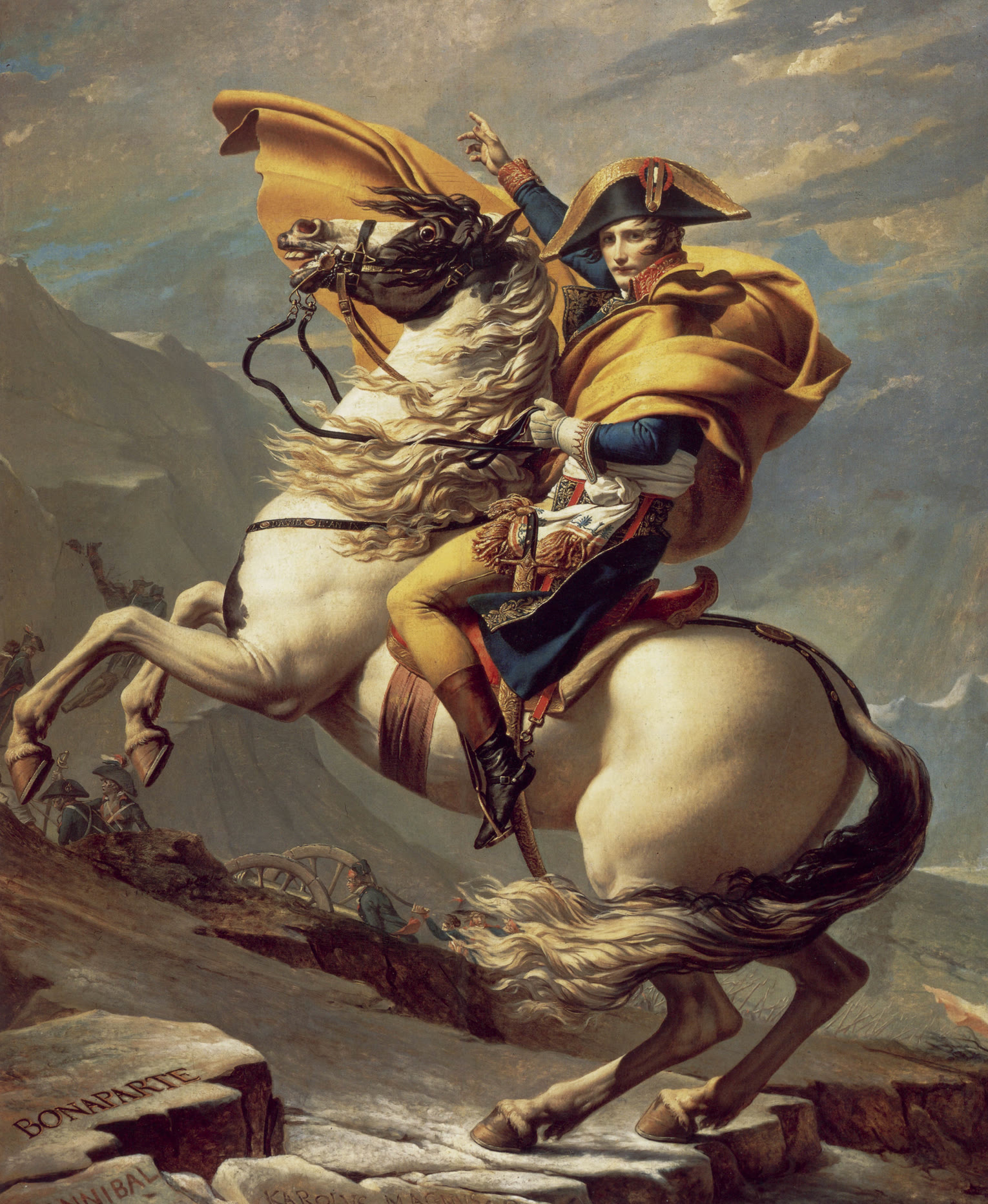
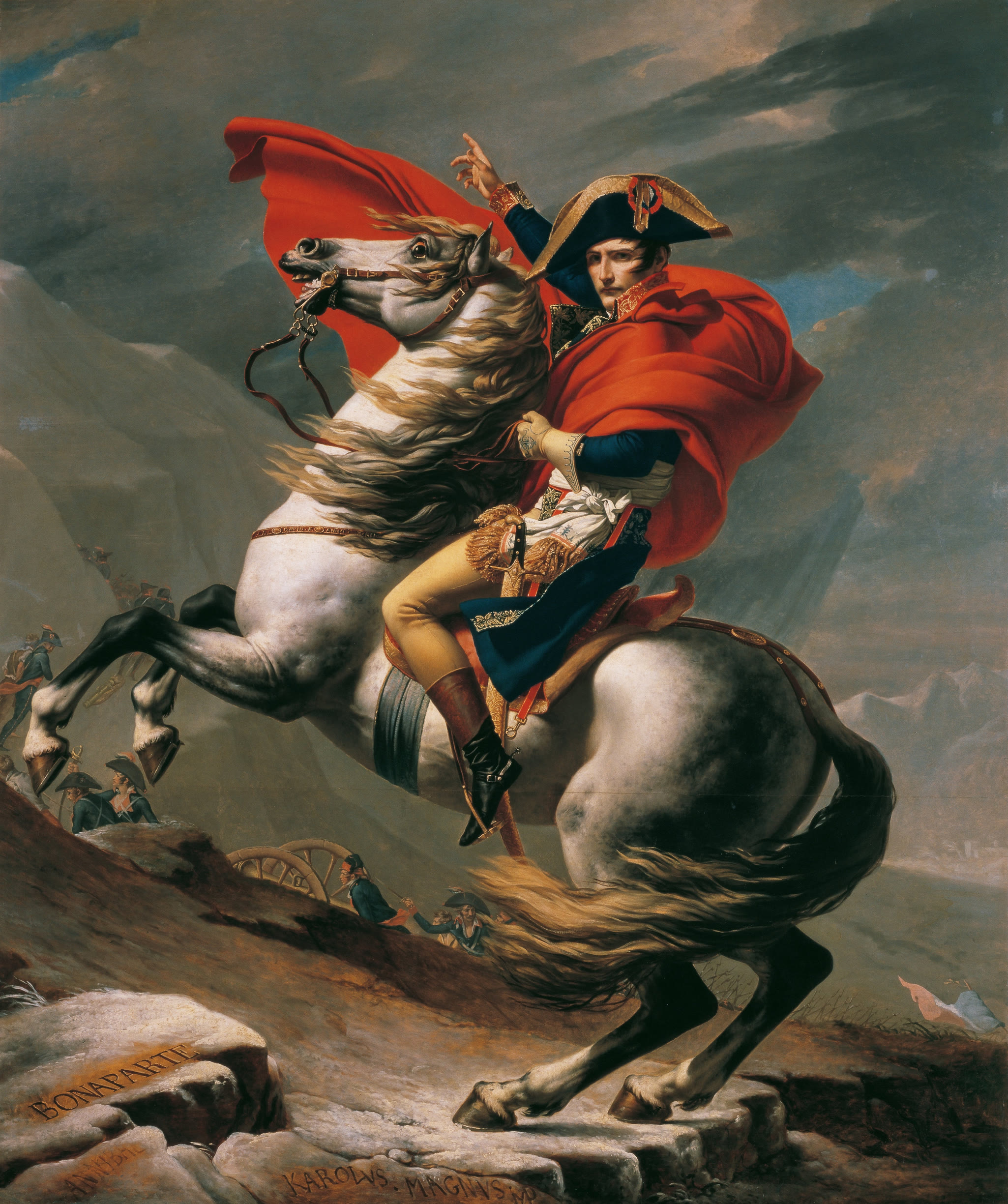
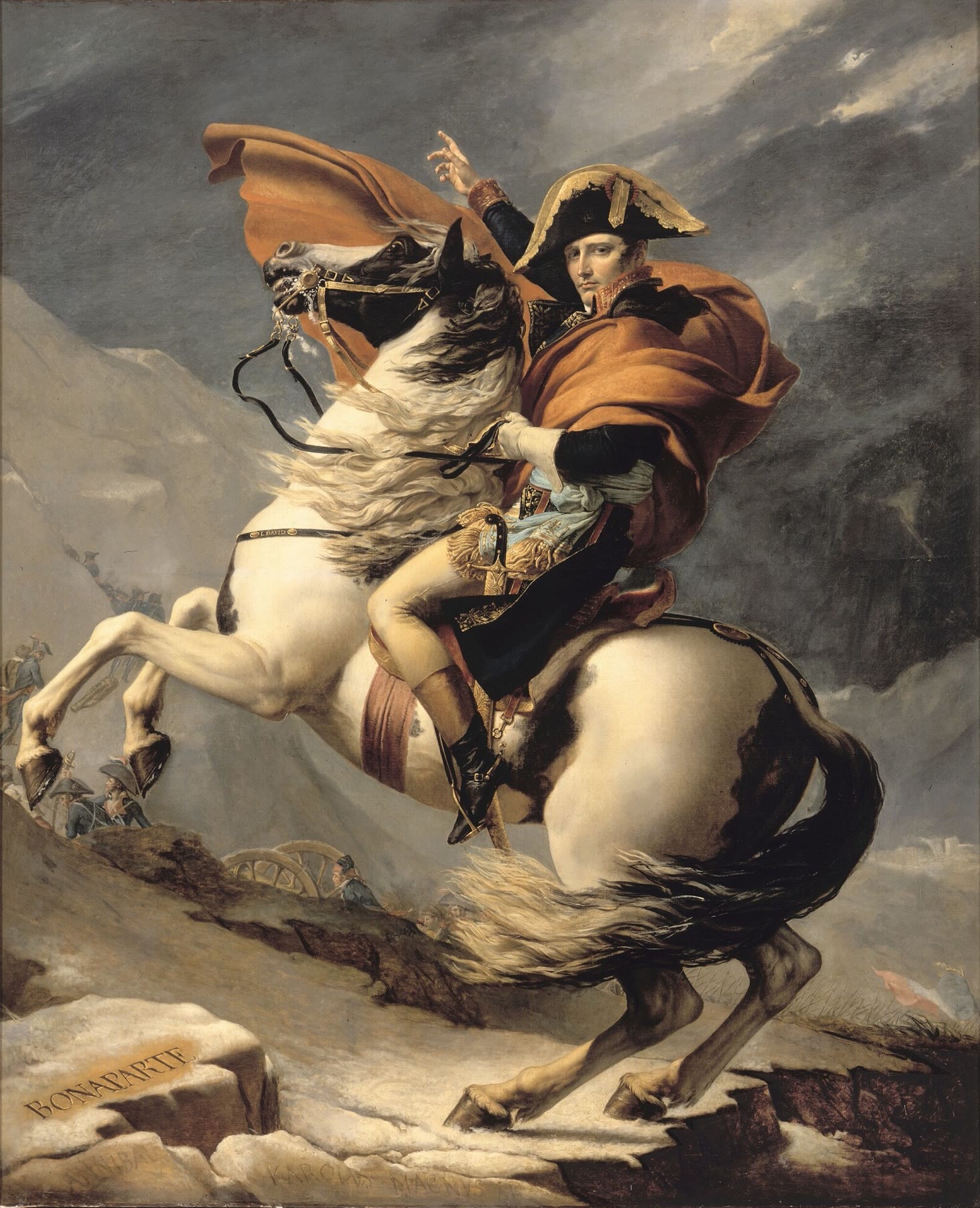
David and his studio produced five versions. The scarlet-cloaked rider and grey horse above belong to the Vienna canvas, made for Milan and now associated with the Belvedere. In the first version, now at Malmaison, the cloak is golden yellow and the horse has a dark head. The other canvases give you three more ways to look at the same pose. Compare the five versions below.
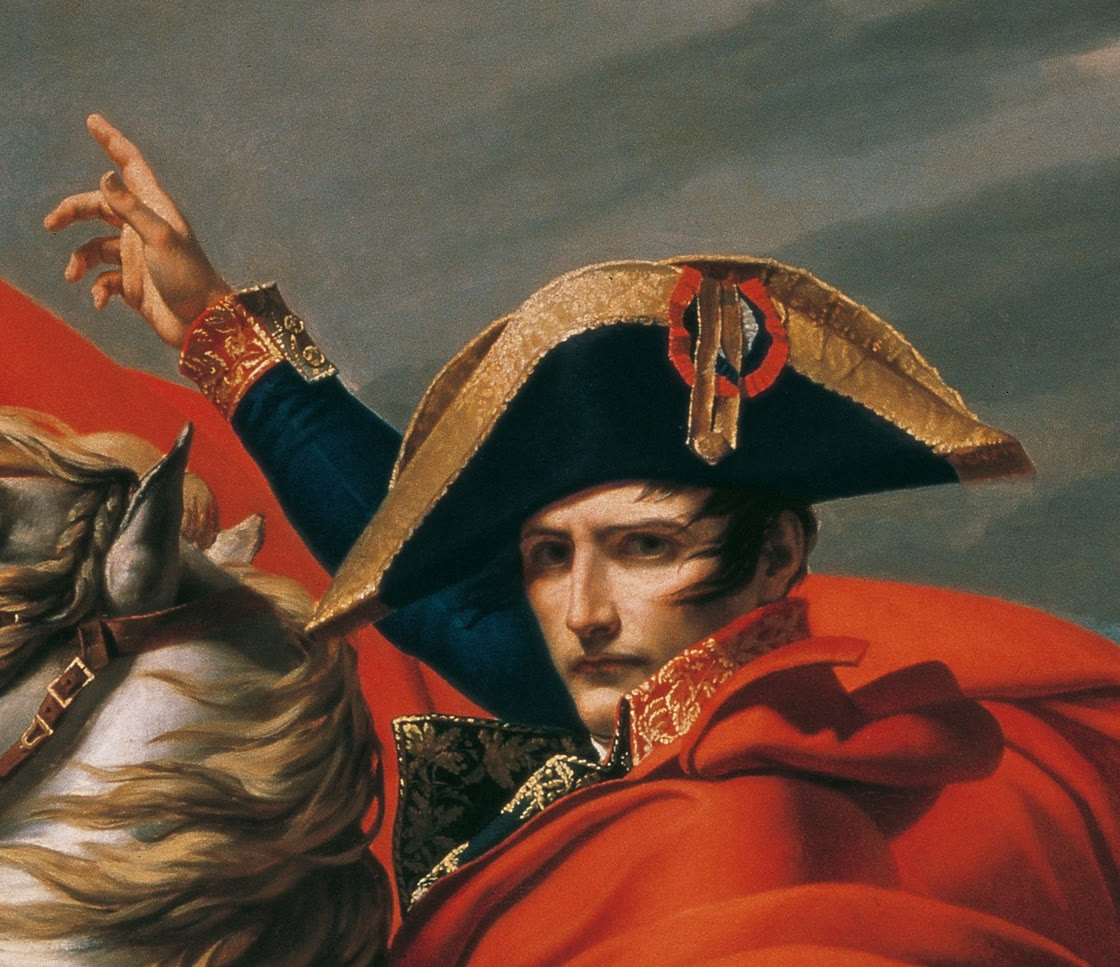
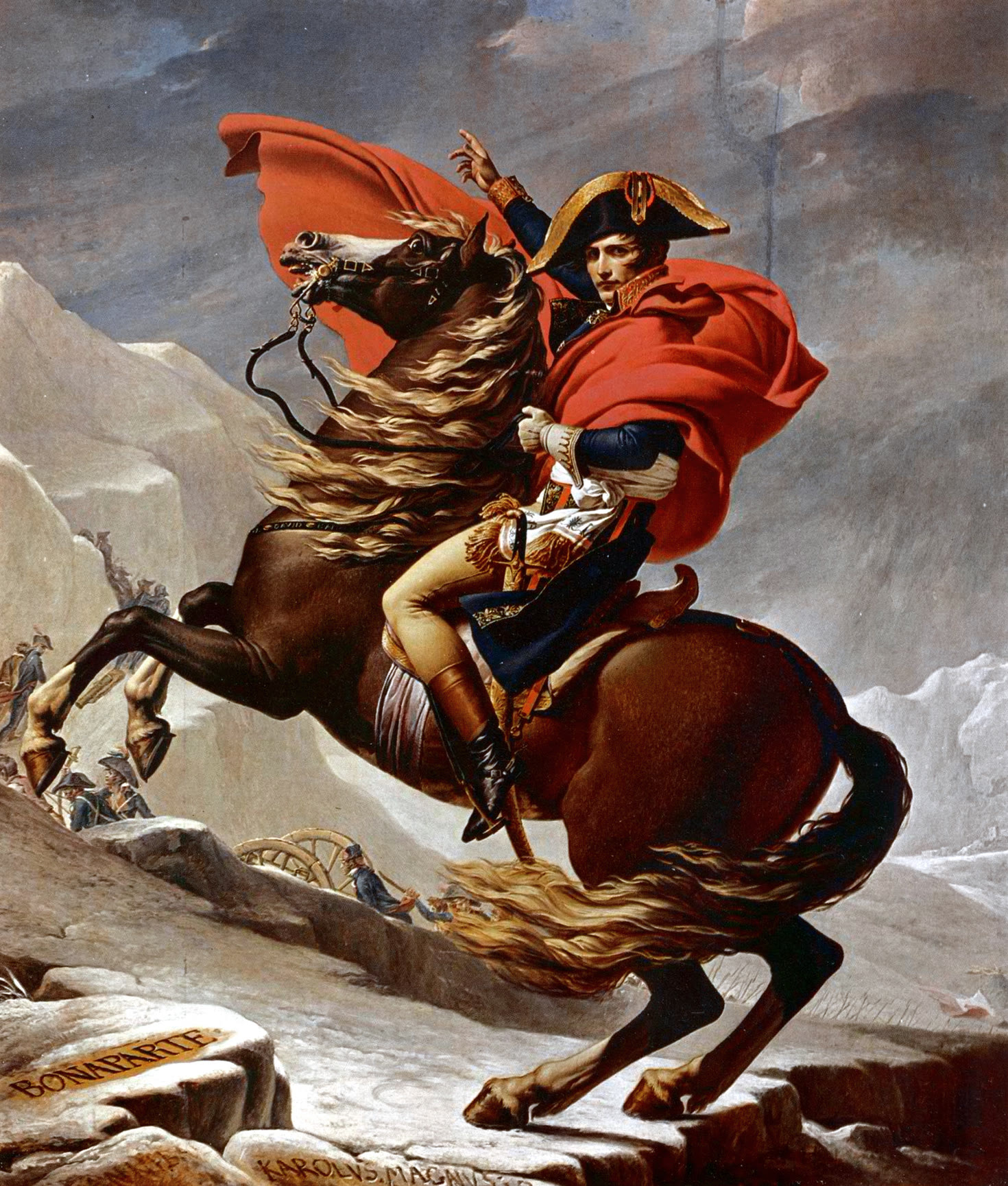
King Charles IV of Spain commissioned the first painting for a room devoted to great commanders in his Madrid palace. According to David’s pupil Étienne-Jean Delécluze, writing decades later, Bonaparte asked to appear calme sur un cheval fougueux, “calm on a fiery horse.” The Vienna version makes that idea easy to see. His raised right hand leads the eye up the mountain, while his face turns outward to meet ours.
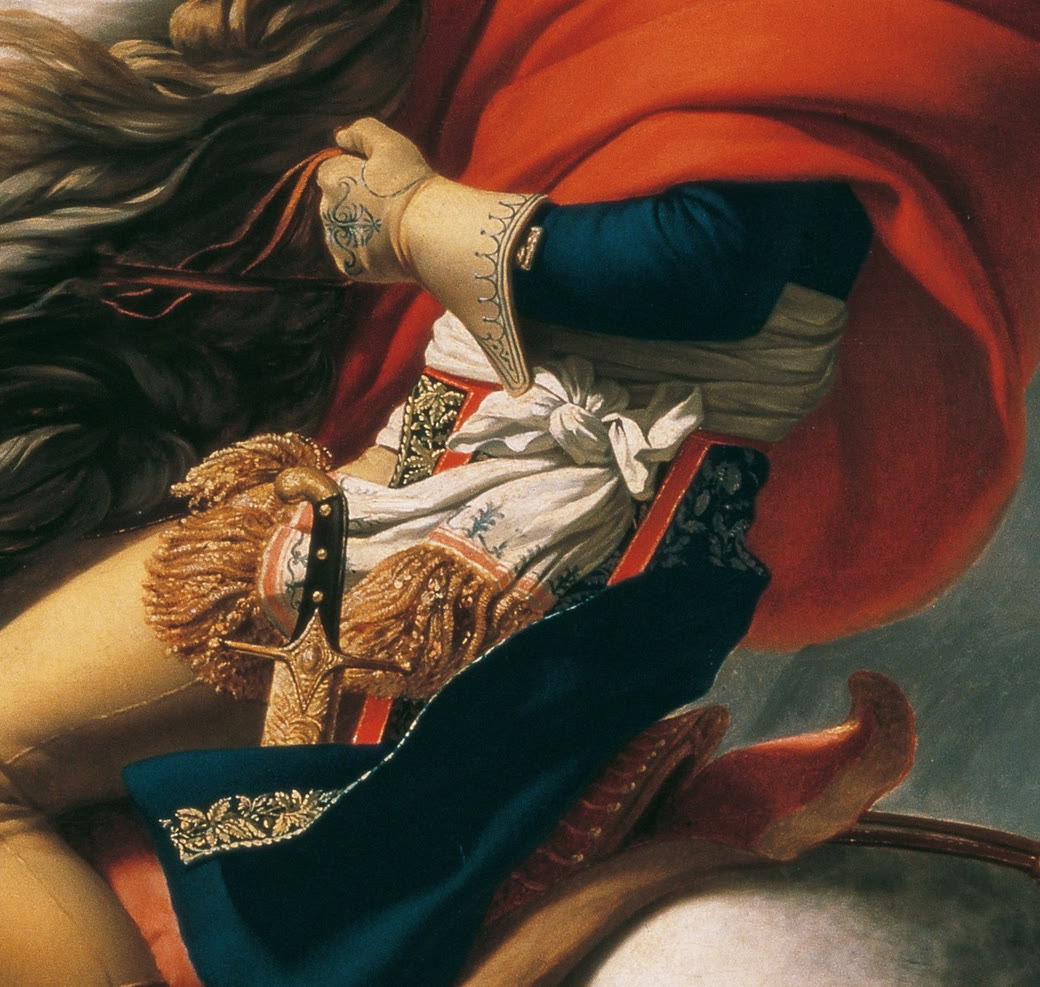
The other hand stays low, keeping hold of the reins. Follow it down to the gold braid, the white sash and the sword hilt. Those small, precise marks give you a moment to study the uniform while the horse’s mane moves across the same patch of canvas.
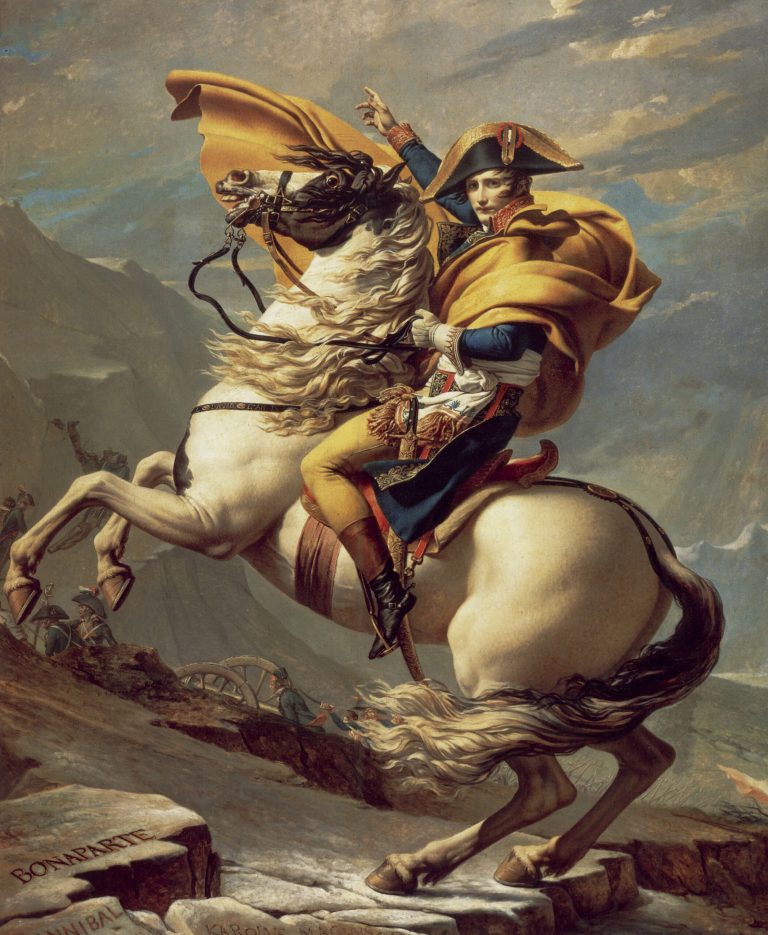
The horse throws its head left. Its flared nostril, open mouth and raised eye make the strain visible. The reins loop into the space in front of the muzzle and lead back to Napoleon’s grip. In the Vienna canvas, the pale muzzle and mane give those lines a clear silhouette.
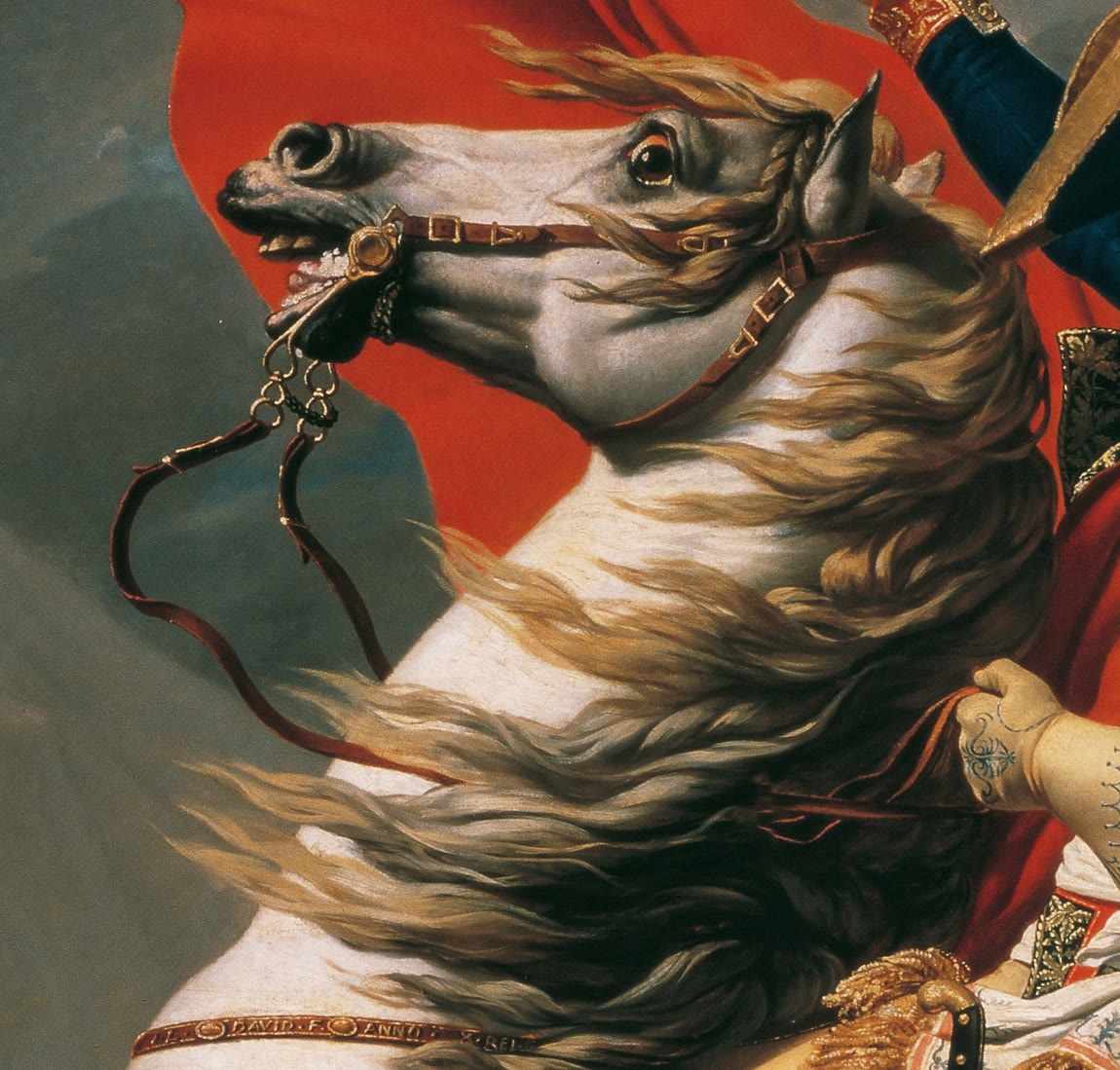
Now follow the red cloth. It rises behind the horse’s ears, passes the raised hand, and folds around Napoleon’s shoulder. The sharp ridge of the rocks below echoes that sweep. These diagonals keep pulling our eyes upward, back toward his gesture.
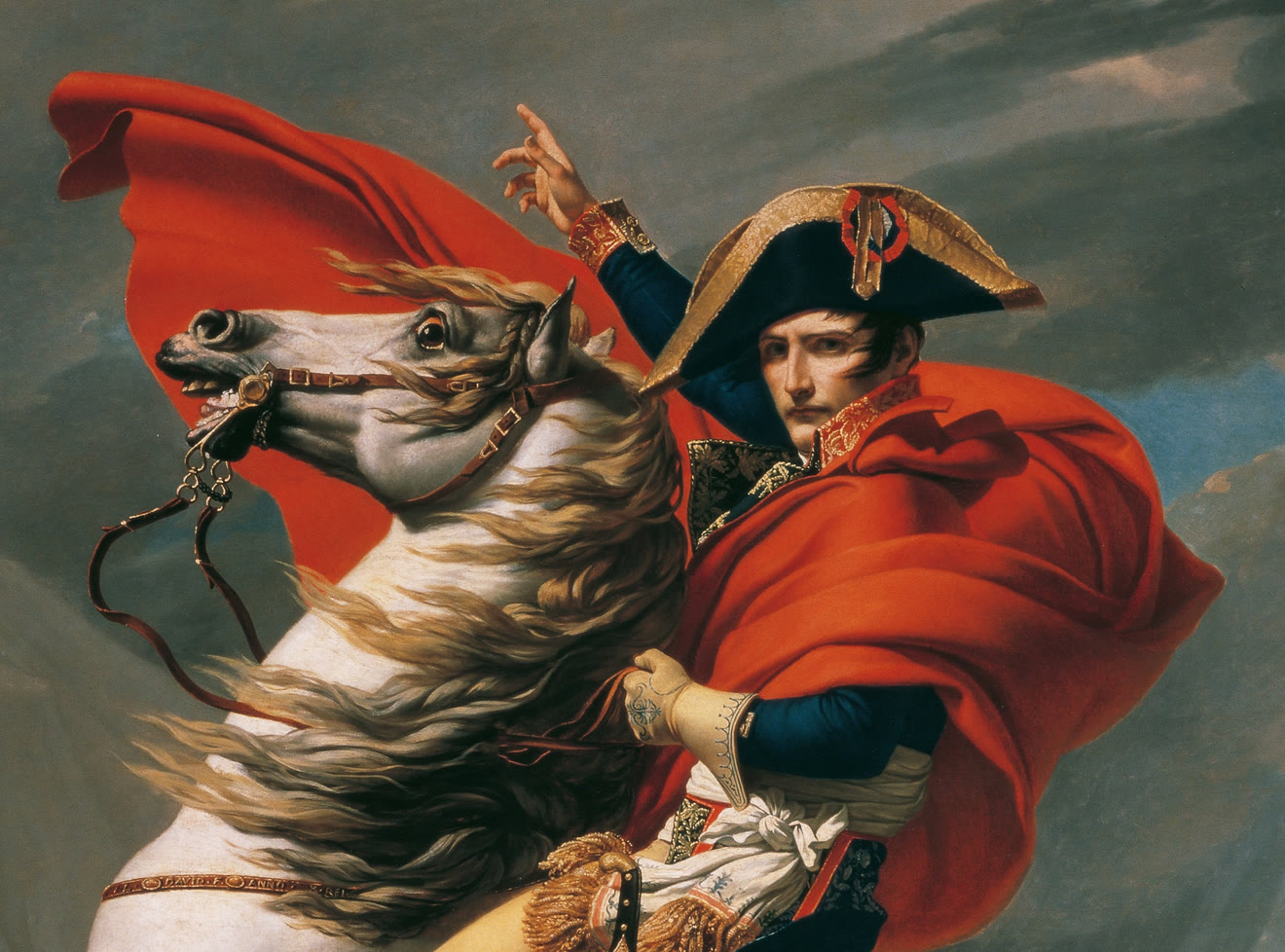
Below the pointing hand, behind the lifted front hooves, a file of soldiers climbs the pass. David put their heads so close to the horse’s shoes that the difference in scale is unmistakable. They are the only figures in the scene who have to bend into the slope.
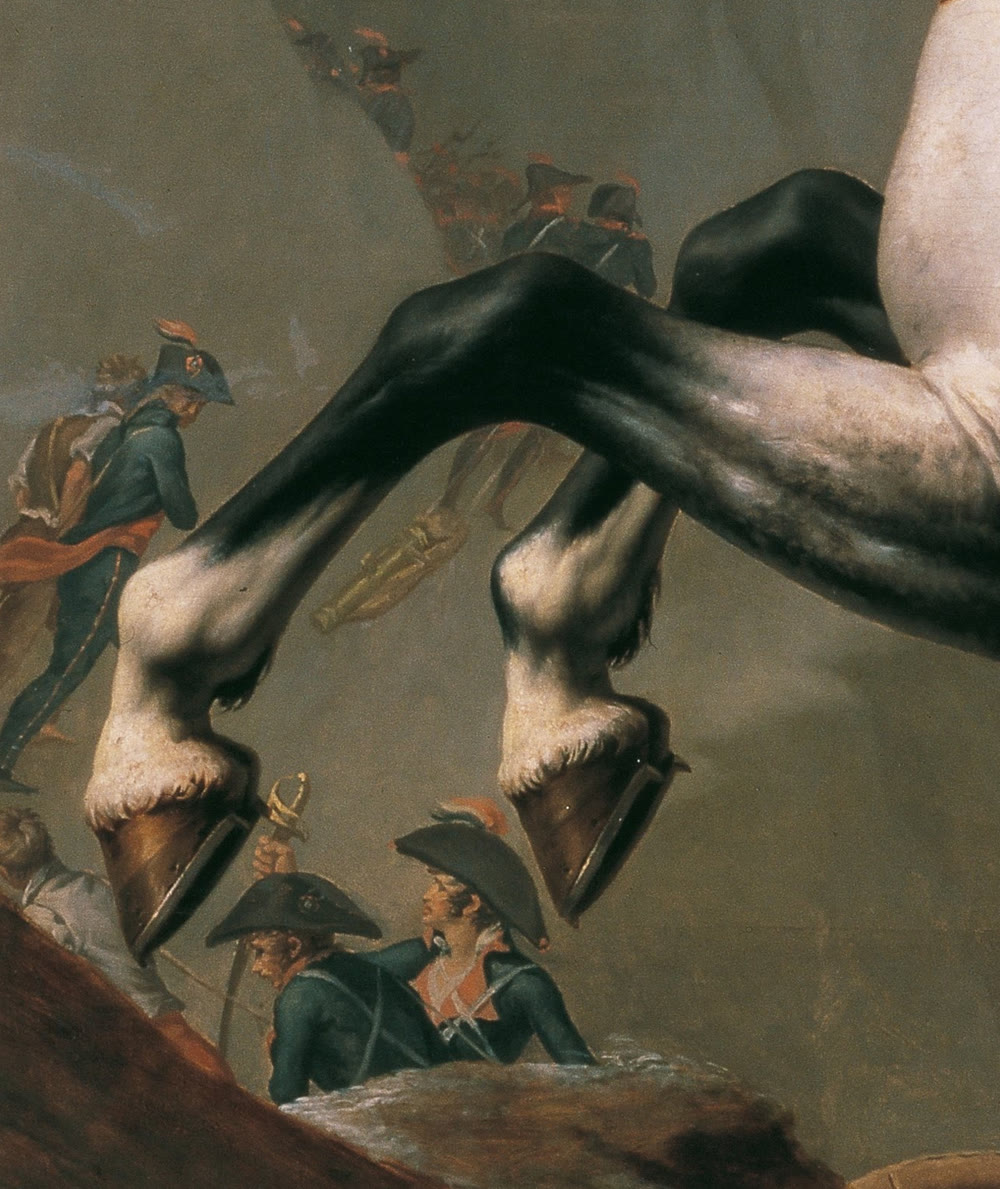
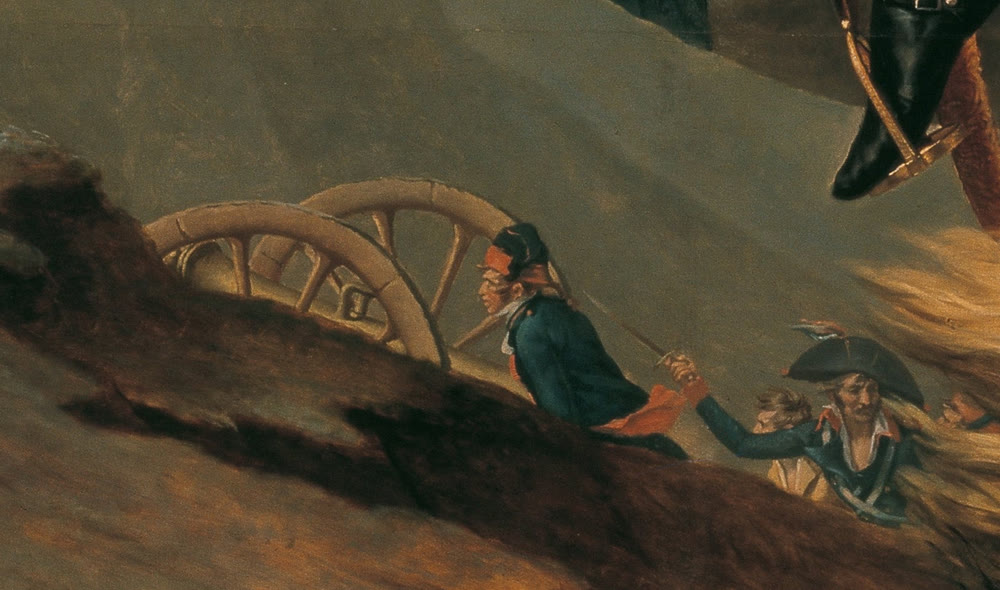
Look lower, below the rider’s boot. Part of a spoked wheel appears above the rocky ridge. One man is ahead of it and more follow behind. The cannon gives the crossing a physical weight that the floating cloak never has.
David carved a second argument into the foreground. BONAPARTE sits above ANNIBAL and KAROLVS MAGNVS, the names of Hannibal and Charlemagne. The Invalides canvas gives a clear view of the arrangement, with Bonaparte’s name on its own bright face of stone. The other names are visible lower down.
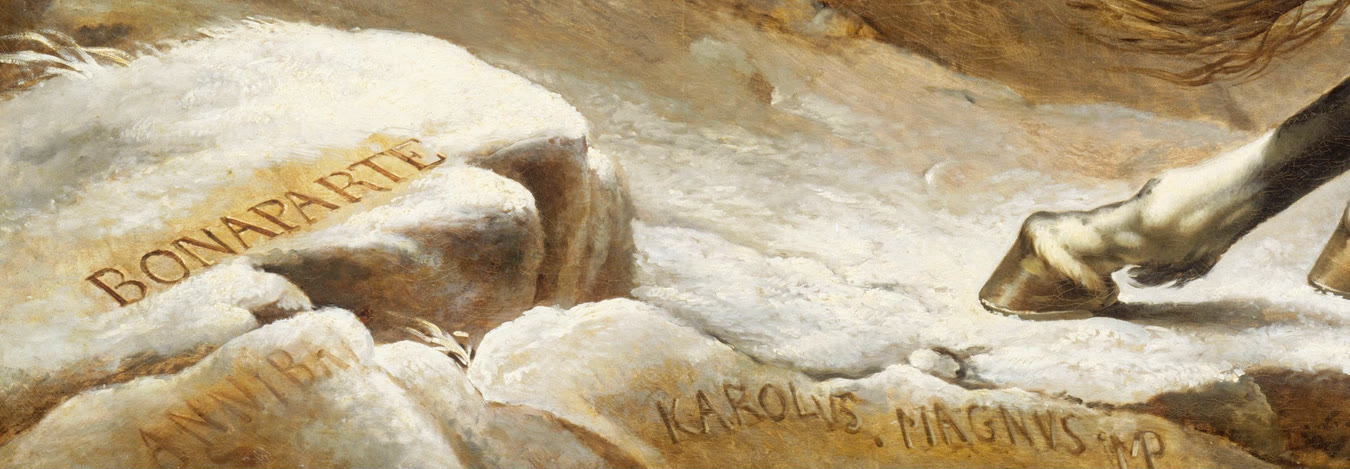
Hannibal crossed the Alps in 218 BCE. Charlemagne led an army across the Alps during his campaign against the Lombards in 773. Their exact routes are beside the point David is making. By putting the First Consul’s name above theirs, he asks the viewer to place the latest crossing in the same history.
Start with the horse’s muzzle and front legs, then look at the collar and cloak. The raised arm and rearing pose are repeated across the series, so those smaller changes are the quickest way to tell the canvases apart. The two at Versailles have separate histories and inventory numbers.
The first version, painted around 1800–01, was commissioned by Charles IV. The cloak is golden yellow, the horse’s head is dark, and the legs are comparatively pale. The Louvre records it as 260 cm high by 221 cm wide. It is in the national collections at Château de Malmaison. Louvre exhibition record
The version made for Napoleon’s residence at Saint-Cloud changes both colours. The red cloak hangs over a dark bay horse with a white stripe down its face. Blücher took the canvas after Napoleon’s defeat in 1815. It passed to the Prussian king and is now in the collection at Schloss Charlottenburg in Berlin. Prussian Palaces and Gardens Foundation
This canvas was installed at the Hôtel des Invalides in 1802 and later entered the Versailles collections. The grey horse and light foreground make the lower half brighter than in the Vienna painting. The red-orange cloak and the bright right flank are useful points of comparison. Versailles catalogues this canvas as MV 1567. French national collections record
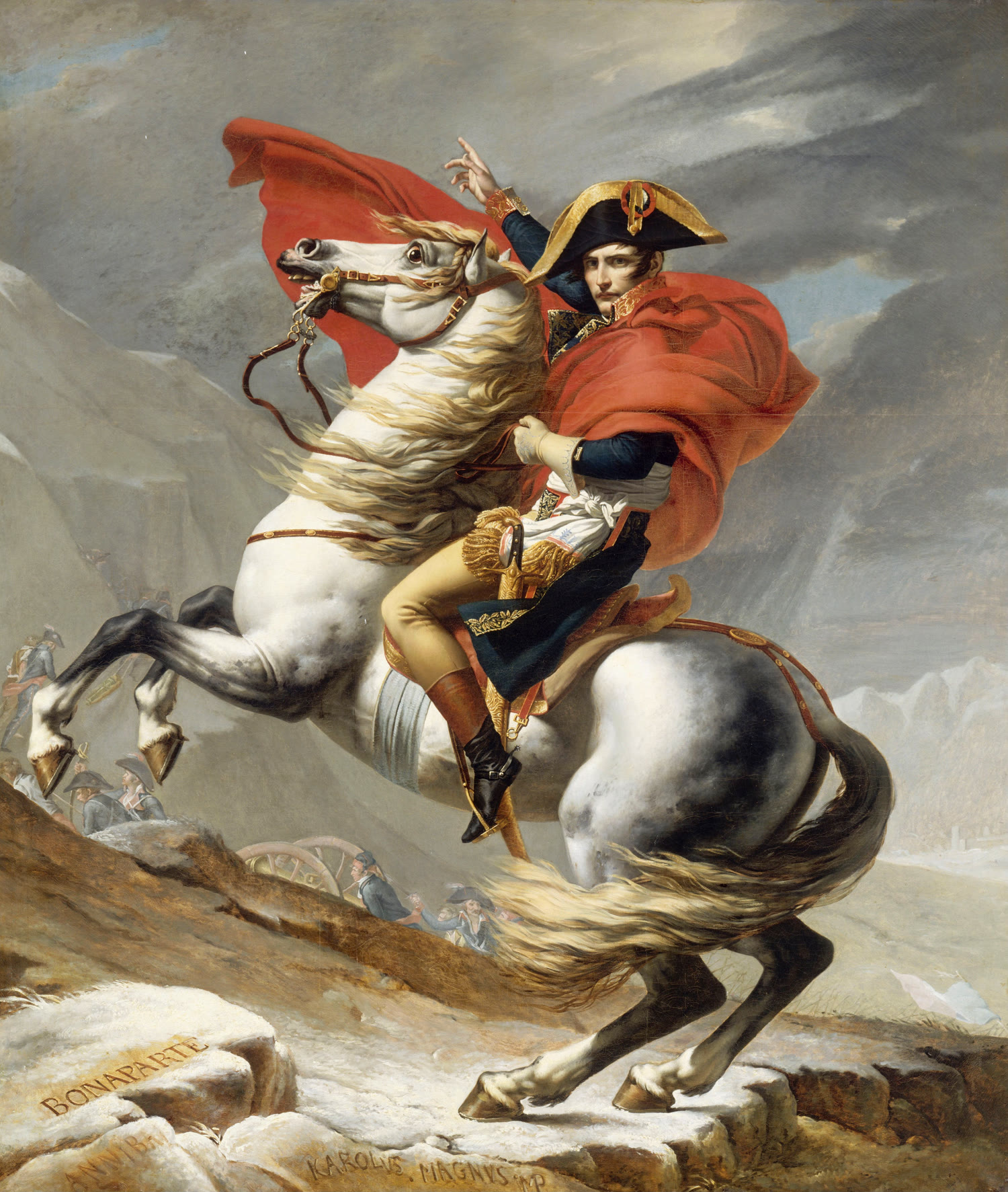
This is the version at the top of the article and in the six close-ups from Vienna. Look for the scarlet cloak, pale muzzle and dark shadows around the hindquarters. The Belvedere dates the work to 1801. It was sent to Milan for the palace of the Italian Republic in 1803 and later went to Vienna. The Kunsthistorisches Museum lends it to the Belvedere. Belvedere collection context
David retained this version. The dark collar and muted orange cloak frame the face, and the horse again has a dark head and lighter body. David’s daughter presented the work to Louis-Napoléon around 1850. It entered the Versailles collection in 1979 as MV 8550. Versailles collection reference
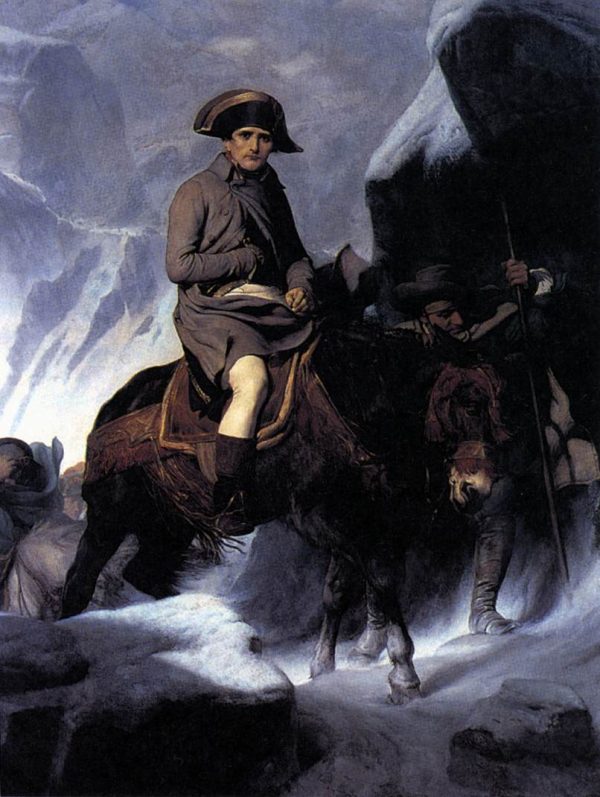
Paul Delaroche returned to the crossing nearly half a century later. In his Bonaparte Crossing the Alps, the rider is wrapped in a coat, the mule picks its way over the snow, and a guide walks beside it. The Louvre dates its Delaroche canvas to 1848. Delaroche puts the mountain weather and the guide’s work where David had put the horse and the sweeping cloak. Louvre collection record
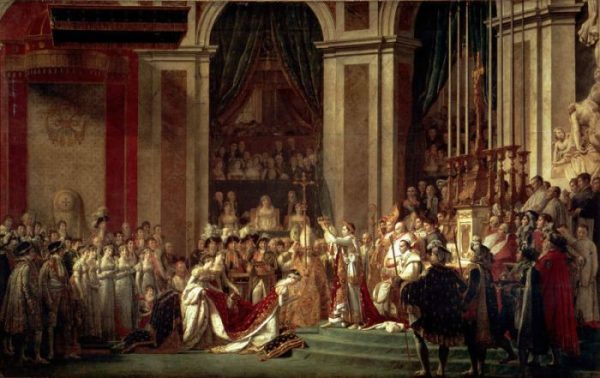
Compare Delaroche’s scene with David’s later portraits. In The Coronation of Napoleon, the emperor raises a crown before an audience. In Napoleon in His Study, he stands beside a desk late at night. David gives him a different setting and a different gesture each time, depending on what the portrait is meant to show.
The first version travelled to Madrid after the Spanish commission. Joseph Bonaparte later took it out of Spain and kept it during his exile in the United States. The painting returned to Europe with his family and was bequeathed to Malmaison in 1949. It is the yellow-cloaked canvas our hand-painted reproduction follows.
For another example of how a painter turned a military crossing into a public image, see Washington Crossing the Delaware. You can also explore David’s place in our Top 10 Famous Neoclassical Paintings.
He rode a mule over the Great St Bernard Pass in May 1800. David painted a rearing horse and a rider pointing up the pass to turn the crossing into a portrait of command. Delaroche’s mule has its own place among our 10 famous Napoleon paintings.
The first version is at Château de Malmaison near Paris. The other versions belong to the collections at Charlottenburg in Berlin, the Kunsthistorisches Museum in Vienna, and Versailles, which has two. The Vienna version is on loan to the Belvedere.
Both commanders had led armies across the Alps. Placing their names below Bonaparte’s ties his recent campaign to earlier military history and claims a place for him alongside them.
Enjoyed this story?
Save articles to your collection
Log in or create a free account, and this article will be waiting in your Private Collection.
Log in or sign up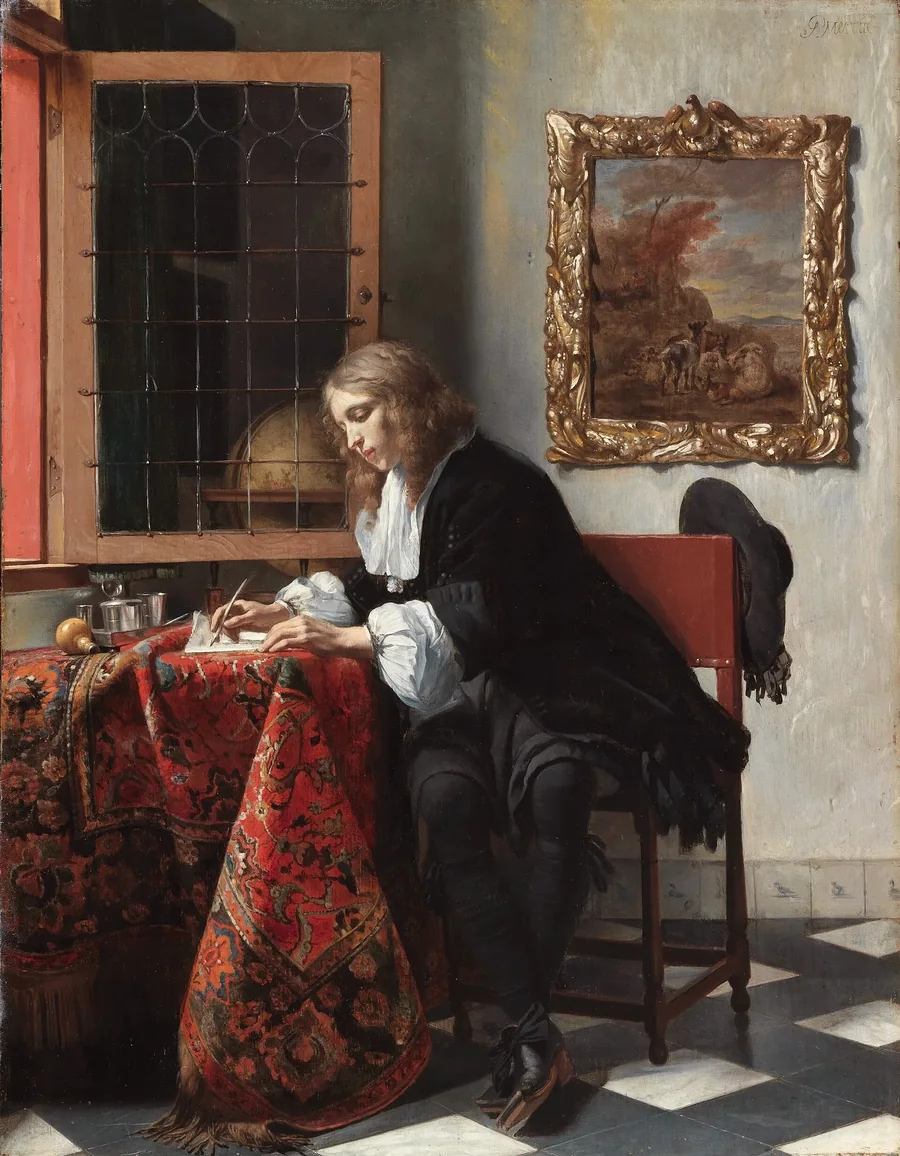
Man Writing a Letter
Gabriel Metsu, c. 1664
The gallery list
Every painting is already 50% off. Join the list and we will send you an extra $15 code, plus first access to new collections.
No spam. Unsubscribe anytime. · Privacy Policy
Welcome
Your $15 code is on its way. Explore the gallery while you wait.