Loading cart…
No products in the cart.

1887 · Oil on canvas · Philadelphia Museum of Art, Philadelphia, United States

Renoir began work on The Large Bathers around 1884 and considered it finished in 1887, investing more sustained preparatory effort in this single canvas than in almost any other work in his career. He produced numerous drawings and studies in the years leading up to the final painting, a working method that was quite different from the direct and spontaneous approach he had employed during his Impressionist years. The composition was partly inspired by a seventeenth century lead relief by Francois Girardon at the gardens of Versailles, which depicted nymphs bathing, suggesting that Renoir was actively engaging with the French classical tradition as a model for reforming his own approach to the figure. He also traveled to Italy in 1881 and was deeply affected by the frescoes of Raphael and the ancient Roman paintings he encountered in Naples and Pompeii.
The painting was exhibited in 1887 and received a mixed critical reception, with some reviewers finding the deliberate linearity and controlled finish a retreat from the vitality of his earlier work. Fellow Impressionists including Camille Pissarro expressed reservations about the direction Renoir was taking. Despite the controversy, the work holds a pivotal place in Renoir's development, representing the culmination of what he later called his period sec, or dry period, during which he sought greater structural clarity and formal discipline. The Philadelphia Museum of Art acquired the painting in 1964, and it is now recognized as one of the defining works of the transition in Renoir's career from his classic Impressionist phase toward the warmer, more sculptural figure style of his late years.
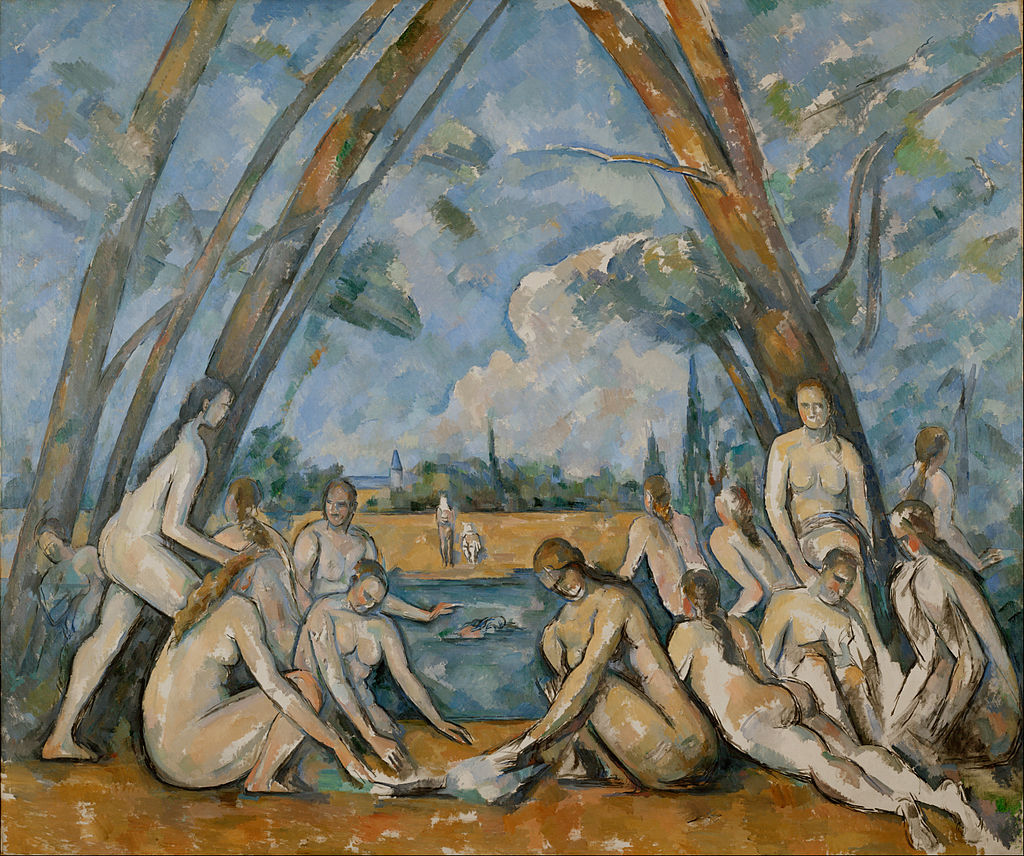
The composition arranges three principal female figures along the bank of a stream or pool, with two additional figures visible in the water in the middle distance. The grouping of the foreground figures is carefully balanced, with the central reclining figure providing a horizontal anchor and the two flanking figures creating a dynamic interplay of diagonals. Unlike Renoir's Impressionist figure paintings, the outlines of the bodies are drawn with a precision and firmness that reveals his study of Renaissance and ancient models. The flesh tones are smooth and luminous, built up in controlled glazes rather than the rapid, broken brushwork of his 1870s canvases. This technical restraint gives the figures a sculptural quality that is quite different from the atmospheric shimmer of his earlier outdoor nudes.
The landscape setting, with its dappled light on water and leafy background, retains more of the Impressionist sensibility than the figures themselves, creating a deliberate tension between the classical treatment of the human form and the atmospheric rendering of the natural environment. This contrast is one of the most discussed aspects of the painting among art historians, with some seeing it as an unresolved conflict and others interpreting it as a productive dialogue between tradition and modernity. The palette is lighter and cooler than in many of Renoir's earlier works, with silvery blues and pale pinks dominating the flesh and water areas. The overall effect is one of refined clarity rather than sensory warmth, a quality that reflects the disciplinary ambitions Renoir set for himself during this period.
The Large Bathers represents a significant moment of self-examination in Renoir's artistic development, a deliberate attempt to measure his own practice against the long tradition of Western figure painting and to determine what elements of that tradition could be revitalized within a modern context. Renoir was not alone among his contemporaries in feeling that Impressionism, for all its achievements, had sacrificed something important in its rejection of line, structure, and the classical nude. His engagement with these concerns connects him to a broader current in late nineteenth century French art that also shaped the development of Paul Cezanne and Georges Seurat, both of whom sought in different ways to restore formal discipline to a movement they felt had become too exclusively focused on optical sensation.
The choice of the female bather as a subject allows Renoir to engage with one of the oldest and most loaded themes in Western painting while placing it in a setting that is ostensibly natural and contemporary rather than mythological. The women in the painting are not named goddesses but anonymous modern figures, yet their placement in a timeless landscape and their treatment in a classical style creates a deliberate ambiguity between the ancient and the present. This ambiguity is itself meaningful, suggesting that Renoir saw beauty not as a historical artifact but as a continuous presence accessible to the modern painter who was willing to learn from the past without simply imitating it. The painting invites viewers to consider what endures across time in the human experience of natural beauty and why the image of the human figure at ease in nature has held such persistent appeal across centuries of artistic production.