Loading cart…
No products in the cart.

Save articles to your collection
Log in or create a free account, and this article will be waiting in your Private Collection.
Log in or sign upOne painted flesh as light dissolved into shadow, the other carved muscle into stone — two Renaissance giants who never agreed on what a body could mean.
Florence, 1504. Both men were in the city at the same time, commissioned to paint opposing murals in the Palazzo Vecchio. They never completed those murals. What they left behind instead was a rivalry so sharp, so personal, and so creatively explosive that it reshaped the entire trajectory of Western art. Leonardo da Vinci and Michelangelo Buonarroti did not merely represent different styles. They represented different philosophies of what a human being was, what a body meant, and what painting and sculpture were for.
The tension between them was not merely professional. Michelangelo reportedly mocked Leonardo in public, calling him out for abandoning a bronze horse commission in Milan. Leonardo, twenty-three years older and already celebrated, looked at Michelangelo with something closer to cool dismissal than open rivalry. These were two men who agreed on almost nothing, from the primacy of painting versus sculpture to the role of intellect versus raw physical force in the creative act.
This article places those two visions side by side. Not to crown a winner, but to understand why they saw the human form so differently, and why that difference still matters every time you stand in front of one of their works.

Leonardo da Vinci was born in Vinci, in the Tuscan region of Italy, on April 15, 1452, and died in Amboise, France, on May 2, 1519. A central figure of the Italian High Renaissance, he…


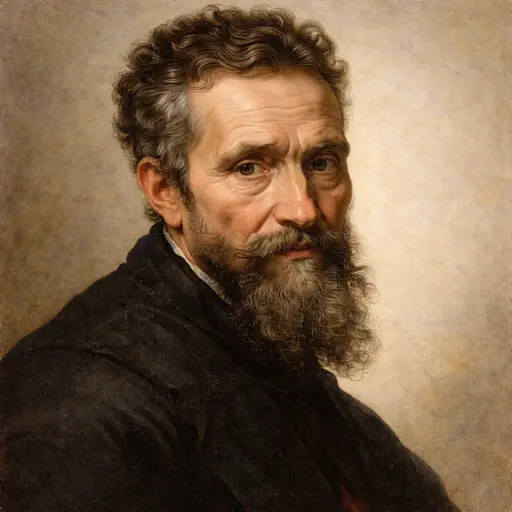
Michelangelo di Lodovico Buonarroti Simoni was born in Caprese, Italy, on March 6, 1475, and died in Rome on February 18, 1564. He lived to eighty-eight years old, outlasting nearly every artist of his generation,…


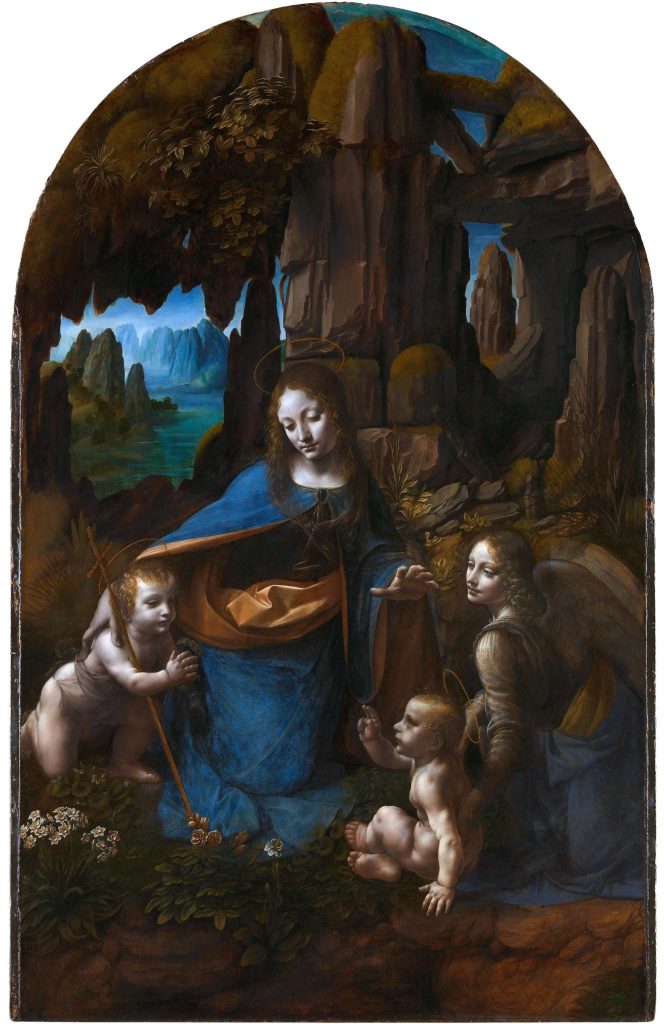
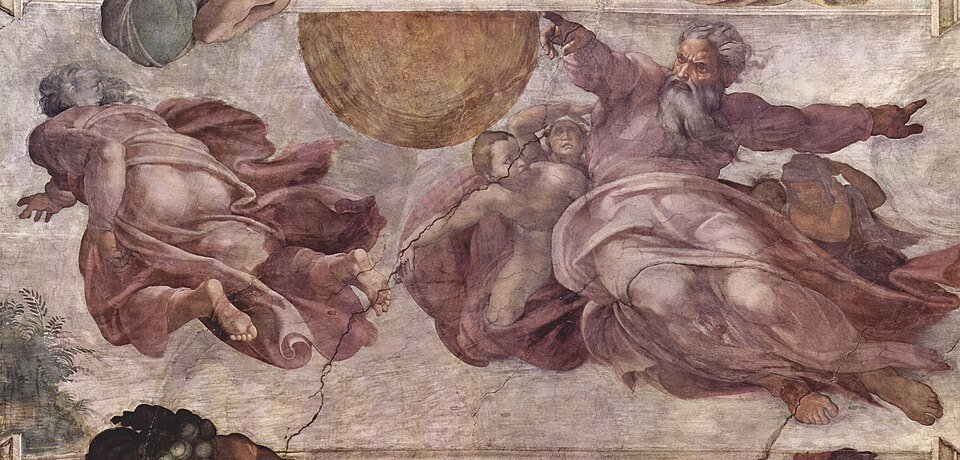
The sharpest way to understand the divide between these two artists is to look at how each handled the sacred human figure. Leonardo painted the Virgin of the Rocks and Michelangelo painted the Sistine Chapel Ceiling. Both works contain figures of spiritual weight. But the bodies inside them have almost nothing in common.
Leonardo places the Virgin in a rocky grotto with soft, diffused light falling across her from no single identifiable source. The figures are tender, slightly turned toward one another, connected by gesture and glance rather than by dramatic physical action. Every edge is softened. The infant Christ and the infant John are almost indistinguishable in their physical fragility. Leonardo wants you to feel that you are witnessing something intimate and found, as though you stumbled upon a private moment in a real cave. The body here is a vessel for inner experience.
Michelangelo wants something entirely different. His ceiling is populated with bodies that strain, twist, reach, and pull against the limits of their own musculature. The Sibyls and Prophets seated along the edges are not calm observers. They are coiled with energy even in stillness. The nude male figures known as the Ignudi flex across the architecture like decorative athletes who refuse to be merely decorative. For Michelangelo, the body was not a vessel for inner life. It was the direct expression of divine power made physical.
Leonardo studied the body to know its secrets. Michelangelo studied the body to transcend it. That is not a small difference. It is the central argument of the entire Renaissance, played out between two men who happened to be alive at the same time.
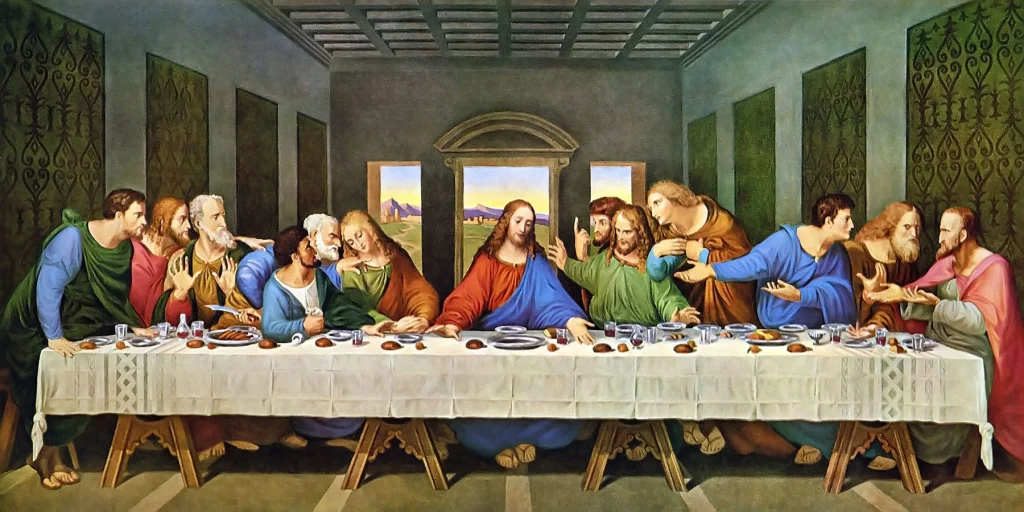
Leonardo spent years on the Last Supper, painted on the refectory wall of Santa Maria delle Grazie in Milan between approximately 1495 and 1498. The scene captures the single instant after Christ announces that one among them will betray him. What Leonardo achieves in that freeze-frame is a psychological portrait of twelve different human responses to a devastating statement. Every apostle reacts differently in body language, in facial expression, in the way hands clutch or gesture or go still. Leonardo was not interested in the theological event. He was interested in what twelve real people would feel and show in their faces and bodies at that specific second.
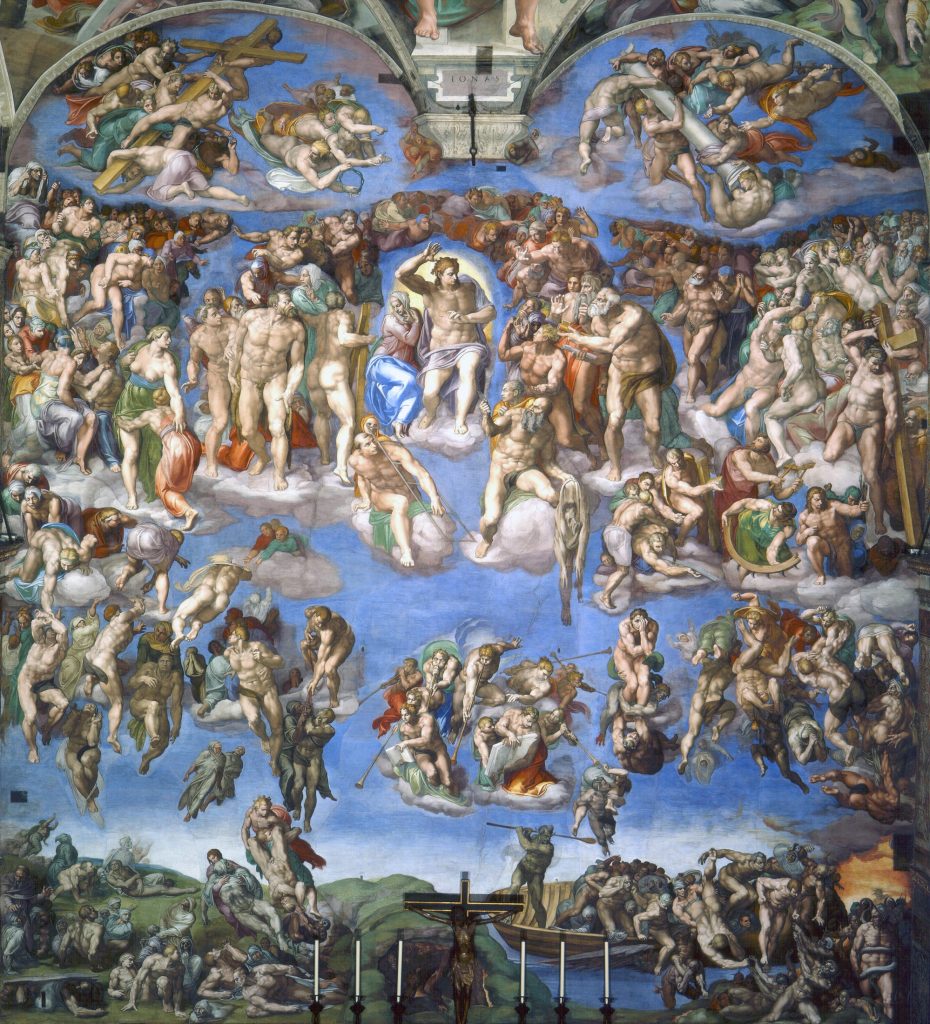
Michelangelo, working on the Last Judgment on the altar wall of the Sistine Chapel between 1536 and 1541, approached the same broad tradition of Christian narrative from a completely different angle. His scene is not a single frozen moment. It is a cosmic upheaval, with hundreds of bodies rising, falling, twisting, and clawing their way through the pictorial space. Christ at the centre is not the gentle teacher of Byzantine tradition. He is a young, muscular, beardless figure whose raised arm sends souls cascading downward with the force of a physical blow.
Where Leonardo isolates psychology, Michelangelo mobilises bodies. Where Leonardo gives each figure a private interior life, Michelangelo gives each figure a physical fate. Neither approach is superior. But they are genuinely incompatible visions of what narrative painting is supposed to do to the person standing in front of it.
Collectors who want to live with these contrasts at home can find a hand-painted oil reproduction of the Last Supper or the Last Judgment in our collection, each rendered in the original palette and scale intentions of the source work.
The argument between Leonardo and Michelangelo did not end with their deaths. It became the foundational tension inside almost every major debate about art that followed. Observation versus idealisation. The interior life of figures versus their physical drama. Painting as a window onto psychology versus painting as a theatre of bodies. These arguments echo through Caravaggio, through Rembrandt van Rijn, through Diego Velazquez, and all the way forward into the realist and academic debates of the nineteenth century.
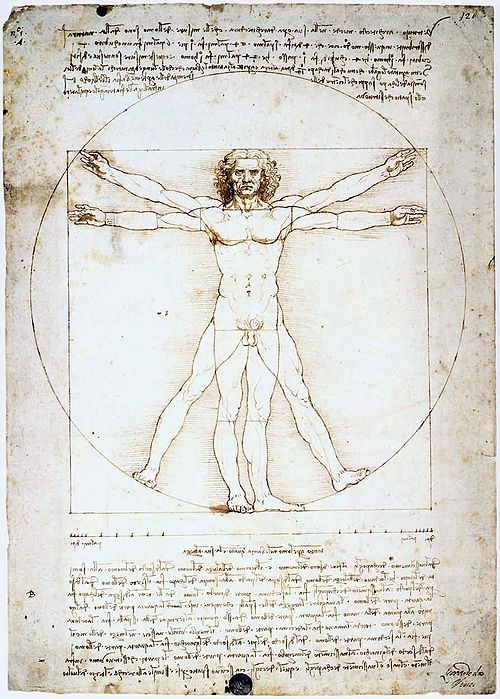
What the Vitruvian Man represents is illuminating in this context. Leonardo drew it around 1490 as a study in proportion, placing a male figure in two overlapping positions inside a circle and a square. It is a diagram of the body as a measurable, rational system. It is also one of the most reproduced images in human history, which tells you something about how deeply the idea of the body as a subject of careful study has embedded itself in the culture Leonardo helped shape. Michelangelo would never have drawn the Vitruvian Man. He would have considered the geometry beside the point. The body for him was already perfect in its tension and struggle. You did not need to measure it. You needed to release it from the marble.
Both artists transformed what it was possible to expect from a painted or sculpted human figure. The Renaissance as a cultural project could not have reached the heights it did without both of them pulling in opposite directions at once. Institutions from Raphael forward had to negotiate between the two poles they set, and that negotiation has never fully resolved itself.
If you want to understand the private psychology of a human being, you go to Leonardo. His portraits and sacred figures carry an inner life that no amount of technical analysis fully explains. The Mona Lisa has been studied for five centuries and her expression still resists a final reading. The Salvator Mundi holds a glass orb with fingers so delicately placed that the image feels less like a religious icon and more like a portrait of a specific, thinking person. Leonardo built empathy into his surfaces through sfumato, through the soft dissolution of edges, through the sense that his figures exist in real air and real time rather than in the controlled geometry of a composition.
If you want to understand the human body as a site of power, struggle, and transcendence, you go to Michelangelo. His Creation of Adam and the muscular cascade of the Last Judgment communicate physical and spiritual force at a scale and intensity that no painter before him had attempted. His bodies do not invite contemplation. They demand a physical response. The rivalry between these two men was never truly about who was better. It was about what art was for. Leonardo said art was for knowing. Michelangelo said art was for feeling the weight of existence in your own body. Both were right, and both answers are still being argued over today.
Enjoyed this story?
Save articles to your collection
Log in or create a free account, and this article will be waiting in your Private Collection.
Log in or sign up
Man Writing a Letter
Gabriel Metsu, c. 1664
The gallery list
Every painting is already 50% off. Join the list and we will send you an extra $15 code, plus first access to new collections.
No spam. Unsubscribe anytime. · Privacy Policy
Welcome
Your $15 code is on its way. Explore the gallery while you wait.