Loading cart…
No products in the cart.

Art Guides · Baroque
Save articles to your collection
Log in or create a free account, and this article will be waiting in your Private Collection.
Log in or sign upBaroque painting was made to grab you. In seventeenth-century Europe, painters threw a spotlight into the dark, froze bodies in the middle of a fight, a fall or a sudden thought, and painted ordinary people so real you could touch them. This guide explores ten famous Baroque paintings, selected using October 2026 search estimates and our catalogue, from a girl in a blue turban to a goldfinch on its perch, and for each one we tell you what you are looking at and the story behind it.
Rembrandt has three of them. Start with the top three, or read the whole list below.
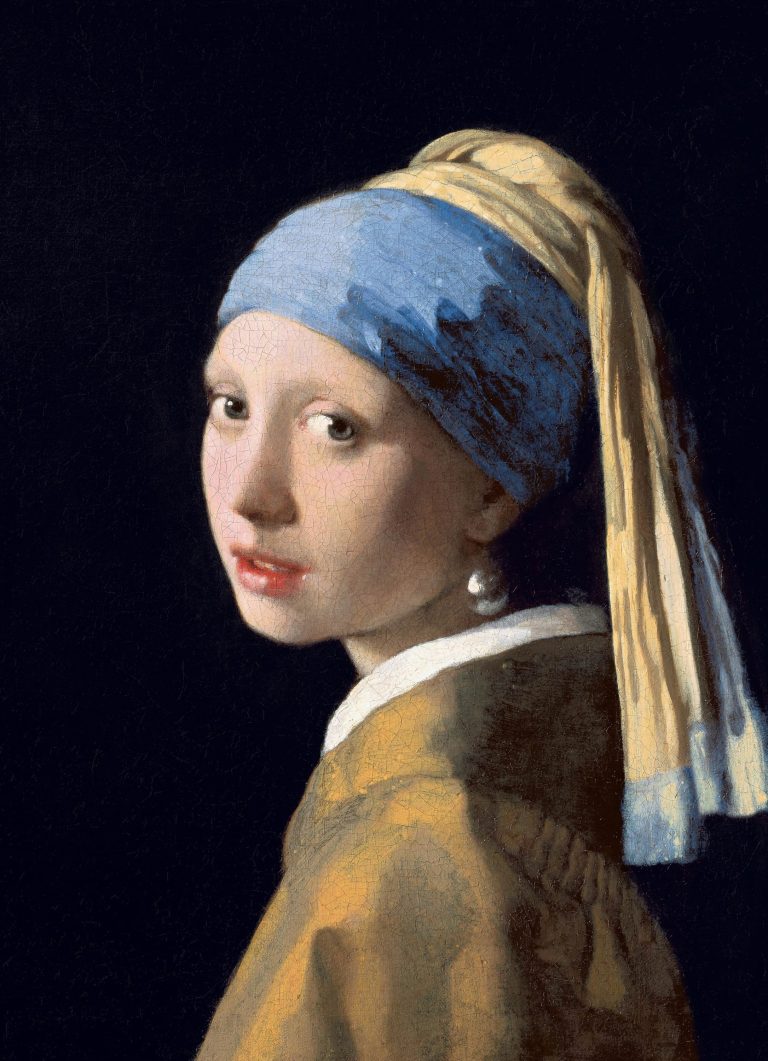
 Explore the artistJohannes Vermeer →
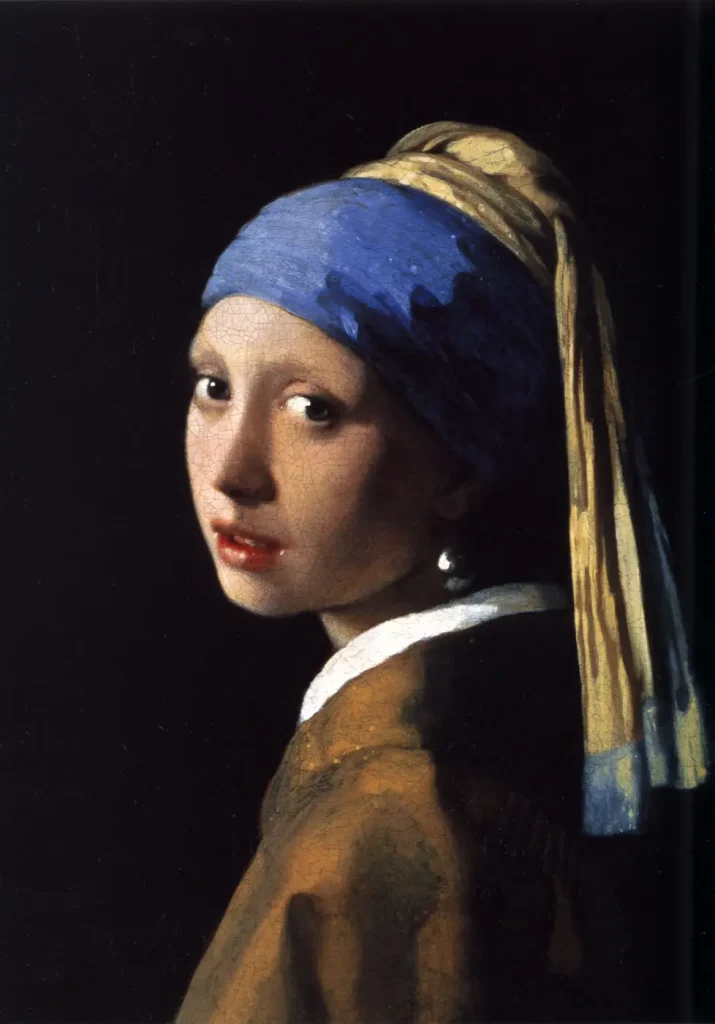
She is a tronie, rather than a commissioned portrait of an identified sitter. In Vermeer's time a tronie was a study of a face, an expression or an exotic costume; a real model could still have posed for it. Her blue turban was painted with ultramarine, made from ground lapis lazuli and more expensive than gold. The famous pearl is just two strokes of paint, a soft grey shape and one bright highlight, and it is probably far too big to be real: it may have been polished glass or tin.
The background was not always black. A study by the Mauritshuis in 2018 found it was once a deep green curtain that has faded, and that she has fine eyelashes, invisible to the naked eye. For two centuries she was almost forgotten. In 1881 a collector bought her at auction in The Hague for two guilders and thirty cents, and left her to the museum. A novel by Tracy Chevalier and a film with Scarlett Johansson later made her a star.
Collection reference: Mauritshuis, The Hague.
Johannes Vermeer · oil on canvas, made to order
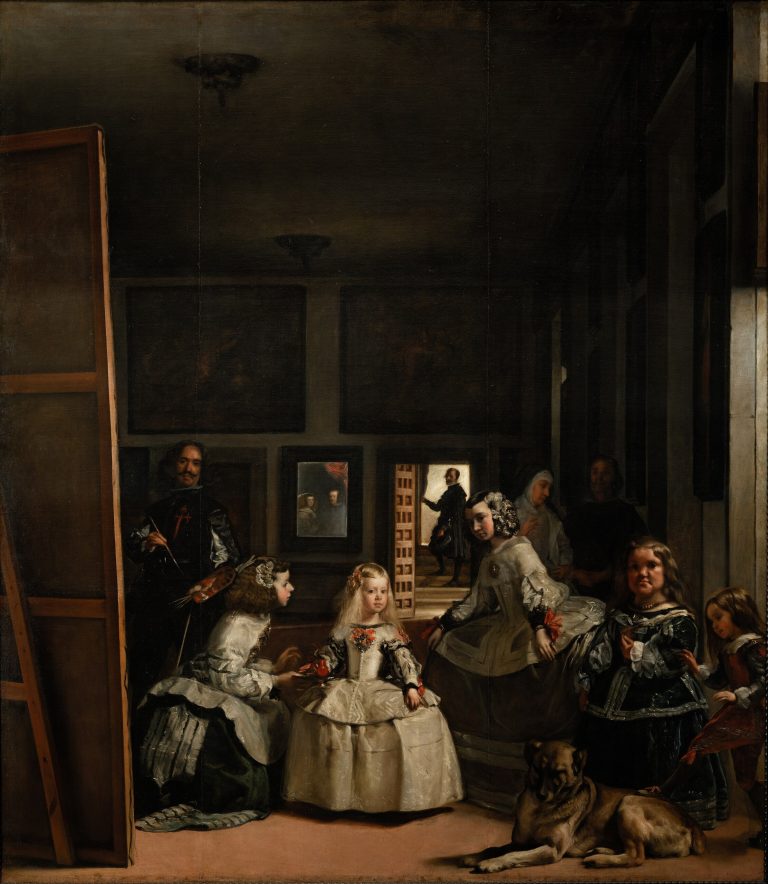
 Explore the artistDiego Velázquez →

In a big room of the royal palace in Madrid, five-year-old Princess Margarita has just arrived, surrounded by her maids of honour, the meninas of the title. One kneels to offer her a drink. On the right stand two dwarfs of the court, one gently kicking the sleeping mastiff. On the left, Velázquez himself looks out from behind an enormous canvas, brush in hand.
But who is he painting? In the mirror on the back wall are King Philip IV and Queen Mariana. One influential reading places them near the viewer’s position, although what the mirror reflects remains part of the painting’s puzzle. It is a puzzle about looking and being looked at that painters have never stopped arguing over. Picasso painted 58 variations of it in 1957. The red cross on Velázquez's chest is the badge of the Order of Santiago, which he received three years after finishing the picture; it was added later, and legend says the king painted it himself.
Collection reference: Museo del Prado, Madrid.
Diego Velasquez · oil on canvas, made to order
 Explore the artistRembrandt →
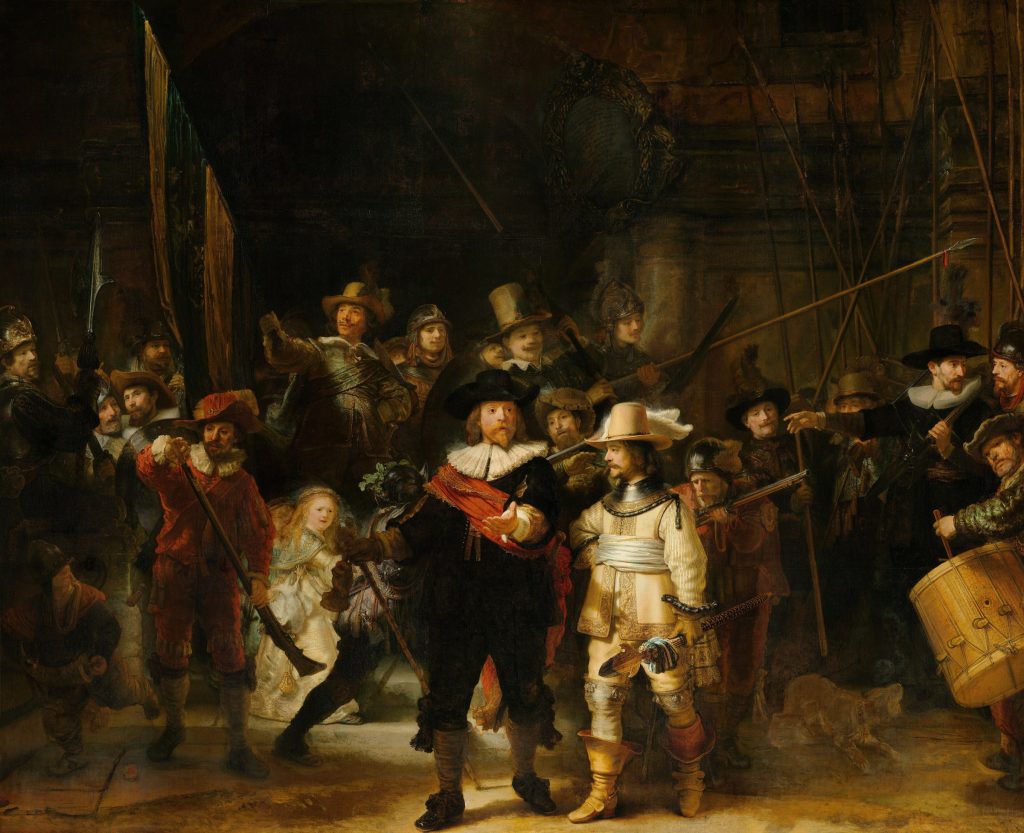
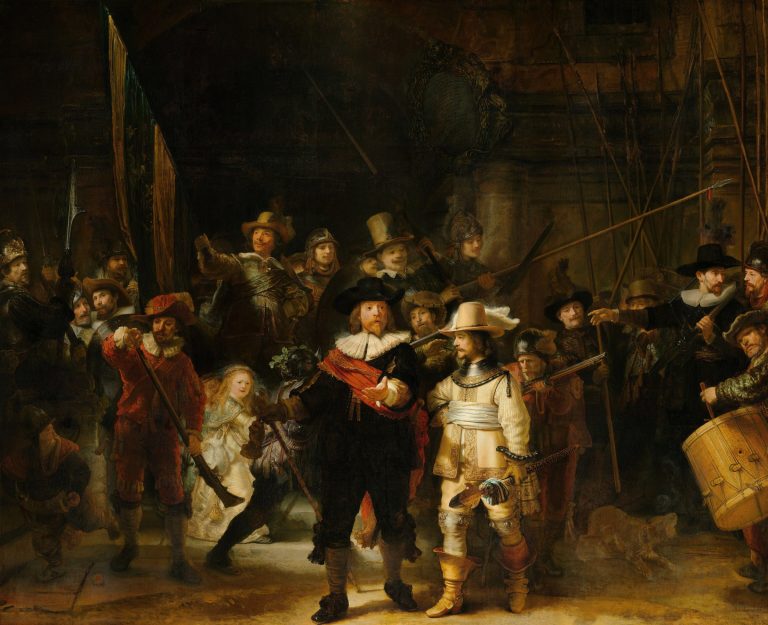
It is not a night scene. The painting shows the Amsterdam civic guard company of Captain Frans Banninck Cocq setting off in broad daylight. Over the centuries the varnish turned so dark that by the end of the eighteenth century people were calling it The Night Watch, and the name stuck. Instead of lining the men up in neat rows like every other group portrait of the time, Rembrandt painted a moment of movement: a musket going off, a dog barking, a drummer beating, flags going up.
Look for the small girl lit up in gold. On her belt hangs a dead chicken with big claws, the emblem of the company. In 1715 the canvas was moved to Amsterdam's town hall and cut down on all four sides to fit between two doors, and the strips were lost. It has survived three attacks, with a knife in 1975 and acid in 1990. Since 2019 it has been restored in a glass room in front of visitors, and the missing edges have been recreated with the help of artificial intelligence.
Collection reference: Rijksmuseum, Amsterdam.
Rembrandt · oil on canvas, made to order
 Explore the artistArtemisia Gentileschi →
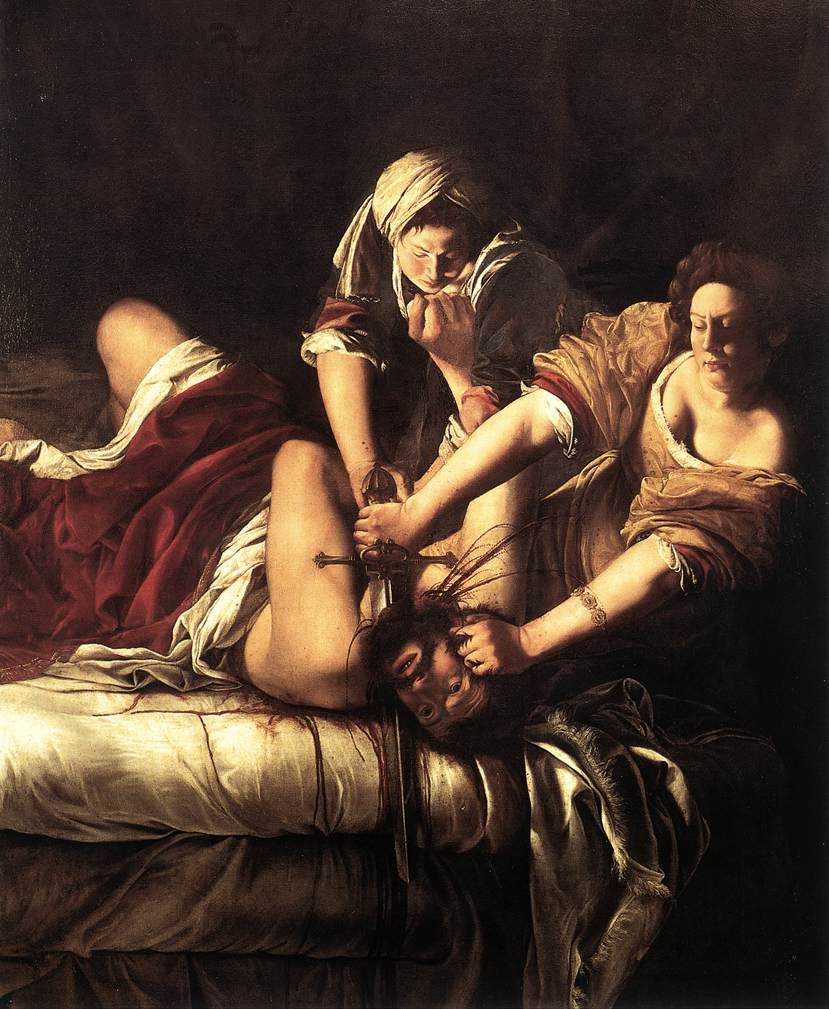
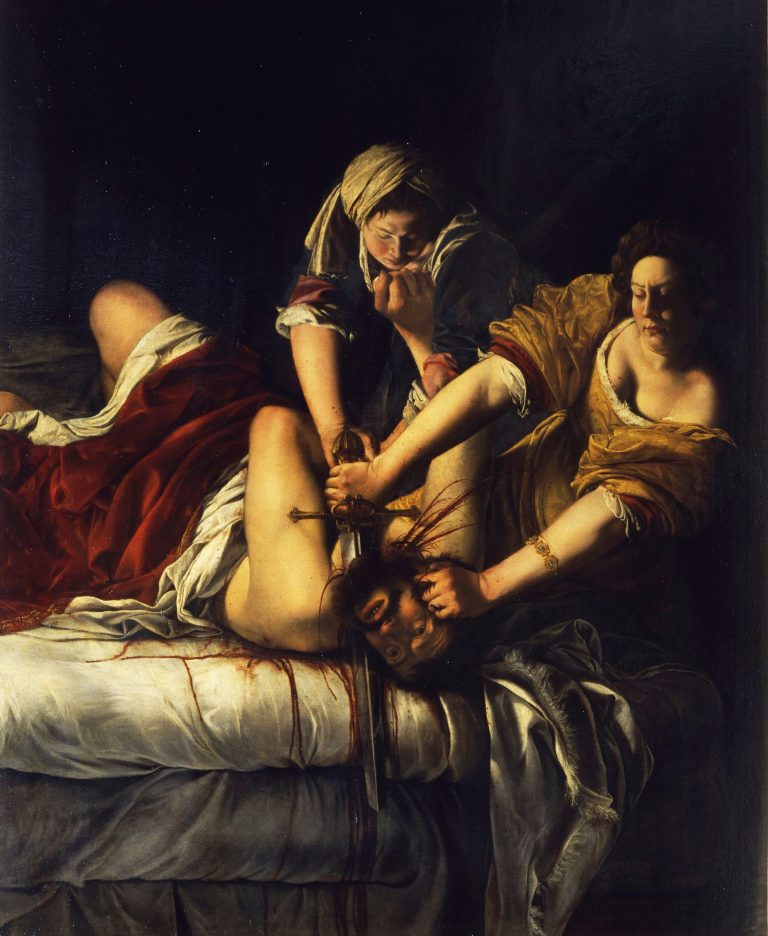
In the Old Testament, the widow Judith saves her town from the Assyrian army by getting into the tent of its general, Holofernes, waiting until he is drunk, and cutting off his head. Painters had shown the scene for centuries, usually with Judith looking graceful and a little reluctant. Caravaggio's famous version of about 1599, which people search for under the title Judith Beheading Holofernes, has her holding the sword at arm's length, as if disgusted.
Artemisia's Judith is not reluctant. She and her maid work together like butchers, leaning in with their full weight while Holofernes fights back and blood runs down the sheets. Artemisia made an earlier version around the time of the 1612 trial of Agostino Tassi, who had raped her when she was seventeen. The Florence painting shown here dates to about 1620. During the trial she was subjected to torture with cords around her fingers to test her testimony. Many people see her anger in this picture. Others warn against reading her whole career through one crime. Either way, it is one of the most powerful paintings of the century.
Collection reference: Uffizi Galleries, Florence.
Artemisia Gentileschi · oil on canvas, made to order
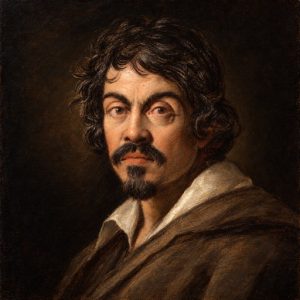 Explore the artistCaravaggio →
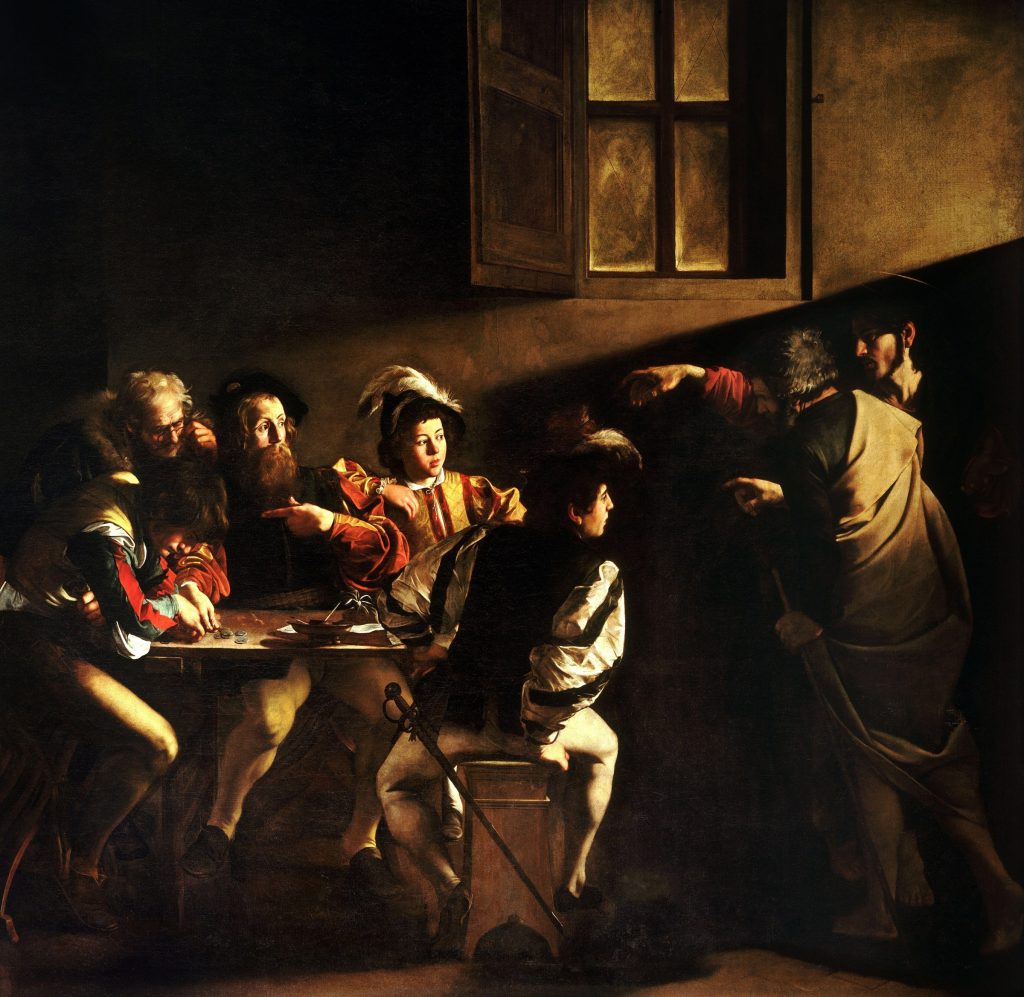
Matthew was a tax collector. Caravaggio puts him in a dim Roman room with a few friends in fashionable clothes, counting coins at a table. Then Christ walks in from the right, half hidden behind Saint Peter, and points. A beam of light cuts across the wall above them, following the line of his arm. Christ's hand is borrowed from Michelangelo's Creation of Adam, the hand that gives life.
It was Caravaggio's first public commission, and it made him famous overnight. Ever since, people have argued about which one is Matthew: the bearded man pointing at himself as if to say "me?", or the young man at the end of the table, still hunched over the money. The painting still hangs in the chapel it was made for, in the French church in Rome, and visitors drop a coin into a machine to switch on the light.
Location reference: City of Rome: San Luigi dei Francesi.
Caravaggio · oil on canvas, made to order
Explore the artistJohannes Vermeer →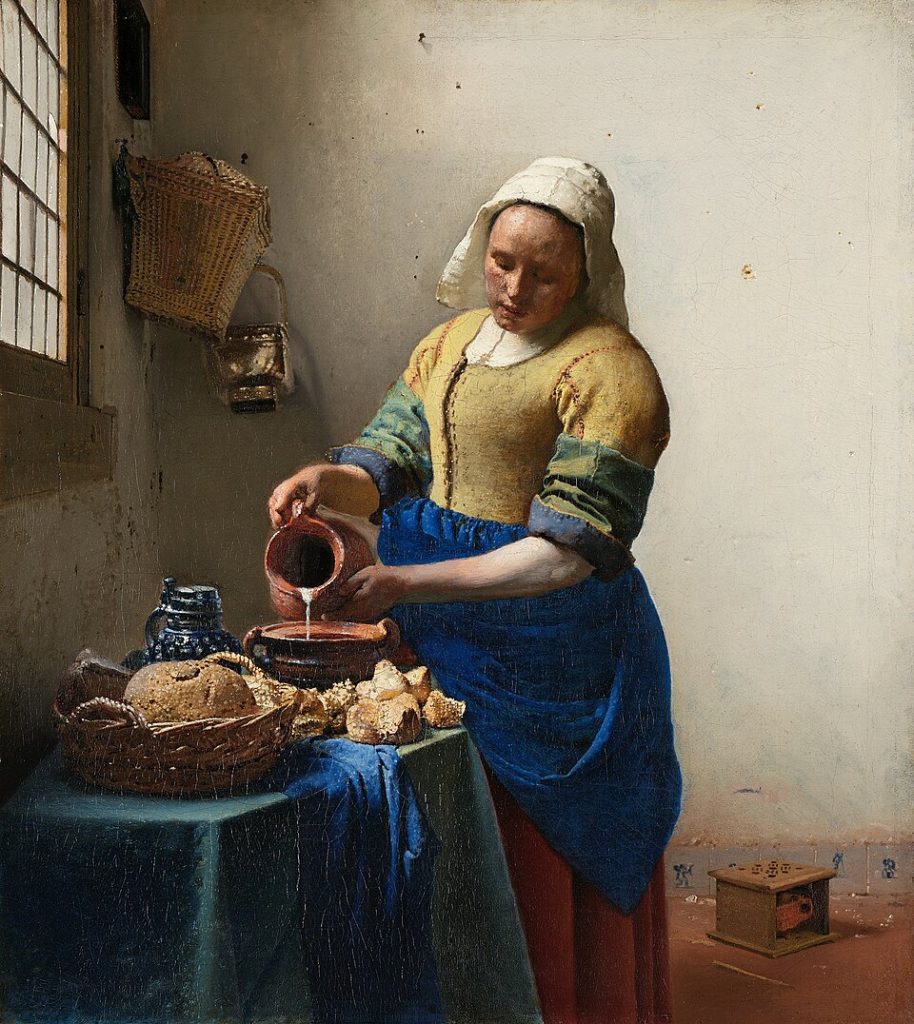
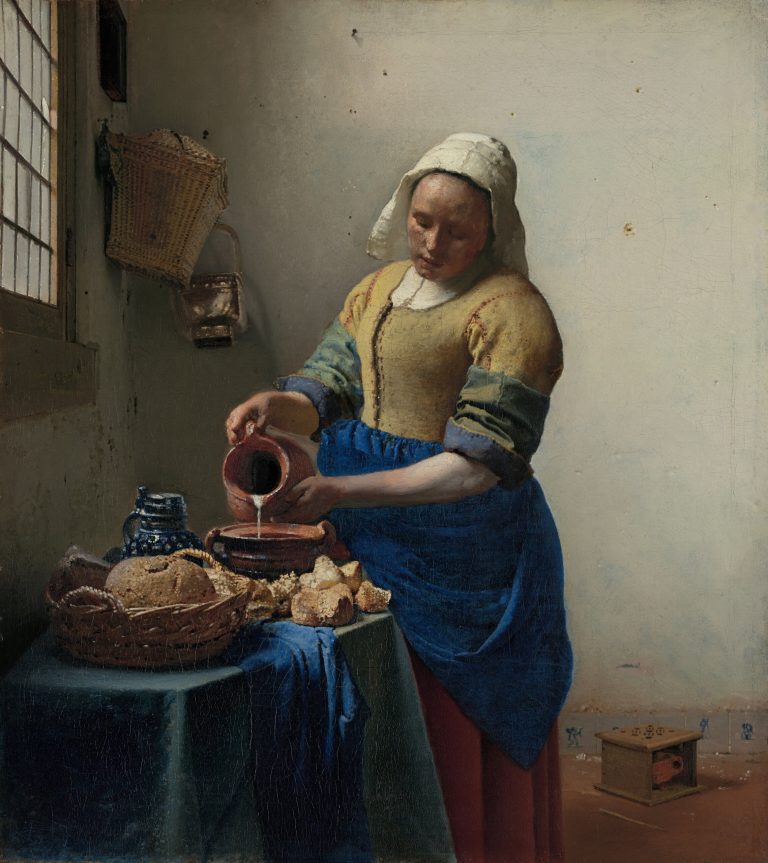
A kitchen maid pours milk into an earthenware bowl, slowly, with total concentration. That is all. Yet everything in the room glows: the crust of the bread is built up with tiny dots of light, the brass pail shines on the wall, and the blue of her apron, ultramarine again, is almost electric next to the yellow of her bodice.
Vermeer worked hard to make it look simple. Technical research has revealed a jug holder on the wall and a large fire basket at the lower right, both later painted over. Removing them gave the maid a quieter setting against the bare plaster. On the floor is a foot warmer, and the little tiles behind it show Cupid, a hint, perhaps, that the maid's thoughts are elsewhere. The Rijksmuseum bought the painting in 1908 after a national campaign to keep it in the Netherlands.
Collection reference: Rijksmuseum, Amsterdam.
Johannes Vermeer · oil on canvas, made to order
Explore the artistCaravaggio →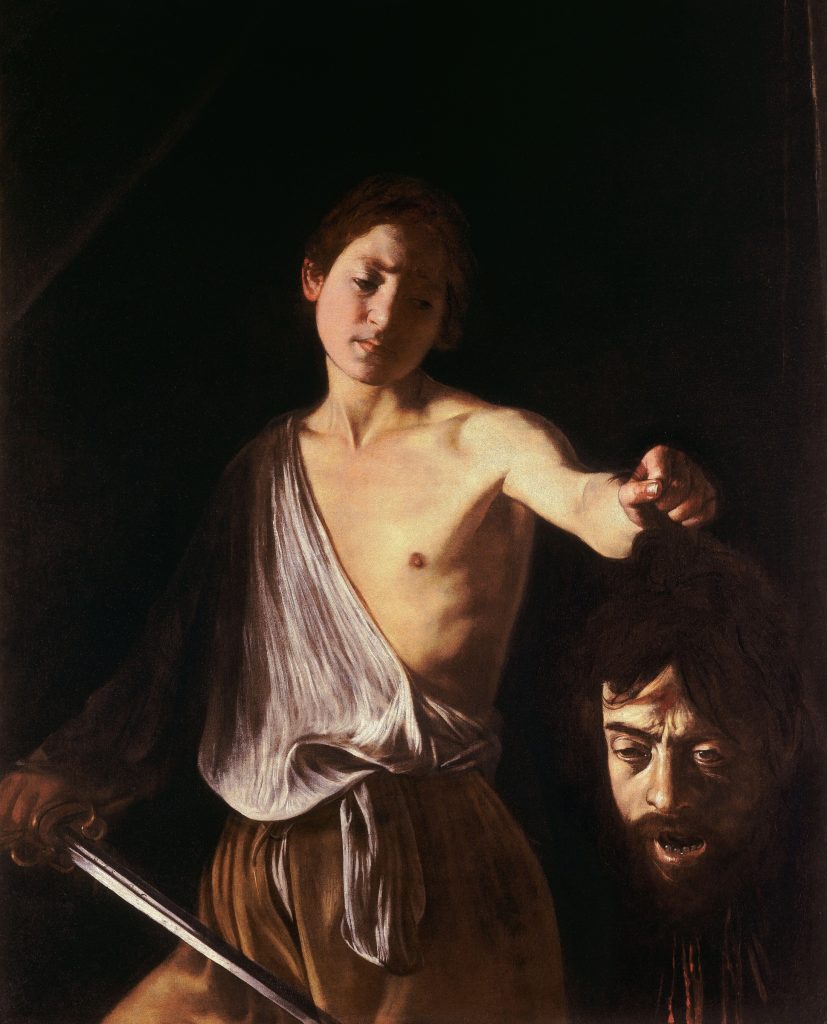
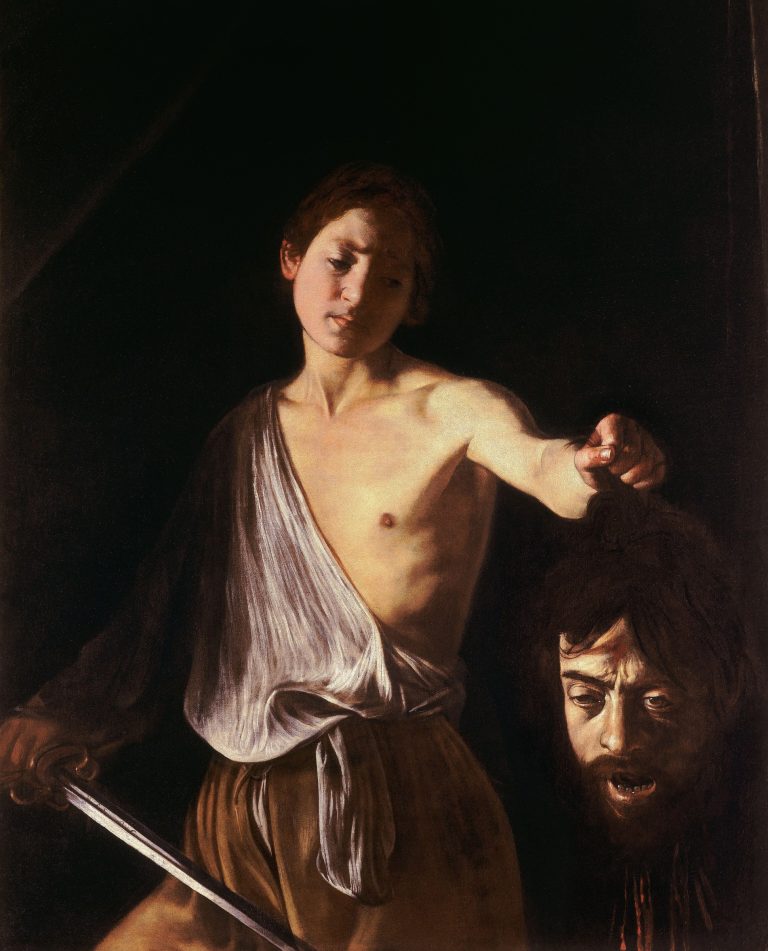
David should look triumphant. Instead he holds the giant's head at arm's length and looks at it with something like pity. The head, mouth open, one eye still half alive, is a self-portrait of Caravaggio himself, worn out and aged far beyond his late thirties.
In 1606 Caravaggio had killed a man, Ranuccio Tomassoni, in a fight in Rome, and was sentenced to death. He fled to Naples, Malta and Sicily. One influential interpretation sees the painting as a gift intended for Cardinal Scipione Borghese, the pope’s nephew, to help secure a pardon. Its exact date and circumstances remain debated. On the sword some read the letters of a Latin motto meaning humility kills pride. In 1610, on his way back towards Rome to receive the pardon, Caravaggio died at Porto Ercole, aged 38.
Collection reference: Galleria Borghese, Rome.
Caravaggio · oil on canvas, made to order
Explore the artistRembrandt →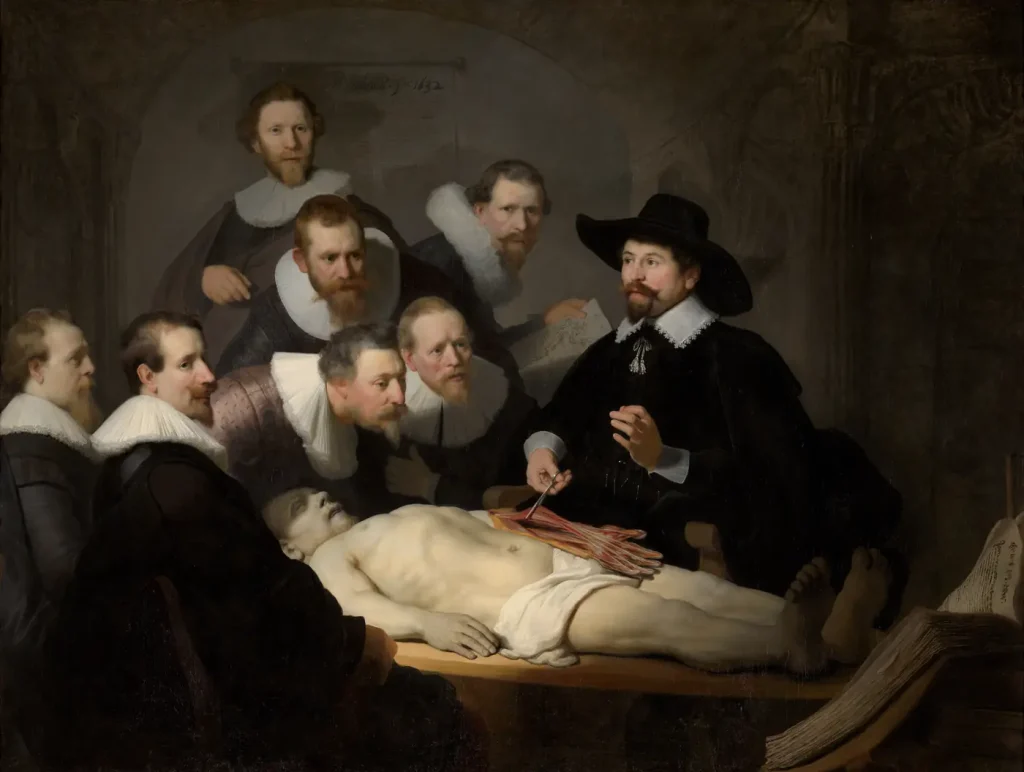
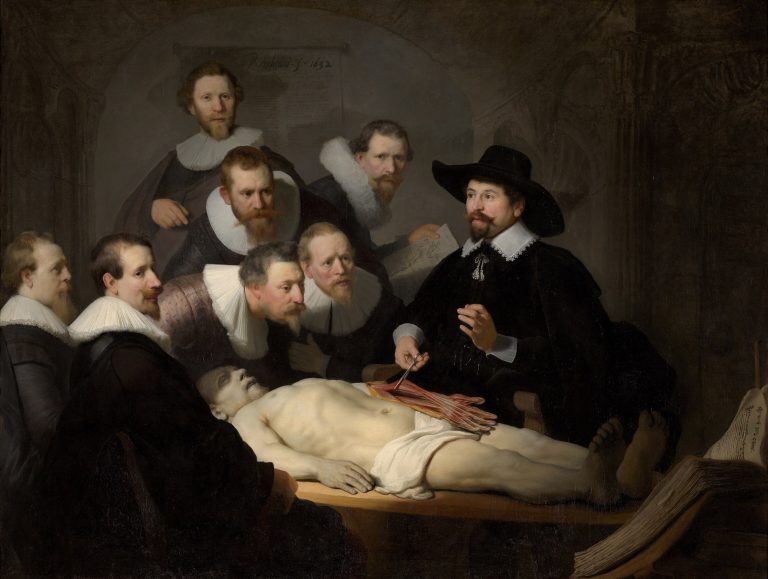
Once a year, the Amsterdam surgeons' guild held a public dissection, and people bought tickets to watch. In January 1632 the body was that of Aris Kindt, an executed offender, and the lecturer was Dr. Nicolaes Tulp. The surgeons who appear in the picture paid to be included, and the names are written on the sheet of paper one of them holds.
Rembrandt was only 25 and new in Amsterdam, and this was his first big commission there. Instead of a stiff row of heads he painted a lesson in progress: Tulp lifting the muscles of the forearm with his forceps and, with his own left hand, showing how they bend the fingers. Some of the men look at the arm, some at the open anatomy book at the corpse's feet, one straight at us. It made Rembrandt the most wanted portrait painter in the city.
Collection reference: Mauritshuis, The Hague.
Rembrandt · oil on canvas, made to order
Explore the artistRembrandt →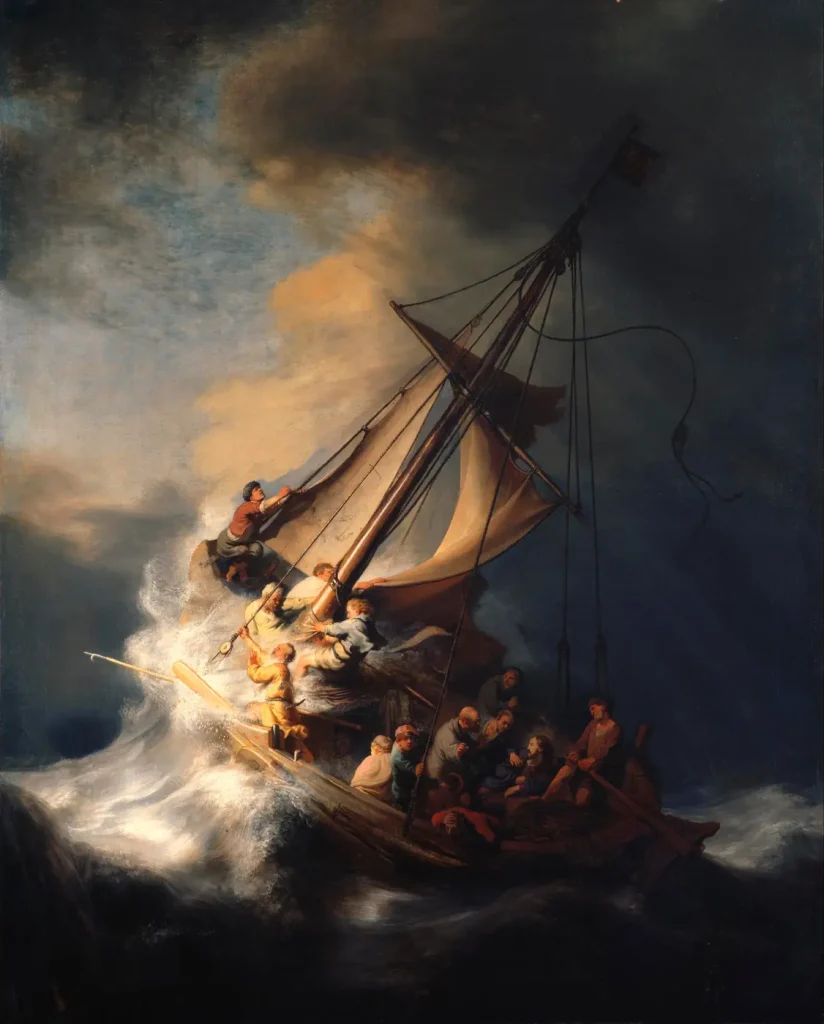
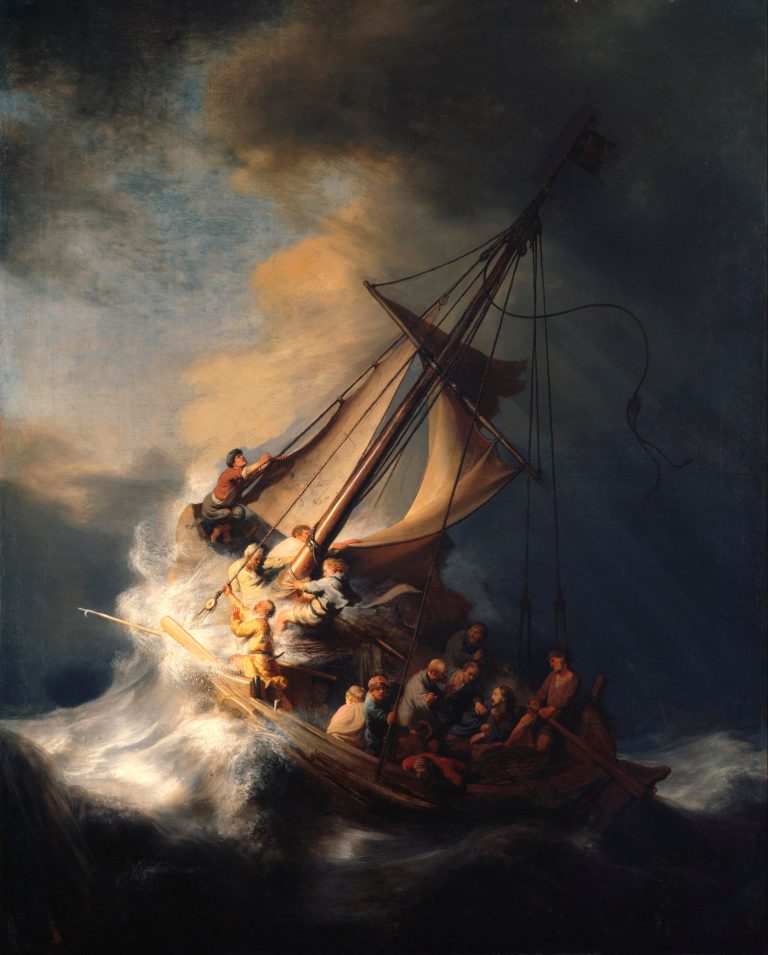
A huge wave lifts the bow of a fishing boat towards the black clouds; the sail is torn, men haul on ropes, one is sick over the side. At the back, in the calm half of the picture, the disciples wake Jesus, who will soon calm the sea. It is Rembrandt's only seascape. Count the people on board and you get fourteen, one too many: the man in the middle holding his cap and looking straight at us is Rembrandt himself.
No one has seen the original since 18 March 1990. That night two men dressed as police officers talked their way into the Isabella Stewart Gardner Museum in Boston, tied up the guards and stole thirteen works, including this painting, which was cut from its frame. It remains one of the largest art thefts in history. The empty frame still hangs on the wall, as a reminder of the missing painting.
Collection reference: Isabella Stewart Gardner Museum, Boston.
Rembrandt · oil on canvas, made to order
 Explore the artistCarel Fabritius →

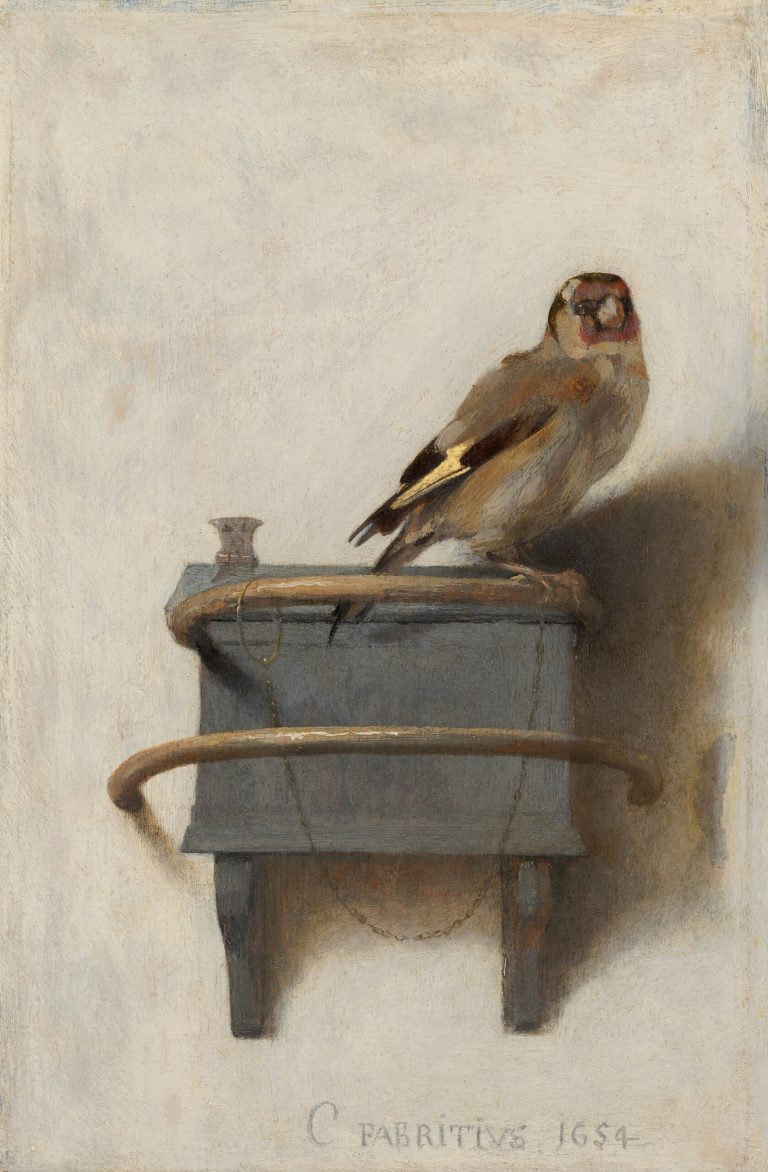
A small goldfinch sits on its feeding box on a pale wall, a fine chain around its ankle. Goldfinches were popular pets in Holland, trained to pull up tiny buckets of water. Fabritius painted it life size with quick, confident strokes, and it may once have been part of a cabinet door or a frame, meant to fool the eye into thinking a real bird was there.
He signed and dated it 1654. A few months later, on 12 October, a gunpowder store exploded in the centre of Delft and flattened a large part of the town, including Fabritius's studio. He was buried in the rubble and died that day, aged 32. Only about a dozen of his paintings survive. A pupil of Rembrandt, he may have taught or inspired Vermeer, and in 2013 Donna Tartt's Pulitzer-winning novel The Goldfinch made his little bird famous all over again.
Collection reference: Mauritshuis, The Hague.
Carel Fabritius · oil on canvas, made to order
Vermeer's Girl with a Pearl Earring, followed by Velázquez's Las Meninas and Rembrandt's The Night Watch.
The style that dominated European art in the seventeenth century, roughly from 1600 to 1720. It is dramatic, emotional and real: strong contrasts of light and dark, movement caught at its peak, and ordinary people painted with total honesty. It began in Rome with Caravaggio and spread to Spain, Flanders and the Dutch Republic.
The Italian word for light-dark: modelling forms with strong contrasts of light and shadow. Caravaggio pushed it so far that his figures seem to emerge from black, a manner called tenebrism.
Yes. Vermeer and Rembrandt belong to the Dutch Golden Age, the Dutch branch of the Baroque, which focused on everyday life, portraits and landscapes rather than grand religious scenes.
Caravaggio, Rembrandt, Vermeer, Rubens, Velázquez and Artemisia Gentileschi are the best known. You can meet them in our ten famous Baroque artists.
In The Hague at the Mauritshuis, in Amsterdam at the Rijksmuseum, in Madrid at the Prado, in Rome at San Luigi dei Francesi and the Galleria Borghese, and in Naples and Florence. The Storm on the Sea of Galilee is still missing. All ten are available from us as hand-painted oil reproductions.
Explore more works in our Baroque collection. Museum and catalogue records are linked beside each painting above.
Enjoyed this story?
Save articles to your collection
Log in or create a free account, and this article will be waiting in your Private Collection.
Log in or sign upRanking follows monthly US Google search volume for each painting's name (OpenSEO, October 2026). Google reports no figure for Girl with a Pearl Earring, which shares its name with a novel, a film and many products; we place it first as the most widely recognised Baroque painting. Searches for Judith Beheading Holofernes include both Caravaggio's and Artemisia Gentileschi's versions; we show hers. Ties are broken with clickstream data. We do not publish the figures.

Man Writing a Letter
Gabriel Metsu, c. 1664
The gallery list
Every painting is already 50% off. Join the list and we will send you an extra $15 code, plus first access to new collections.
No spam. Unsubscribe anytime. · Privacy Policy
Welcome
Your $15 code is on its way. Explore the gallery while you wait.