Loading cart…
No products in the cart.

Save articles to your collection
Log in or create a free account, and this article will be waiting in your Private Collection.
Log in or sign upPlan a visit to the Met in New York with admission prices, opening hours and ten paintings, from Washington Crossing the Delaware to Vermeer.

The Metropolitan Museum of Art can make a single visit feel like several different journeys. On Fifth Avenue, American landscapes and portraits share a museum with European painting, ancient objects and art from many other traditions. For a painting-focused visit, the pleasure lies in the changes of scale: Leutze's dramatic river crossing, a small Vermeer interior and the open distance of a Bruegel harvest.
This guide concentrates on The Met Fifth Avenue in Manhattan. It covers practical admission information and ten public-domain paintings from the collection. The selection is an introduction rather than an official ranking. Check each collection record before travelling: a work belonging to the museum is not a guarantee that it will be on display that day.
New York State residents and students from New York, New Jersey and Connecticut qualify under the Met's pay-what-you-wish rules, with required identification. A payment is still required. New Jersey and Connecticut students must obtain these tickets in person. General admission covers exhibitions and both Met locations on the same date. Online advance tickets are available but not required. Official admission and booking information.
The museum lists additional holiday closures on Thanksgiving, 25 December, 1 January and the first Monday in May. Check its current notices for gallery closures.
The paintings below belong to the Fifth Avenue collection. The Met Cloisters is a different location in northern Manhattan, focused on medieval European art. Do not treat the two buildings as neighbouring entrances. If you want to visit both, plan the journey separately using the museum's location information.
We suggest allowing three to four hours for a first painting-focused visit, with a break. Start by choosing a few priorities rather than trying to find all ten at speed. Compare an American landscape with a European landscape, or a public portrait with an intimate interior. Those pairings give the visit a question to follow.
Ask for a current map and an accessible route appropriate to your needs. The numbering here introduces the pictures; it is not a room-by-room walking order. Loans, conservation work and gallery closures can change the route.

These ten public-domain paintings are selected for their visual interest and the different experiences they offer. This is an editorial collection guide, not an official ranking or a live display checklist.
Emanuel Leutze · 1851
 Emanuel Leutze collection
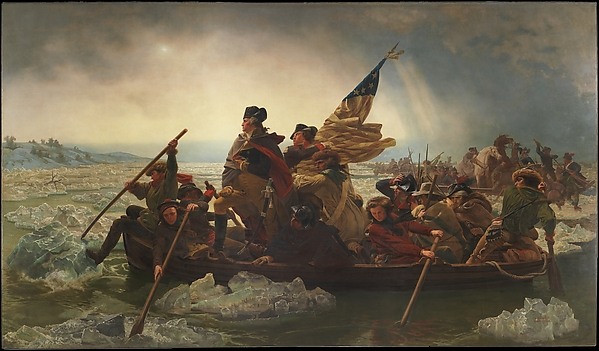
The standing Washington is the picture's most recognisable figure, but the crossing depends on the people working around him. Follow the oars, the boat's crowded edge and the pieces of ice: they make movement look difficult rather than effortless.
Leutze painted this scene in 1851, long after the Revolutionary War event. It is a constructed historical image, not an eyewitness record. The flag and the bright opening in the sky help the central boat read as a single public symbol, while the smaller boats extend the undertaking beyond one individual.
Jacques-Louis David · 1787
 Jacques-Louis David collection
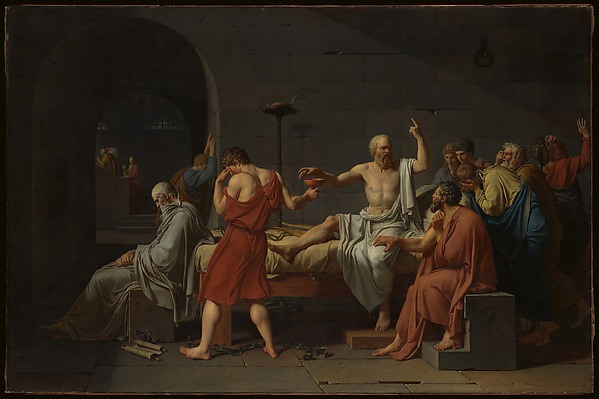
Socrates sits upright with one hand raised and the other reaching towards the cup. The people around him respond with grief, hesitation and physical withdrawal. David makes that difference in composure the centre of the scene.
Trace the hands before identifying the faces. The cup sits between two gestures, turning a small object into the point on which the larger story depends. The severe interior and clear arrangement of bodies give the painting its measured pace, even though its subject is a death.
Rembrandt van Rijn · 1653
 Rembrandt van Rijn collection
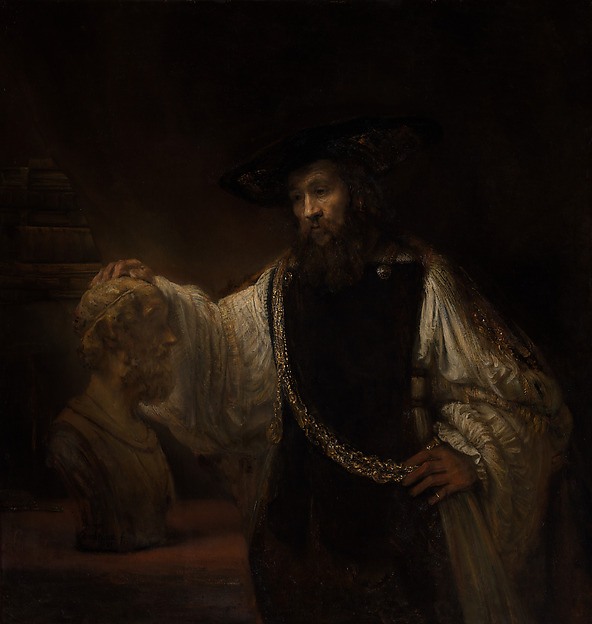
A hand on a sculpted head creates the quiet contact at the heart of Rembrandt's picture. Aristotle's gaze does not simply follow that touch. His face turns into a space of thought, while the gold chain and richly worked clothing keep material success visibly present.
Look at the difference between living flesh, stone and metal. Rembrandt gives each a different response to light. The portrait invites reflection on learning, reputation and wealth, but its effect begins with this very concrete encounter between a person and an object.
John Singer Sargent · 1883 to 84
 John Singer Sargent collection
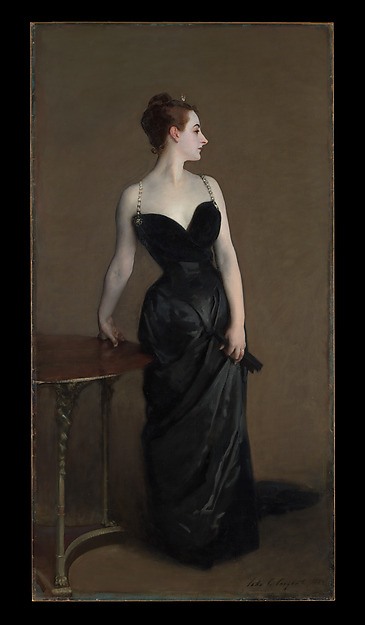
The black dress initially reads as one decisive shape. Then the portrait becomes a study in smaller tensions: a pale shoulder, the angle of an arm, the head turned away and the hand placed against the table.
Sargent's sitter is Virginie Amélie Avegno Gautreau, identified in the museum's title. Rather than looking only for the face, follow the silhouette from head to hem. The spare background gives that outline unusual authority. The painting turns a formal social pose into an image that can feel both poised and physically strained.
Vincent van Gogh · 1889
 Vincent van Gogh collection
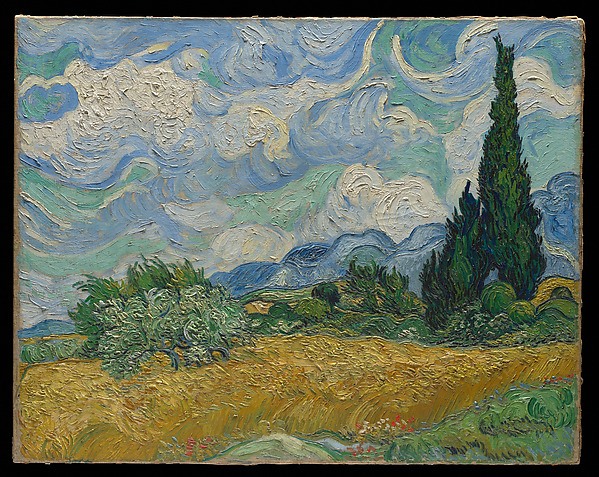
The wheat field spreads across the lower part of the canvas, while the cypresses rise against a restless sky. Van Gogh does not give each area the same kind of movement: short marks fill the field, darker strokes build the trees and larger curves animate the clouds.
Try following one colour as it moves between those areas. Blues and greens keep returning in new relationships to the yellow. This Met canvas is one particular work in a subject Van Gogh revisited; its museum record is the reference for the version illustrated here.
Pieter Bruegel the Elder · 1565
 Pieter Bruegel the Elder collection
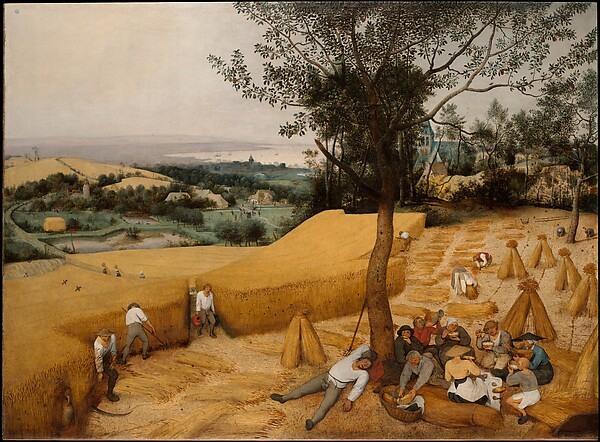
Some workers bend to the harvest while others eat or rest beneath a tree. Bruegel lets those activities coexist without turning them into a single dramatic event. The changing distances matter: close figures and stalks open out towards fields, buildings and a far horizon.
Look for the paths that connect one task to another. They make the landscape feel inhabited and worked, rather than merely seen. A slow scan across the picture reveals how much of its story is carried by small actions away from the most prominent group.
Johannes Vermeer · ca. 1662
 Johannes Vermeer collection
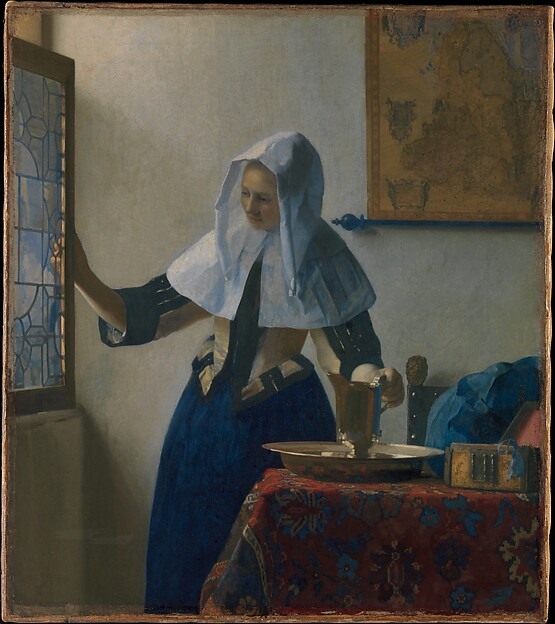
One hand holds the window and the other rests on the pitcher. Between those gestures, the woman seems paused in an ordinary action. Vermeer makes the white headdress, the reflective metal and the patterned cloth register different kinds of light.
The painting is useful to approach after the larger historical scenes. Its concentration does not depend on a dramatic incident. Notice the shape of the open window and the quiet spacing around the figure. The room becomes legible through relationships between objects, surfaces and a momentary movement.
Winslow Homer · 1899; reworked by 1906
 Winslow Homer collection
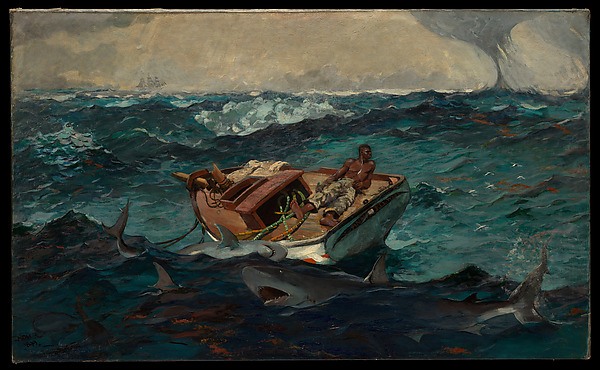
The damaged boat occupies the foreground with almost no room for escape. Sharks circle below, while distant weather and a small ship introduce possibilities that remain physically remote from the man on deck.
Homer painted the work in 1899 and reworked it by 1906, as the museum records. Look at how near and far are made to feel different: the sharp presence of the boat and water against the much smaller vessel on the horizon. The scene sustains uncertainty rather than resolving it into a clear rescue or ending.
Thomas Cole · 1836
 Thomas Cole collection
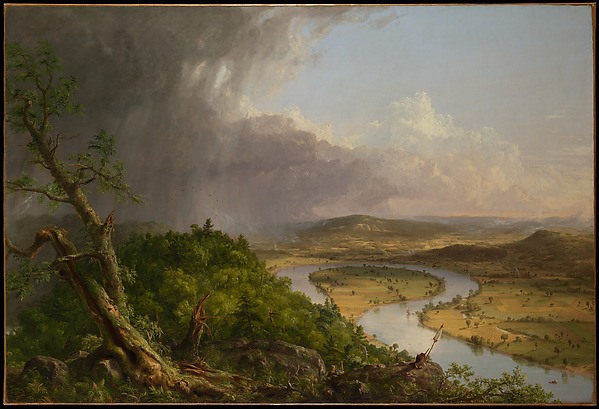
Cole divides the view between a dark, rough slope and a broad valley where the river bends through cultivated land. The contrast is easy to see from a distance, but the transition between the two areas deserves closer attention.
Look for the small painter working within the landscape. His presence changes the view from an apparently untouched prospect into a picture being actively made. The canvas invites questions about cultivation and wilderness, while its weather and shifting light keep those ideas rooted in a particular-looking place.
Vincent van Gogh · 1887
Vincent van Gogh collection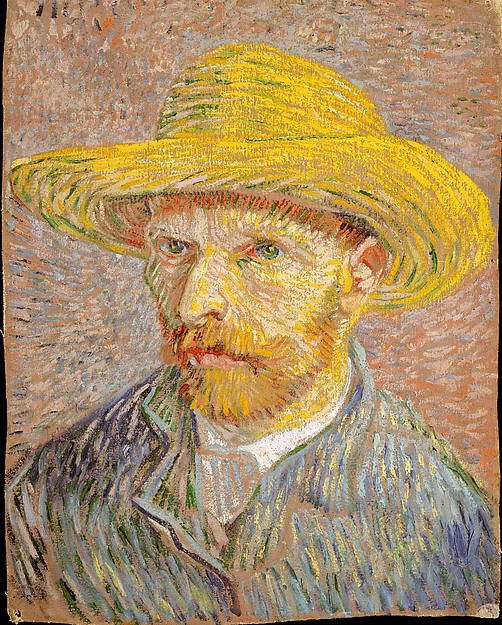
The hat gives the portrait a broad light frame, but the face is assembled from small marks that remain visibly separate. Van Gogh uses shifts of colour to turn the head and describe the beard, rather than hiding every stroke within a smooth surface.
Compare the direction of marks around the cheeks with those in the clothing and background. The picture's energy comes partly from those changes. The Met identifies this 1887 self-portrait with another painting, The Potato Peeler, on the reverse, a reminder that a canvas can have more than one history.
No. The Metropolitan Museum of Art and the Museum of Modern Art are separate New York museums. This guide is about the Met on Fifth Avenue.
Check the individual museum records and current gallery notices. This is a selection from the collection, not a guarantee of simultaneous display.
Choose three works that interest you most, then leave time for nearby discoveries. A smaller set of priorities makes it easier to look carefully.
Explore another collection in our Louvre Museum guide.
Enjoyed this story?
Save articles to your collection
Log in or create a free account, and this article will be waiting in your Private Collection.
Log in or sign up
Man Writing a Letter
Gabriel Metsu, c. 1664
The gallery list
Every painting is already 50% off. Join the list and we will send you an extra $15 code, plus first access to new collections.
No spam. Unsubscribe anytime. · Privacy Policy
Welcome
Your $15 code is on its way. Explore the gallery while you wait.