Loading cart…
No products in the cart.

Save articles to your collection
Log in or create a free account, and this article will be waiting in your Private Collection.
Log in or sign upDiscover the revolutionary world of Impressionism, from Monet and Renoir to the techniques that transformed modern art forever.
Impressionism stands as one of the most transformative movements in the history of Western art, born in France during the 1860s and 1870s as a radical departure from the rigid conventions of academic painting. Rather than striving for polished, idealized depictions of history, mythology, or religion, Impressionist painters turned their attention to the fleeting effects of light, color, and everyday life, capturing moments with loose, expressive brushwork and vibrant palettes. The movement reshaped the relationship between artist and subject, laying the groundwork for nearly every modern and contemporary art form that followed.
The roots of Impressionism lie in the turbulent social and cultural landscape of mid-19th-century France. Paris was undergoing dramatic transformation under Baron Haussmann, whose ambitious urban renewal projects replaced medieval streets with sweeping boulevards and public parks. The rise of the middle class created a new leisure culture of cafes, riverside outings, dance halls, and seaside resorts, and it was precisely these modern scenes that a younger generation of painters found far more compelling than the classical subjects favored by the official Salon.
The Salon, sponsored by the Academie des Beaux-Arts, served as the dominant gatekeeper of artistic reputation in France. Its jurors consistently rejected works that deviated from historical subjects, smooth surfaces, and careful draftsmanship. In 1863, the sheer volume of rejections prompted Emperor Napoleon III to sanction the Salon des Refuses, an alternative exhibition where the public could view the rejected works. It was here that Claude Monet, Pierre-Auguste Renoir, and their colleagues first found a wider audience, though much of the initial public reaction was mockery rather than admiration.
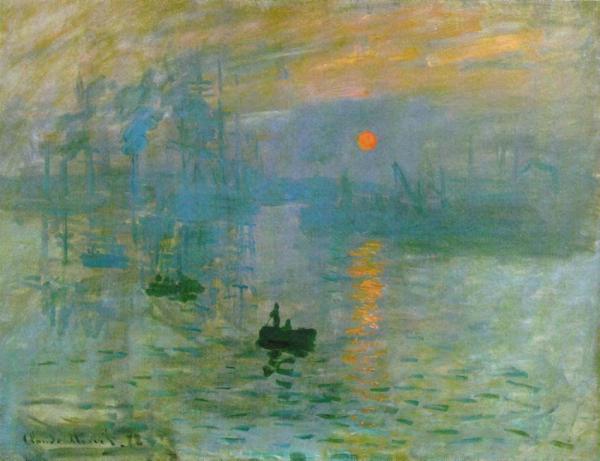
The name Impressionism itself arose from a critical jab. When the group organized their own independent exhibition in 1874, critic Louis Leroy ridiculed Monet's painting Impression, Sunrise by suggesting the whole show consisted of nothing more than unfinished impressions. The artists embraced the label, and what began as an insult became a rallying identity. The movement drew on earlier influences including the Barbizon school of landscape painting, the bold realism of Gustave Courbet, and the luminous seascapes of English painter John Constable, weaving these threads into something entirely new.
The visual language of Impressionism is immediately recognizable, even to viewers with no formal art training. At its core, the style prioritizes the optical sensation of a scene over a literal or detailed record of it. Painters applied paint in short, broken strokes that, when viewed from a distance, blend together in the eye rather than on the canvas. This technique, sometimes called optical mixing, allowed artists to convey the shimmer of water, the dappled quality of sunlight through leaves, or the soft blur of movement with remarkable freshness and energy.
Color is equally central to the Impressionist approach. Painters largely abandoned the dark brown underpainting and heavy shadows favored by academic artists, preferring instead to work on white or light-toned grounds that allowed colors to remain luminous. Shadows were no longer rendered in black or grey but in complementary hues, a blue shadow cast on a sunlit path might carry hints of violet or green. This sensitivity to color as light transformed the emotional register of painting, making Impressionist canvases feel warm, alive, and immediate in ways that earlier works rarely achieved.
The subject matter of Impressionism was equally revolutionary. Rather than historical allegories or religious narratives, these painters depicted parks, rivers, railway stations, dance halls, racetracks, and domestic interiors. The inclusion of women as both subjects and practitioners of the movement was also significant. Artists such as Berthe Morisot and Mary Cassatt brought the private, interior world of bourgeois feminine life into serious artistic conversation. Plein-air painting, working directly in front of the landscape rather than in a studio, was another hallmark practice that kept the work anchored in direct observation.
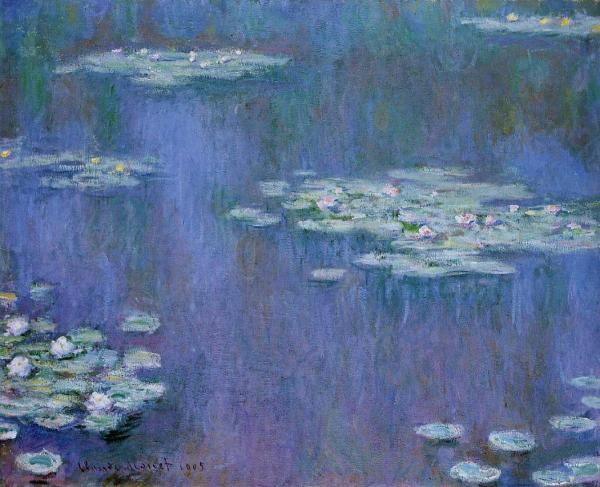
Claude Monet is perhaps the figure most closely associated with Impressionism, and his career traces the arc of the movement from its combative beginnings to its international triumph. Working in series to study the changing effects of light on a single subject, whether haystacks, poplar trees, or the facade of Rouen Cathedral, Monet pursued an almost scientific investigation of perception. His later Water Lilies series, painted at his garden in Giverny, pushed toward a radical dissolution of form that would inspire abstraction in the following century. Our collection includes his iconic Impression, Sunrise (painting_id: 47) and the serene Water Lilies (painting_id: 48).
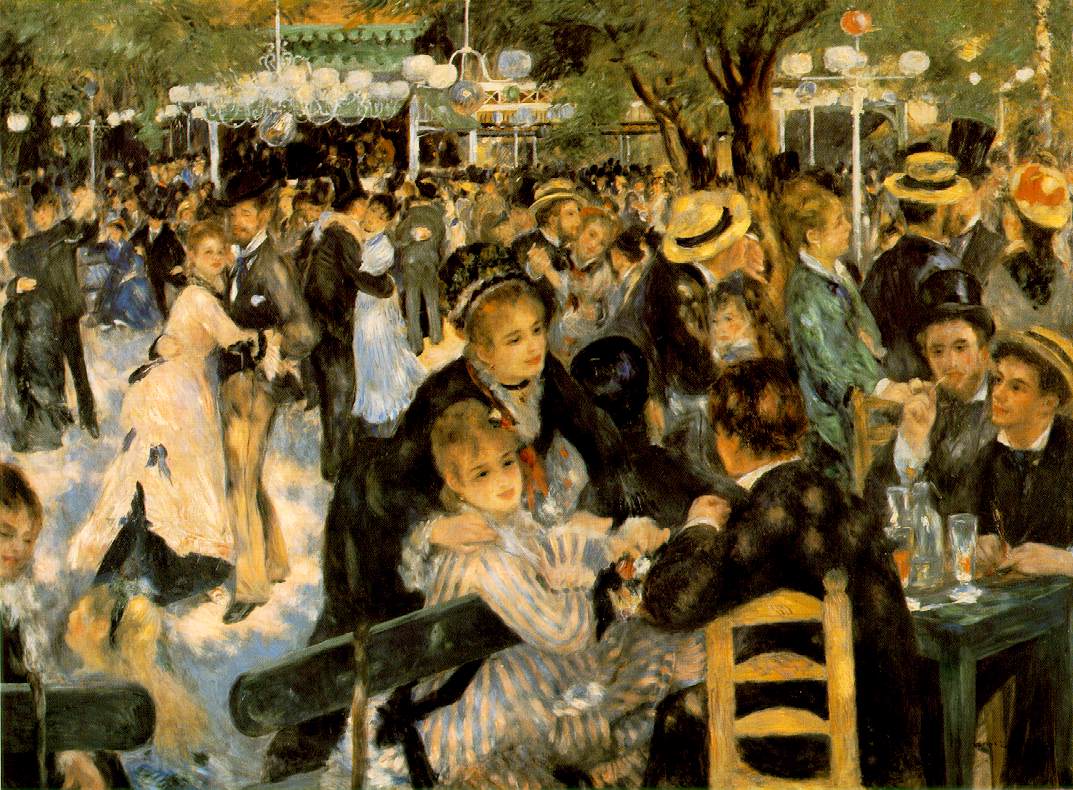
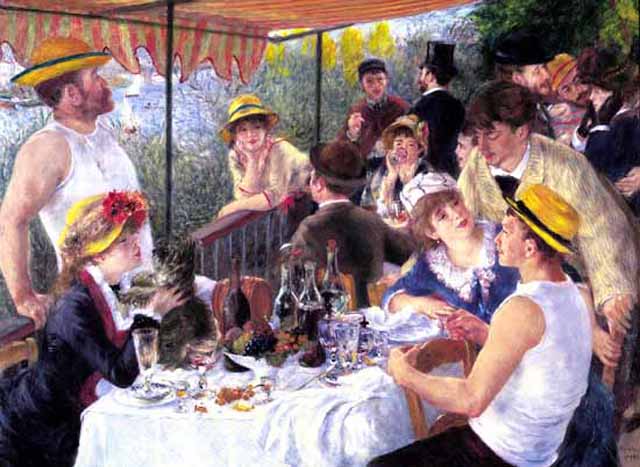
Pierre-Auguste Renoir brought an unmatched warmth and sensuality to the movement, filling his canvases with the pleasures of Parisian social life. His Dance at Le Moulin de la Galette (painting_id: 150) remains one of the most celebrated depictions of leisure and light in art history. Renoir was also a gifted portraitist whose tender characterizations of women and children brought him considerable commercial success during his lifetime. His work in our collection also includes the convivial Luncheon of the Boating Party (painting_id: 103).
Edgar Degas, though often grouped with the Impressionists, preferred to call himself a Realist and rarely painted outdoors. His signature subjects were ballet dancers, horse races, laundresses, and cafe scenes, all rendered with an extraordinary command of line and movement. Degas experimented extensively with pastel, monotype, and sculpture, making him one of the most technically adventurous figures of his era. His devotion to capturing bodies in motion gave his compositions a psychological tension that sets them apart from the more lyrical works of his contemporaries.
Berthe Morisot was the first woman to exhibit with the Impressionist group in 1874, and she contributed to nearly every one of their subsequent independent exhibitions. Her paintings of domestic interiors, gardens, and the figures of women and children at leisure carry a distinctive lightness of touch and an intimate emotional quality. Morisot worked extensively with Edouard Manet, whose looser brushwork influenced her significantly, and she in turn pushed Manet toward a brighter palette. Her contributions to the movement remain foundational even as they were long overlooked by mainstream art history.
Camille Pissarro was the only artist to participate in all eight of the official Impressionist exhibitions, and he served as a mentor and steady presence for many younger painters including Paul Cezanne and Georges Seurat. His landscapes of the Normandy countryside and his series of Parisian boulevards, including the well-known Boulevard Montmartre series, demonstrate a commitment to observing the rhythms of everyday life across all seasons and weather conditions. Pissarro briefly adopted the Pointillist technique of Seurat before returning to his more characteristic loose brushwork in his later years.
Impression, Sunrise by Claude Monet (1872) is the painting that inadvertently named the entire movement. Depicting the industrial port of Le Havre at dawn, the canvas shows a small orange sun reflected in blue-grey water, with loose strokes suggesting steam, mist, and boats in a manner that critics of the time found scandalously unfinished. The work is now housed in the Musee Marmottan Monet in Paris and stands as one of the defining images of 19th-century art. Our hand-painted oil reproduction (painting_id: 47) captures the luminous haze and energetic brushwork of the original with exceptional fidelity.
The Water Lilies series represents the culmination of Monet's lifelong investigation of light and reflection. Painted at his purpose-built water garden in Giverny over the final decades of his life, these large-scale canvases dissolve the boundary between surface and depth, between solid form and shimmering reflection. The series eventually grew into the monumental decorations installed in the Orangerie in Paris, conceived by Monet as a sanctuary of contemplative calm. Our reproduction (painting_id: 48) brings this meditative quality directly into the home or office.
Dance at Le Moulin de la Galette by Pierre-Auguste Renoir (1876) depicts a Sunday afternoon dance at a popular outdoor venue in Montmartre. The canvas buzzes with the energy of couples dancing, chatting, and drinking beneath strings of paper lanterns, with sunlight filtering through the trees to create the dappled patterns of light and shadow that Renoir handled so brilliantly. It is a celebration of modern urban pleasure rendered with an almost musical rhythm. Our hand-painted reproduction (painting_id: 150) preserves the warmth and spontaneity that make the original so irresistible.
Edgar Degas, The Ballet Class (c. 1874), housed in the Musee d Orsay in Paris, is among the defining images of the Impressionist era even though Degas himself resisted the label. The painting depicts dancers rehearsing under the instruction of a ballet master, with figures arranged across the canvas in a staggered, naturalistic manner that avoids the symmetry of academic composition. Degas used his characteristic viewpoint from above and to the side, giving the scene a candid, almost voyeuristic quality. While this specific work is not in our current collection, our range of Renoir ballet-adjacent scenes offers a comparable exploration of movement and light.
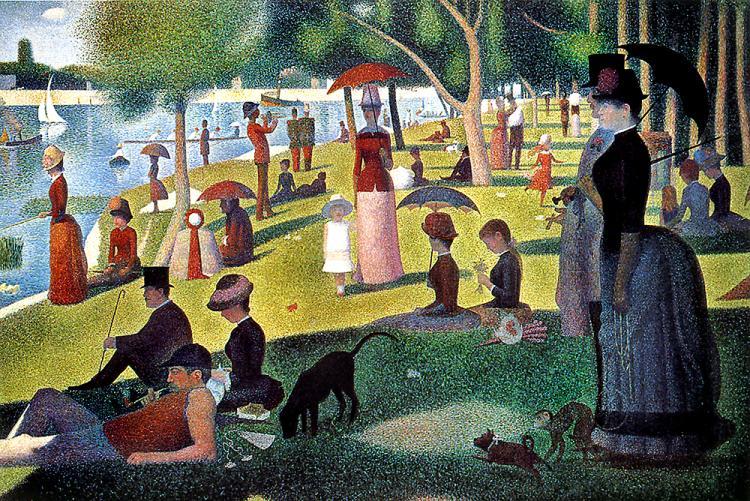
Impressionism did not simply end when its leading practitioners moved on to new ideas. It seeded an extraordinary proliferation of subsequent movements that reshaped the entire course of modern art. Post-Impressionism, a loose grouping rather than a formal movement, gathered artists who had absorbed the lessons of Impressionism but pushed them in divergent personal directions. Paul Cezanne used Impressionist color while seeking a more underlying geometric structure in nature, work that would directly inspire Cubism and Pablo Picasso. Vincent van Gogh intensified Impressionist brushwork into swirling, emotionally charged surfaces that pointed toward Expressionism. Georges Seurat developed Pointillism, a systematic method of applying pure dots of color that owed a direct debt to Impressionist optical theory.
The movement also had a profound impact internationally. In the United States, Mary Cassatt and James McNeill Whistler helped introduce Impressionist ideas to American collectors and painters, transforming the landscape of cultural patronage in cities like Boston and New York. Japanese woodblock prints, which many Impressionists collected and studied, contributed their flattened perspectives and bold compositional cropping to the visual vocabulary of the movement, a cross-cultural exchange that enriched both traditions. By the early 20th century, Impressionism had become so widely admired that it influenced painters as stylistically different as Gustav Klimt and Edvard Munch.
More than a century after the last Impressionist exhibition in 1886, the legacy of the movement continues to shape how we look at and talk about art. The Impressionists established principles that we now take for granted: that personal perception is a legitimate subject for serious painting, that the act of seeing is itself a profound experience worthy of artistic inquiry, and that technical virtuosity need not mean slavish adherence to smooth surfaces or conventional finish. These ideas liberated subsequent generations of artists to follow their own visual instincts rather than prescribed rules.
Impressionist works also transformed the economics and institutions of the art world. By organizing independent exhibitions outside the Salon system, these painters helped establish the model of the commercial gallery, the artist-run exhibition, and the international art market that still structures the contemporary art world today. Museums around the world, from the Musee d Orsay in Paris and the Art Institute of Chicago to the National Gallery in London and the Metropolitan Museum of Art in New York, now dedicate significant rooms to Impressionist and Post-Impressionist collections, which consistently draw the largest public audiences of any painting galleries in existence.
For collectors and art lovers, Impressionism retains a deeply personal appeal. The movements focus on light, color, and the beauty of ordinary moments resonates with viewers across cultures and generations. Owning a hand-painted oil reproduction of a work by Monet, Renoir, or Degas allows you to bring that same sense of warmth and visual wonder into your own living space, connecting daily life to one of the most joyful and transformative chapters in the history of human creativity.
Enjoyed this story?
Save articles to your collection
Log in or create a free account, and this article will be waiting in your Private Collection.
Log in or sign up
Man Writing a Letter
Gabriel Metsu, c. 1664
The gallery list
Every painting is already 50% off. Join the list and we will send you an extra $15 code, plus first access to new collections.
No spam. Unsubscribe anytime. · Privacy Policy
Welcome
Your $15 code is on its way. Explore the gallery while you wait.