Loading cart…
No products in the cart.

The stories behind famous paintings, the painters who made them, and the movements that shaped them. Every work here can be recreated by hand in oil on canvas.
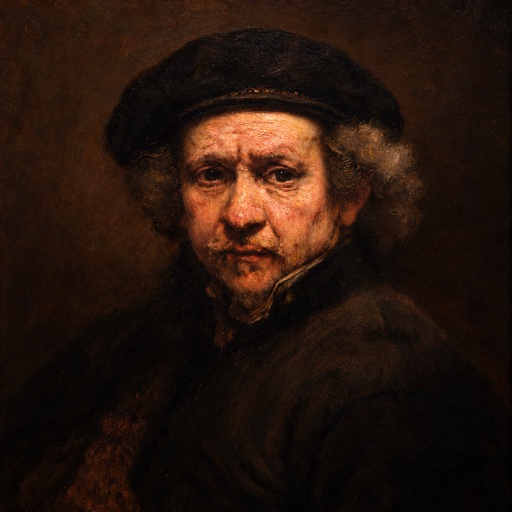
Rembrandt at fifty-three, after bankruptcy, looks out from under a dark beret with honest, tired eyes. Painted in 1659.
Five officials of the cloth-makers’ guild look up from their book as if we had just walked in: Rembrandt’s De Staalmeesters of 1662.
A nearly blind father lays his hands on his kneeling, ragged son: Rembrandt’s late masterpiece of forgiveness, in the Hermitage.
A woman with long black hair leans back, eyes half closed, with a red band instead of a halo: Munch’s unsettling Madonna of 1894 to 1895.
Jan van Eyck’s wife at thirty-three, looking straight at us in a frilled headdress and red gown, dated 17 June 1439 on the frame.
Mary nurses the Christ child on a lion-throne in a small room with a carafe, an orange and an oriental carpet: Van Eyck’s Lucca Madonna.
An elderly canon kneels before the Virgin, painted with merciless detail, between Saint Donatian and Saint George in shining armour.
A stern Burgundian courtier in a fur hat, wearing the gold collar of the Order of the Golden Fleece, painted by Van Eyck around 1435.
An old man in a fur hat holds a carnation and wears the cross and bell of the Order of Saint Anthony: a tiny portrait in Van Eyck’s manner.
The Ghent Altarpiece by Hubert and Jan van Eyck, completed in 1432: the Mystic Lamb, singing angels, Adam and Eve, and a history of thefts.
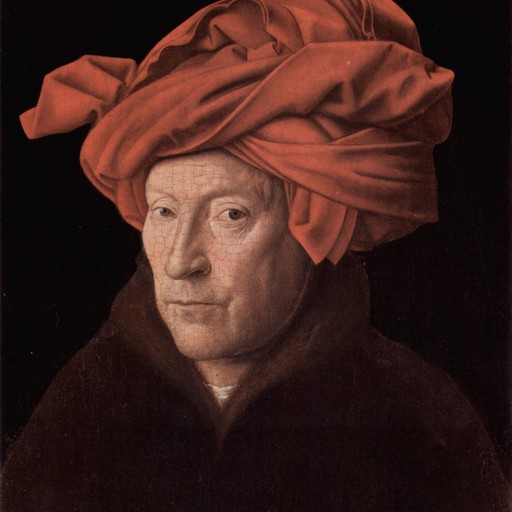
A man in a red headdress looks straight out, signed and dated 21 October 1433 with the motto As I Can: probably Van Eyck himself.
Saint Jerome reads in a study crowded with books, an astrolabe and an hourglass, his lion asleep under the table: a tiny Van Eyck panel in Detroit.
A merchant and his wife in their room in Bruges, a convex mirror, a dog and a signature that reads like a witness’s note: Van Eyck, 1434.
Northern Renaissance · Dutch · c. 1390 to 1441
Michelangelo’s late fresco in the Pauline Chapel: Saint Peter, crucified upside down, turns to stare at the viewer as soldiers raise the cross.
Christ plunges from heaven as an old Saul falls blinded and his soldiers scatter: Michelangelo’s late fresco in the Pauline Chapel.
Michelangelo combines temptation and expulsion in one Sistine Chapel fresco, showing Adam and Eve before and after the choice that transforms…
Mary twists to take the Christ child from Joseph, with nude youths behind: Michelangelo’s only undisputed panel painting.

Man Writing a Letter
Gabriel Metsu, c. 1664
The gallery list
Every painting is already 50% off. Join the list and we will send you an extra $15 code, plus first access to new collections.
No spam. Unsubscribe anytime. · Privacy Policy
Welcome
Your $15 code is on its way. Explore the gallery while you wait.