Loading cart…
No products in the cart.

The meaning and history of famous paintings: what they show, where the originals hang, and how each one is recreated by hand in oil on canvas.
A kitchen maid pours milk in Vermeer’s quiet masterpiece of about 1660: sparkling bread, an ultramarine apron and a bare, light-filled wall.
Explore Vermeer’s Woman in Blue Reading a Letter: the unreadable message, two hands, lapis-lazuli blue and map in the Rijksmuseum painting.
Aristotle rests his hand on a bust of Homer, a gold chain across his chest: Rembrandt’s meditation on fame and wisdom, painted in 1653.
A couple joined by a tender gesture of the hands, painted in thick gold and red: Rembrandt’s late masterpiece that Van Gogh adored.
Rembrandt’s 1654 portrait of his friend Jan Six, painted with astonishingly free brushwork, still owned by the Six family in Amsterdam.
Rembrandt at about sixty, palette in hand, in front of two mysterious circles: one of his greatest late self-portraits, free to see at Kenwood.
A glowing hand writes on the wall as King Belshazzar turns in terror: Rembrandt’s dramatic feast in the National Gallery.
Dr Tulp demonstrates the muscles of a dead man’s arm to seven surgeons: the group portrait that made the young Rembrandt famous.
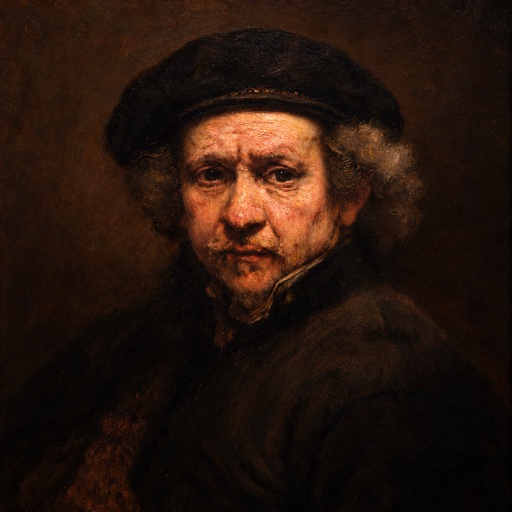
Rembrandt at fifty-three, after bankruptcy, looks out from under a dark beret with honest, tired eyes. Painted in 1659.
A nearly blind father lays his hands on his kneeling, ragged son: Rembrandt’s late masterpiece of forgiveness, in the Hermitage.
Five officials of the cloth-makers’ guild look up from their book as if we had just walked in: Rembrandt’s De Staalmeesters of 1662.
A woman with long black hair leans back, eyes half closed, with a red band instead of a halo: Munch’s unsettling Madonna of 1894 to 1895.
Jan van Eyck’s wife at thirty-three, looking straight at us in a frilled headdress and red gown, dated 17 June 1439 on the frame.
Mary nurses the Christ child on a lion-throne in a small room with a carafe, an orange and an oriental carpet: Van Eyck’s Lucca Madonna.
A stern Burgundian courtier in a fur hat, wearing the gold collar of the Order of the Golden Fleece, painted by Van Eyck around 1435.
An elderly canon kneels before the Virgin, painted with merciless detail, between Saint Donatian and Saint George in shining armour.
An old man in a fur hat holds a carnation and wears the cross and bell of the Order of Saint Anthony: a tiny portrait in Van Eyck’s manner.
A man in a red headdress looks straight out, signed and dated 21 October 1433 with the motto As I Can: probably Van Eyck himself.

Man Writing a Letter
Gabriel Metsu, c. 1664
The gallery list
Every painting is already 50% off. Join the list and we will send you an extra $15 code, plus first access to new collections.
No spam. Unsubscribe anytime. · Privacy Policy
Welcome
Your $15 code is on its way. Explore the gallery while you wait.